
Aircraft hangar fall protection works when the maintenance task, aircraft envelope, access method, rescue plan, and supporting steel are engineered as one system. An MRO buyer may specify an overhead rail after the hangar frame is released, then discover that roof bracing, door travel, cranes, lights, or tail clearance occupy the same space. The result can be redesign, restricted coverage, or an anchor that lacks a documented load path. This guide helps you define an aircraft hangar fall protection scope that bidders can price and engineers can verify.
1. Which maintenance tasks require protected access?
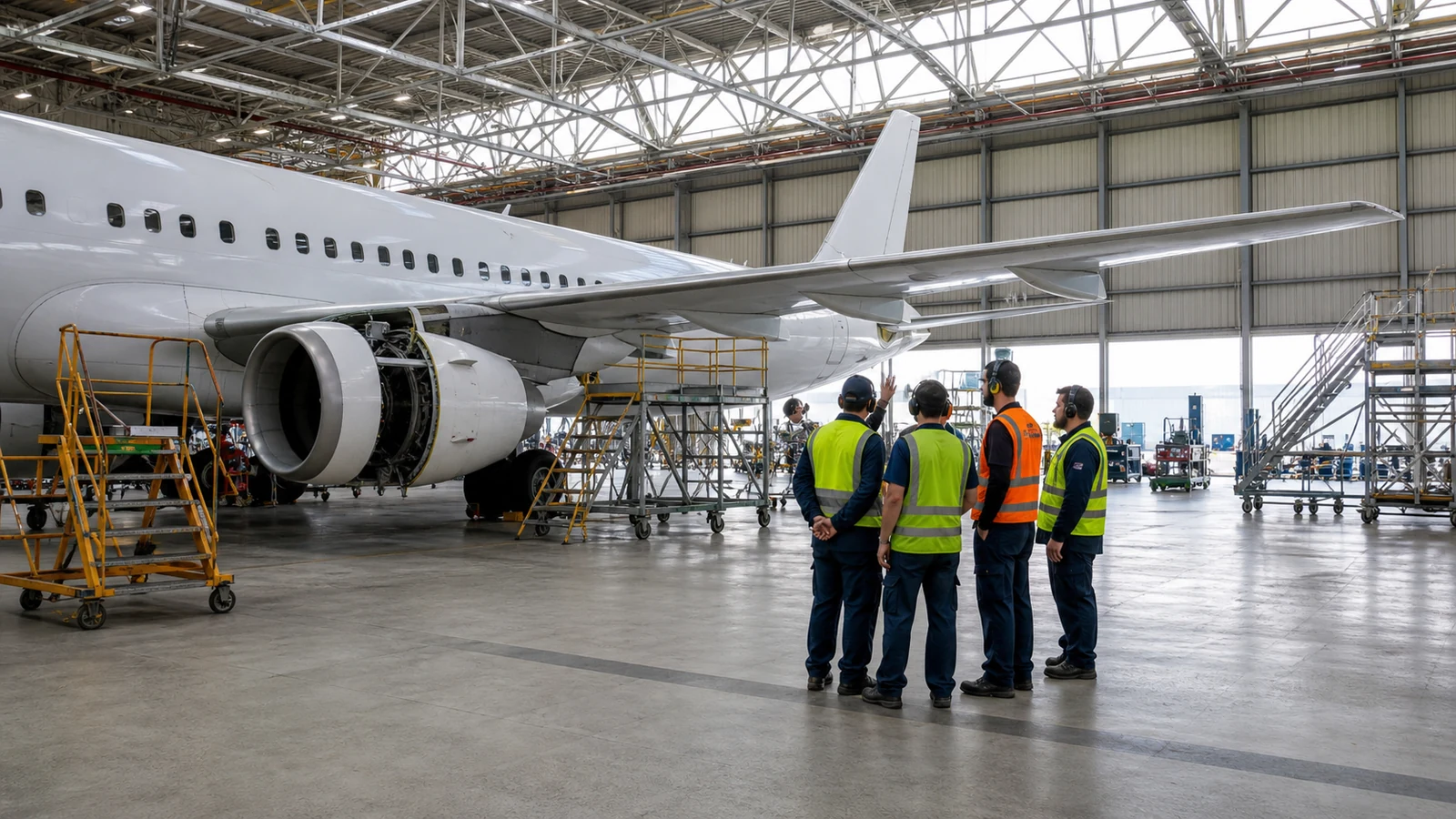
Protected access should follow the actual maintenance tasks, not the floor area alone. Fueling, cleaning, inspection, component replacement, and heavy checks put technicians at different locations and require different reach, tools, duration, and aircraft status.
What belongs in the task survey?
Map each work position against aircraft type, parking orientation, dock or platform use, simultaneous crews, and foreseeable fleet changes. Include infrequent tasks because a once-a-year tail inspection can govern rail height and rescue access.
- Aircraft models and parking coordinates
- Wing, fuselage, engine, and empennage work zones
- Task frequency, duration, tools, and crew count
- Tow paths, door movements, and ground-support routes
- Planned fleet or maintenance-program changes
If the survey omits a wingtip task, the installed trolley may stop short of the hazard; the operator then improvises an anchor and creates an uncontrolled fall path. The operator owns task data, while the fall-protection designer converts it into a coverage plan.
Key Takeaway: Approve a task-and-aircraft coverage drawing before choosing hardware.
2. Should you prevent a fall or arrest one?
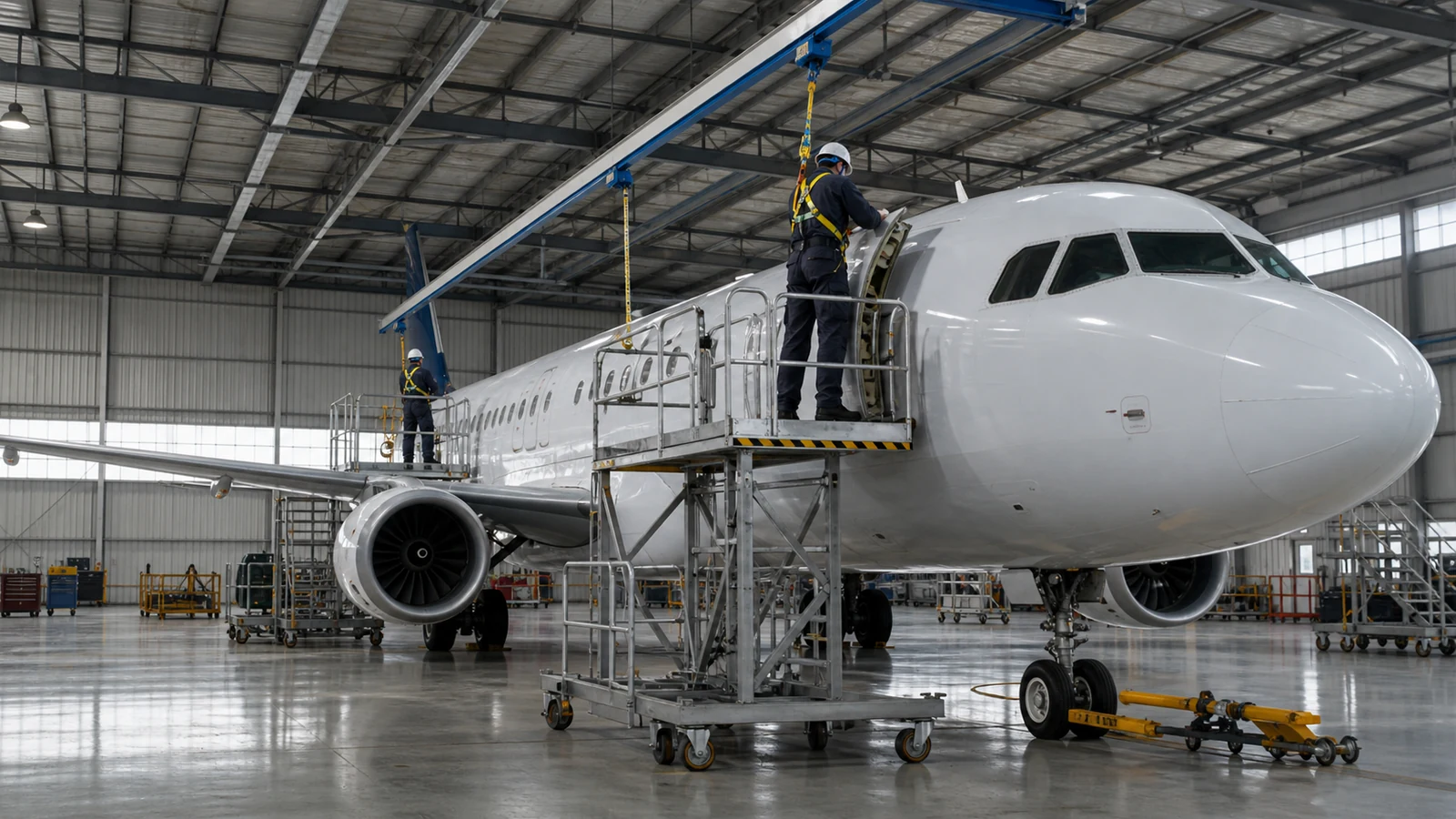
You should prefer prevention or travel restraint where the work permits it, then use fall arrest where exposure cannot be eliminated. Guarded platforms and restraint reduce the chance of a fall, while arrest systems manage the forces and clearance after one begins.
How do access methods compare?
Fixed docks suit repeatable heavy-maintenance positions but can obstruct aircraft movement. Mobile elevated platforms offer flexibility but need floor routes, setup space, inspection, and trained operation; overhead rails offer broad movement yet transfer dynamic actions to the building.
Where does the wrong choice fail?
A short lanyard on a poorly placed anchor may create swing fall against the fuselage or a lower platform. A system that arrests the worker without preventing contact with the aircraft or floor does not solve the complete hazard.
Key Takeaway: Compare prevention, restraint, arrest, and mobile access against every task rather than selecting one universal method.
3. How does the aircraft envelope control coverage?
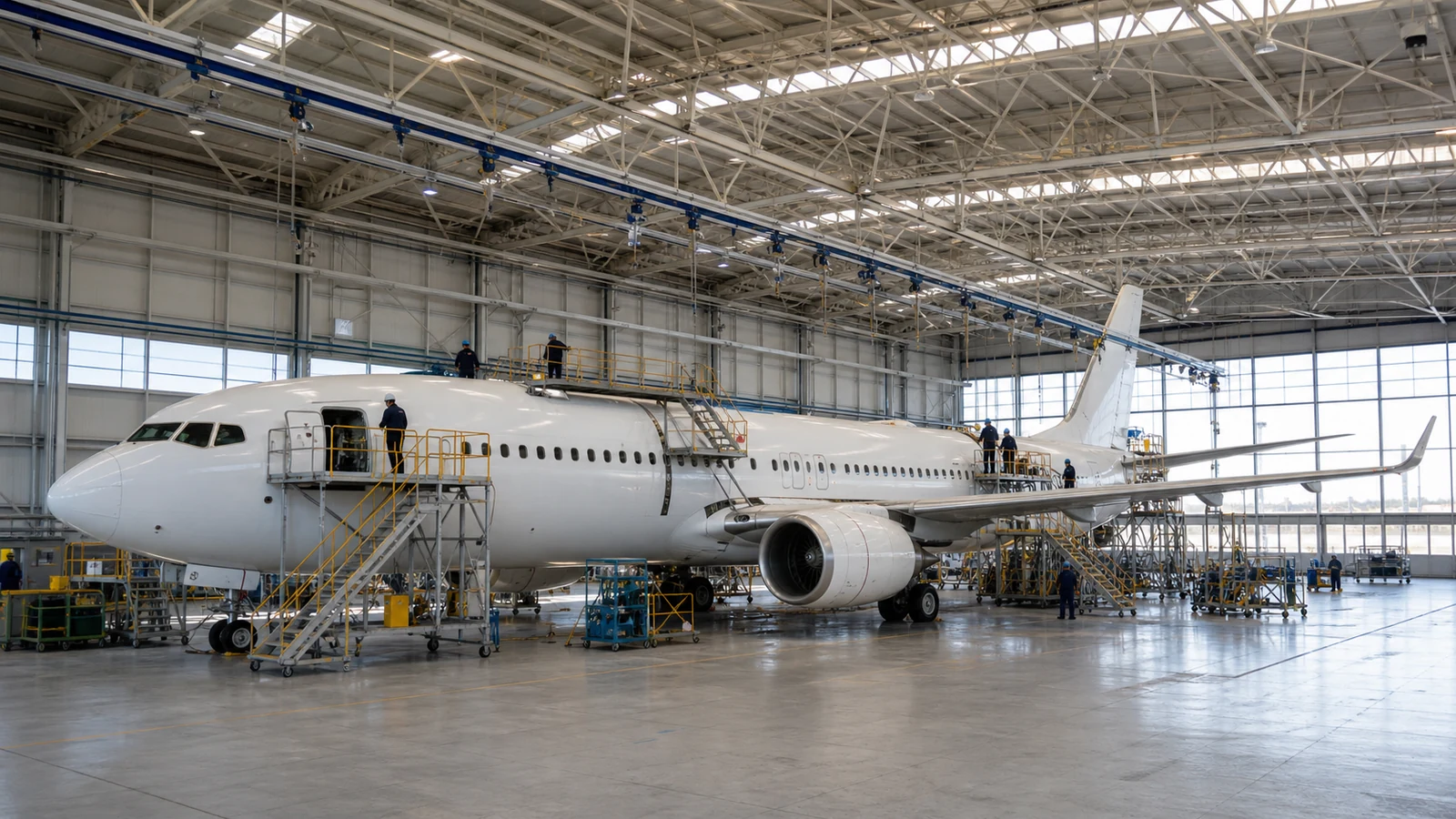
The aircraft envelope controls where a technician can move, where a line can hang, and where a trolley may travel without striking the aircraft. Wing sweep, tail height, open panels, raised control surfaces, stands, and tow tolerances can enlarge the protected zone beyond the parked outline.
What drawing should bidders receive?
Issue a coordinated plan and section showing aircraft extremes, work positions, rail centerlines, usable trolley travel, cable drop zones, hangar doors, cranes, ducts, lighting, and fire systems. Distinguish nominal parking from maximum operational tolerance.
An anchor placed over the fuselage centerline may leave a wing technician with excessive lateral offset; a fall then becomes a pendulum event with collision risk. The MRO layout owner confirms the operational envelope, and the qualified designer confirms usable system coverage.
Key Takeaway: Evaluate coverage in plan and section with the aircraft in every relevant maintenance configuration.
4. What loads reach the hangar steel frame?
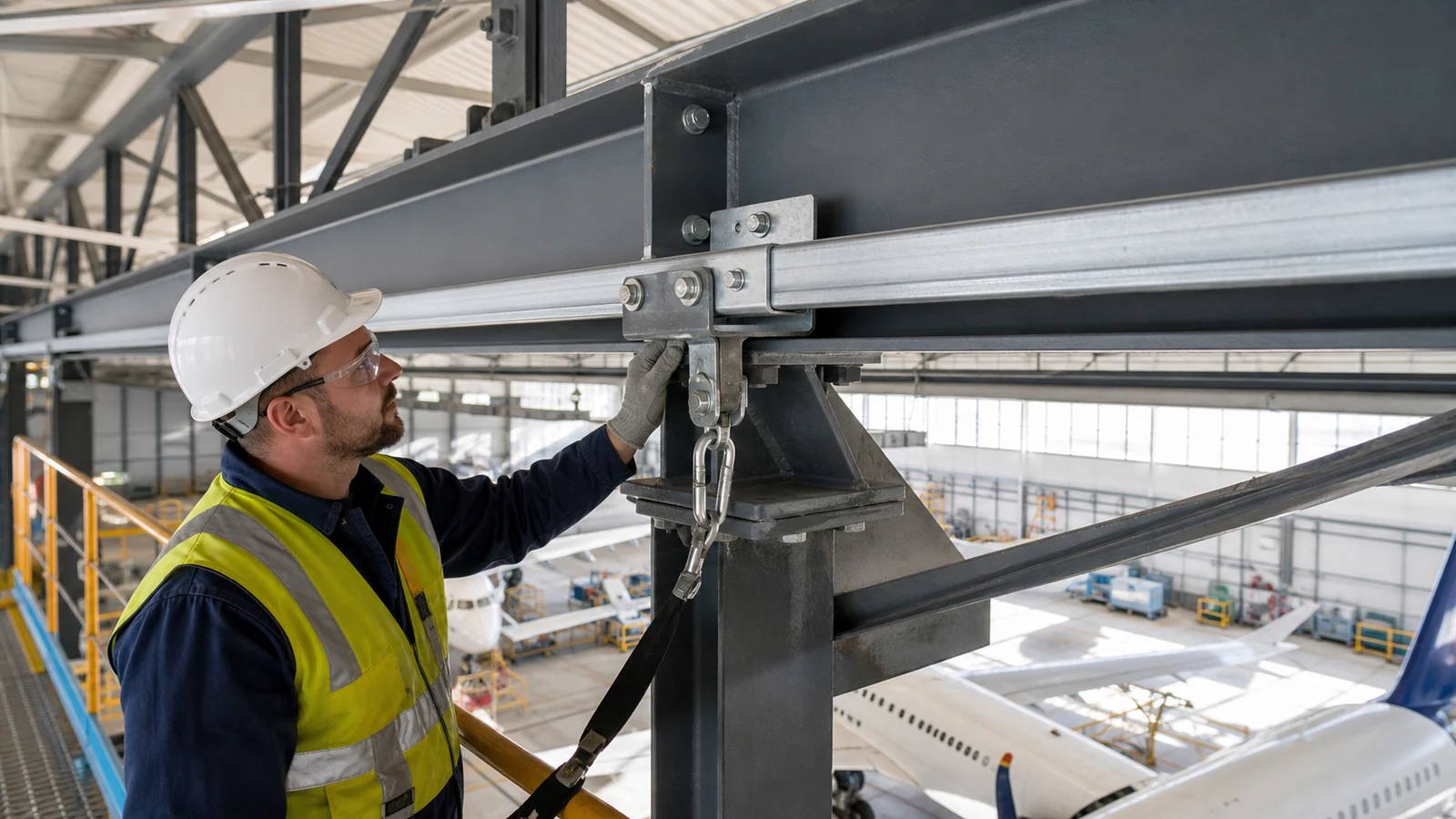
Fall-protection loads reach the hangar through the rail, brackets, secondary steel, connections, rafters, bracing, columns, and foundations. The design action is not merely the worker’s weight; arrest dynamics, line geometry, multiple users, eccentric brackets, and load combinations can control.
Why can cable geometry amplify reactions?
A horizontal lifeline develops higher end reactions as sag decreases, so an apparently neat, tight cable can impose large forces on its anchorages. Multiple users and long spans further change the system response and should be evaluated by a qualified fall-protection designer.
Which structural records are required?
Request design reactions for every bracket, load direction, simultaneous-user case, deflection allowance, fatigue assumption where relevant, and connection detail. The structural engineer should return a traceable calculation showing how those actions reach the primary frame.
If a rail bracket is attached only to a light roof purlin, arrest loading can distort the purlin and disable both the safety system and roof assembly. Late reactions may also force local reinforcement after coating or cladding is complete.
Key Takeaway: Freeze certified interface reactions before releasing frame and connection design.
5. How much fall clearance is actually available?
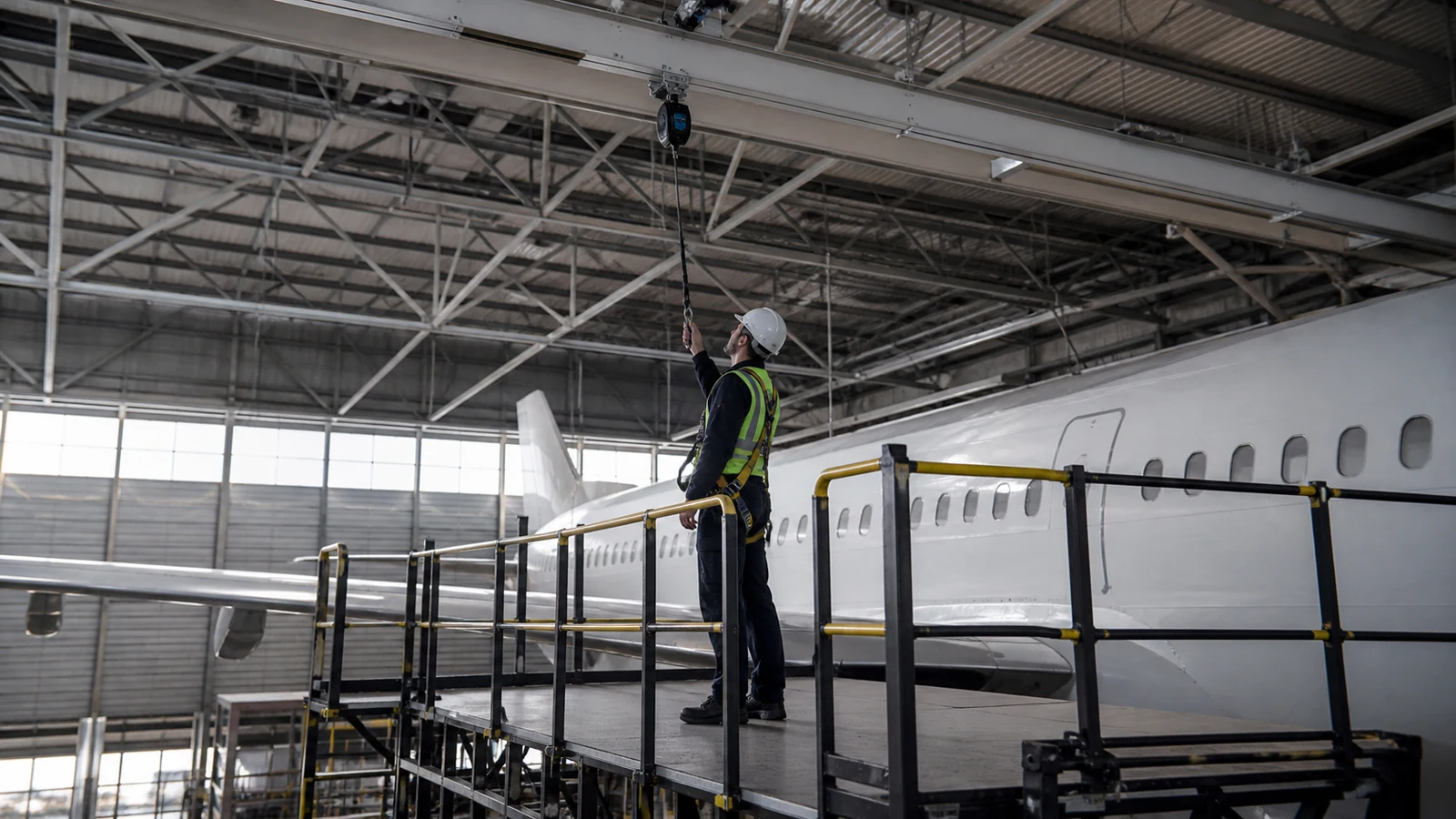
Available clearance is the vertical distance between the working level and the nearest obstruction or lower level, after accounting for the complete arrest path. Free fall, device activation, deceleration, line stretch, harness movement, worker height, rail deflection, and a safety margin all affect the result.
What changes clearance across the bay?
The work surface may be an engine stand in one zone and the aircraft crown in another. Rail height, retractable-lifeline model, lateral offset, roof slope, and nearby tail surfaces can therefore produce different clearance outcomes along one rail.
- Clearance calculation for each critical work zone
- Product-specific device data
- Maximum structural and rail deflection
- Obstruction and aircraft-contact check
- Rescue access below the arrested position
If the lowest available clearance is not checked, the system can activate yet allow contact with a wing, dock, or floor. The calculation should use the selected equipment and project geometry, not a generic diagram.
Key Takeaway: Approve a zone-by-zone clearance schedule before procurement.
6. How should rails, doors, cranes, and services coexist?
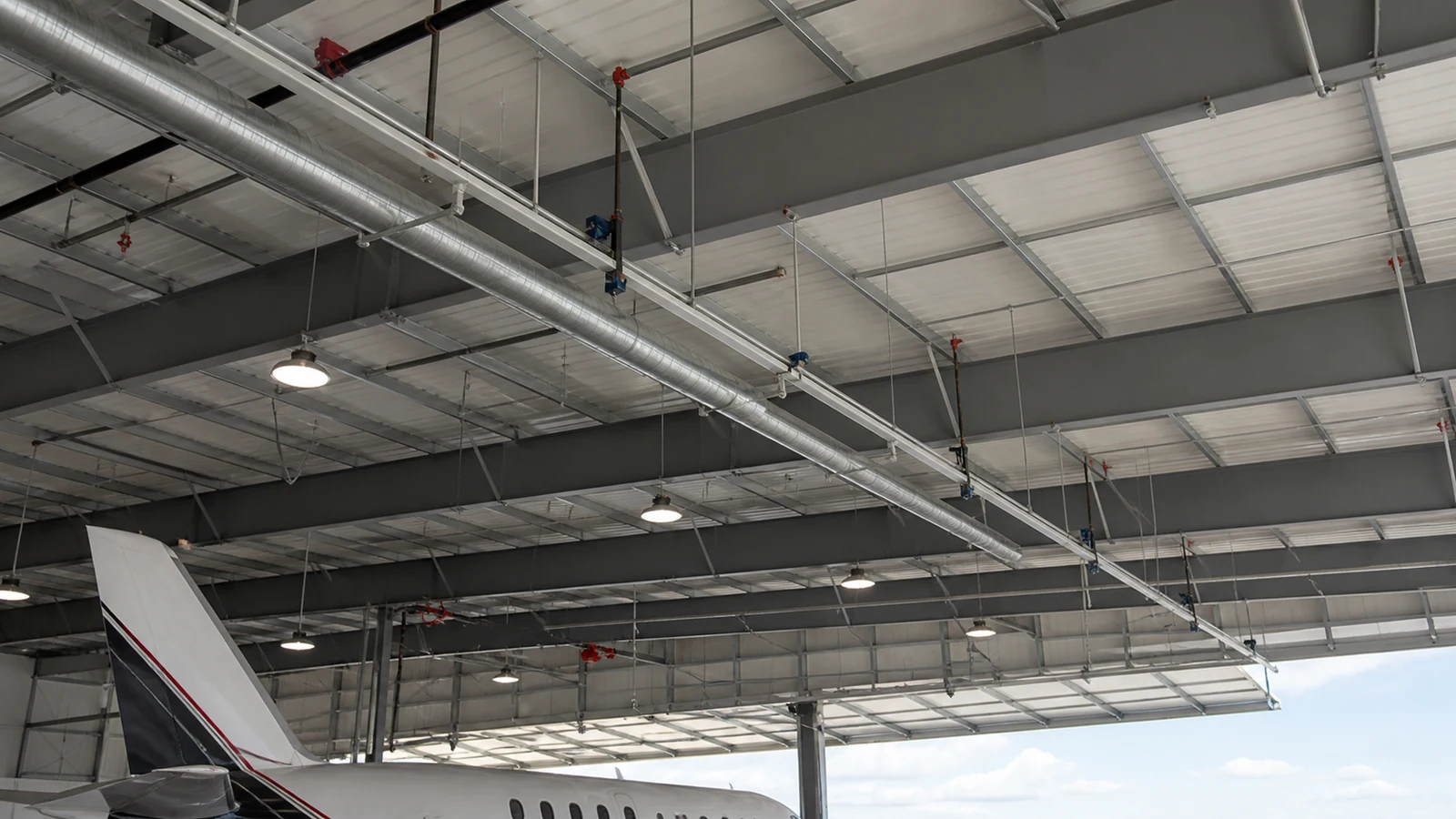
Rails, doors, cranes, lighting, sprinklers, ducts, and maintenance access should be coordinated in one overhead model. Each system needs movement space, support steel, installation access, inspection clearance, and a sequence that does not block later work.
Which clashes cost the most to correct?
Hangar-door tracks and fabric-door pockets often occupy the gable and roof zone needed by a fall-protection runway. Bridge cranes may cross the same bay, while high-output lights placed behind rails create shadows at work surfaces.
A service routed through the trolley path can limit continuous attachment and leave an unprotected transfer point. The lead designer should maintain a coordinated reflected-ceiling and section package with defined priority zones and hold points, while the hangar construction sequence reserves installation access.
Key Takeaway: Resolve moving envelopes and maintenance access before shop drawings are approved.
7. What do OSHA and ANSI concepts require?
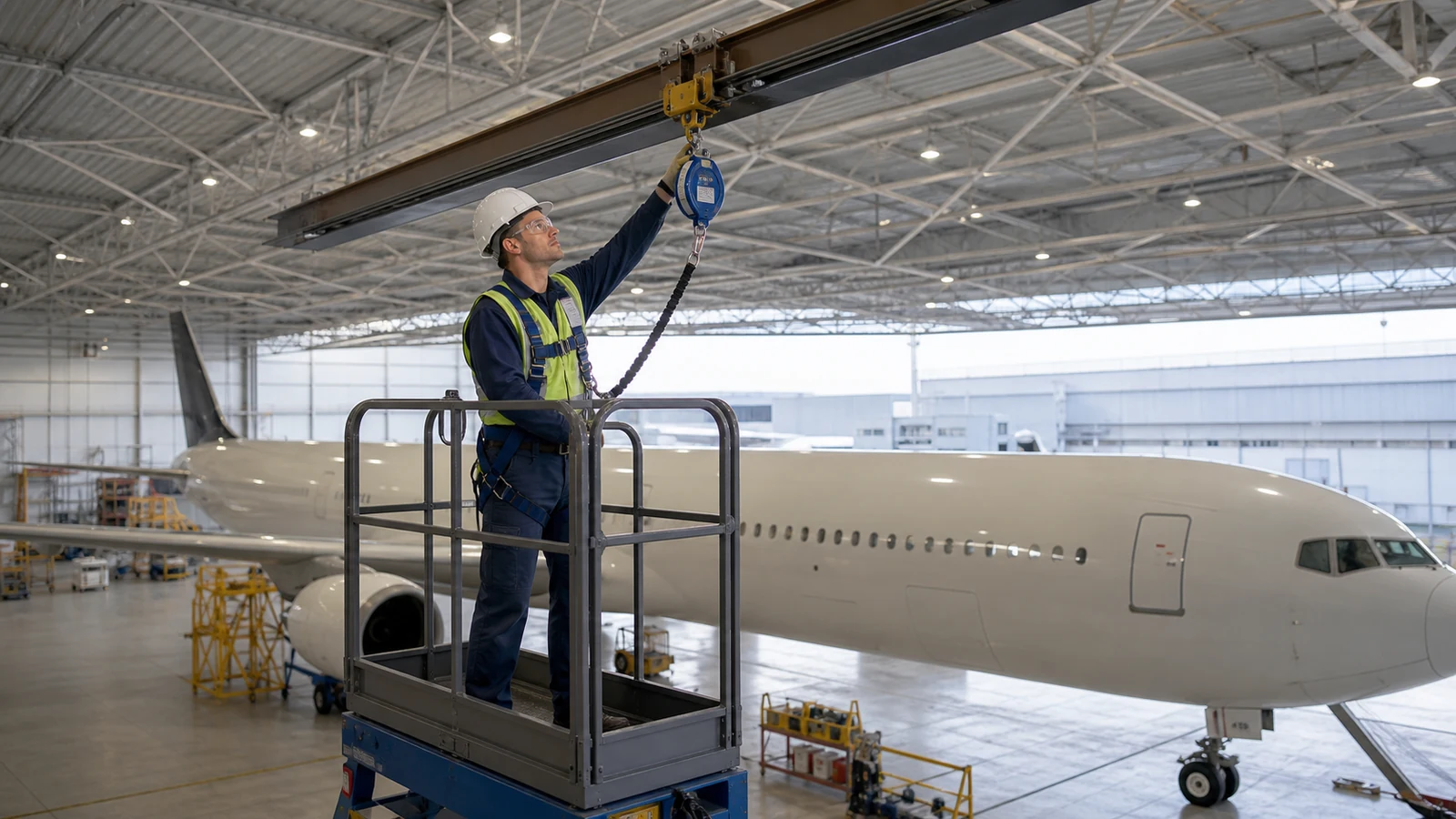
U.S. general-industry projects commonly use OSHA walking-working-surface and personal-fall-protection requirements, while ANSI/ASSP Z359 concepts support system design by qualified persons. These references distinguish restraint, arrest, anchorage, compatible components, inspection, training, and rescue, but the adopted rules depend on jurisdiction and employer activity.
What should a buyer verify?
OSHA 29 CFR 1910.140 sets performance, care, and use criteria for personal fall-protection systems in its scope. ANSI/ASSP Z359.6 addresses engineered active systems; local occupational-safety rules, aviation-facility requirements, and the engineer of record still govern the project.
Do not convert a prescriptive strength value into a complete design without checking system geometry and structural response. A compliant component connected to an unverified building member leaves the system without a demonstrated load path.
Key Takeaway: Put the governing jurisdiction, standard editions, designer qualifications, and approval roles in the RFQ.
8. Which inspection and rescue evidence is needed?
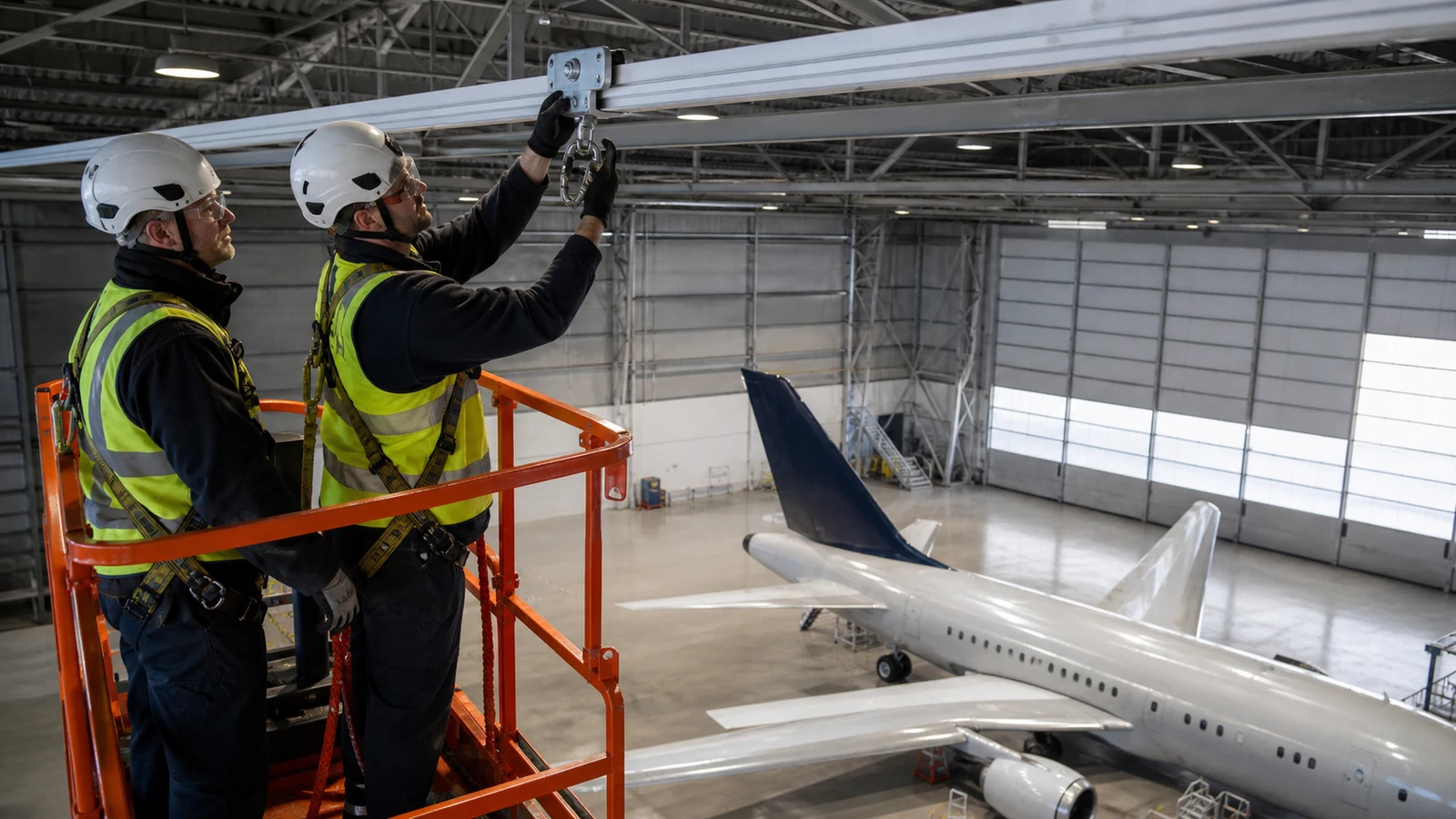
The system needs installation verification, commissioning, user inspection, periodic competent-person review, and a workable rescue plan. A worker suspended above an aircraft cannot be treated as a problem solved by calling emergency services without site-specific access planning, so the maintenance strategy should include inspection access.
What are the commissioning hold points?
Check bracket locations and substrates before concealment, verify bolts or welds against approved details, confirm trolley travel and end stops, and complete functional or proof testing when required by the design and manufacturer. Record serial numbers, certificates, as-built locations, inspection intervals, and rescue equipment.
- Approved calculations and shop drawings
- Installation and connection records
- Commissioning and test report
- Equipment register and inspection log
- Training records and rescue drill record
If an end stop is installed in the wrong position, the rail may pass inspection as an object yet fail to cover the task. The owner accepts operational coverage; the qualified designer and installer provide technical evidence within their scopes.
Key Takeaway: Commission the complete work system, not just individual components.
9. How should bidders divide design responsibility?
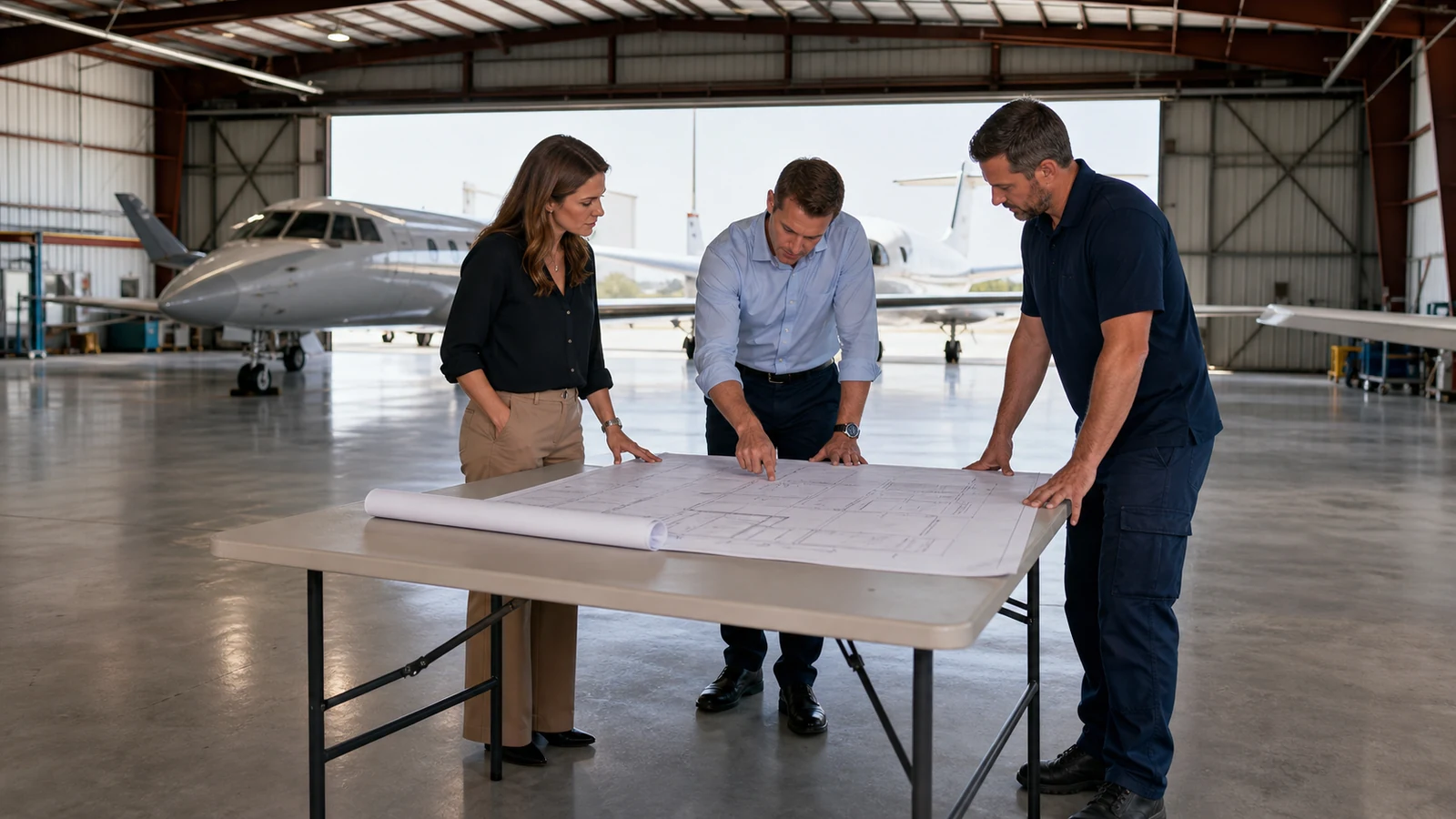
Bidders should divide responsibility through an interface matrix that names each input, design output, approval, installation record, and final owner. This prevents the common gap where the rail supplier assumes the building engineer checked reactions while the building supplier expects certified reactions from the rail designer.
Which matrix improves bid comparison?
| Decision or evidence | Originator | Technical approver | Bid return |
|---|---|---|---|
| Aircraft and task envelope | MRO operator | Facility lead | Coverage drawing |
| System reactions | Fall-protection designer | Qualified person | Reaction schedule |
| Building load path | Steel designer | Engineer of record | Calculation index |
| Overhead coordination | Lead designer | Owner team | Clash-free sections |
| Installation and testing | Specialist installer | Qualified inspector | Commissioning dossier |
| Rescue and training | Employer/operator | Safety authority | Rescue plan and records |
This matrix exposes exclusions before contract award. A low bid that omits support steel, access equipment, testing, or rescue documentation is not equivalent to a coordinated scope.
Key Takeaway: Price every interface and name the party who provides acceptance evidence.
10. What should you send for a coordinated hangar RFQ?
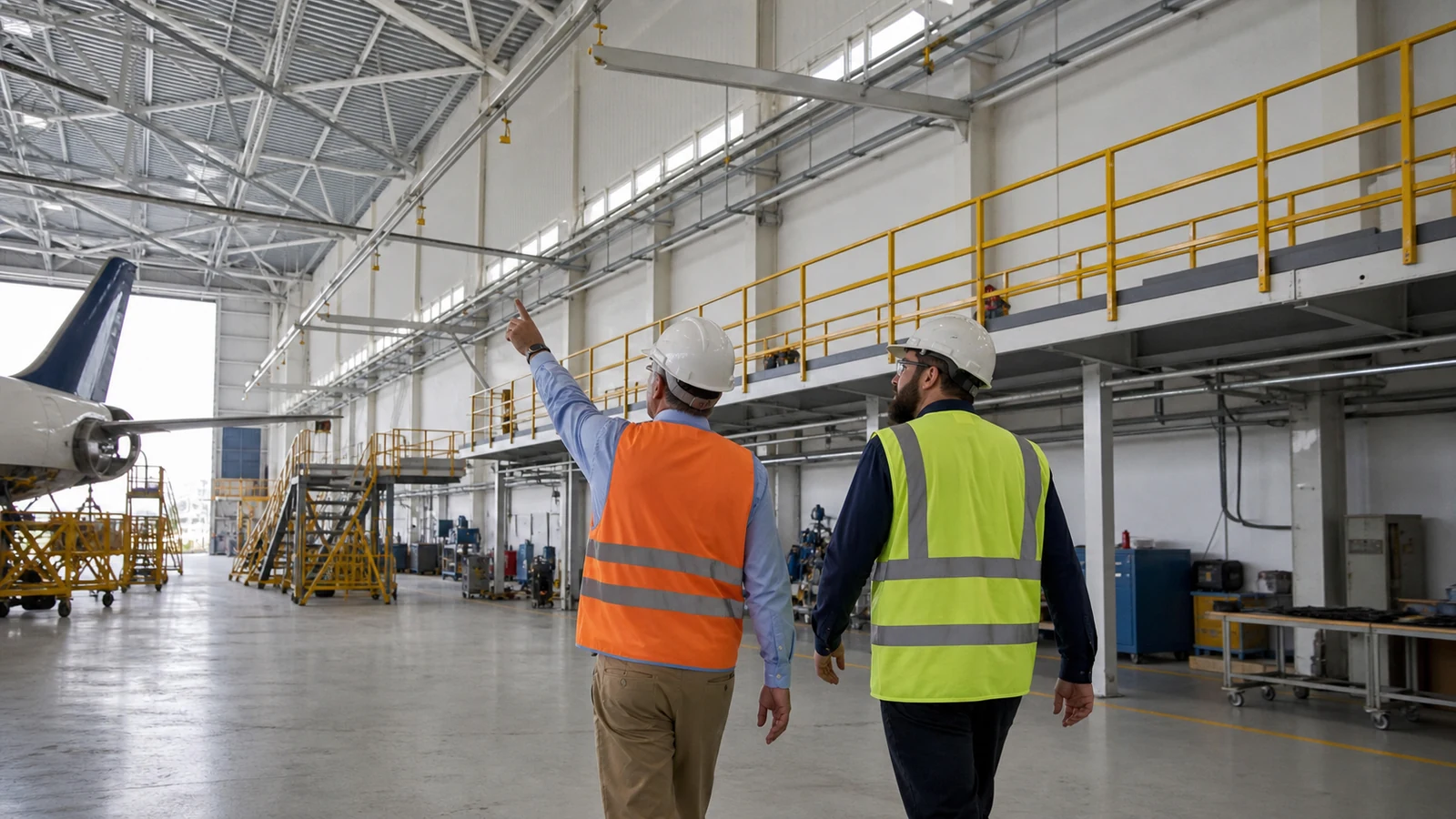
A coordinated RFQ should include aircraft data, work tasks, bay geometry, structural information, overhead services, governing rules, user count, commissioning needs, and responsibility boundaries. These inputs allow a steel-building and safety-system team to test feasibility before fabrication.
Which submission starts a useful review?
Send the project location, aircraft families, parking and tow layout, maintenance-task map, hangar plans and sections, door and crane details, available roof-steel data, target system type, simultaneous users, clearance constraints, schedule, and required records. For a new hangar, early steel and safety-system integration can reserve support steel efficiently; for a retrofit, include surveys and reliable as-built information.
You can explore our steel structure solutions to understand the wider building scope, then provide the project package for a disciplined interface review. Good hangar safety begins with a load path, work envelope, and responsibility chain that remain clear from design through handover.
Key Takeaway: Ask suppliers to return coverage, reactions, exclusions, evidence, and structural interfaces—not only a system price.
Plan Safer Hangar Fall Protection—Request a Design Review !
Email:sales@showhoo.com.cn
Phone/WhatsApp:+86 186 7895 5927
Frequently Asked Questions
Can I attach a fall-arrest rail to existing roof purlins?
Possibly, but only after the purlins, connections, primary frame, and foundations are checked for the certified system reactions. Roof support members designed for cladding loads may not provide a suitable arrest load path.
What’s the best system for maintaining several aircraft types?
It depends on the task and envelope study. A rigid rail, flexible lifeline, mobile platform, fixed dock, or combined system should be compared against coverage, clearance, obstruction, rescue, and fleet-change requirements.
How do I know if the rail covers the full wing?
Check a scaled coverage drawing and critical sections using the actual aircraft, maintenance positions, trolley limits, and permissible lateral offset. A rail length alone does not prove usable coverage.
Can I add the system after the hangar is built?
Often, but retrofit surveys and structural checks are required. Existing bracing, purlins, services, coatings, access, and foundations may limit bracket locations or require reinforcement.
What records should be included at handover?
Require approved calculations, reaction schedules, as-built drawings, component certificates, installation records, commissioning results, inspection instructions, training records, and the rescue plan.