
Managing a modern poultry farm without a highly optimized airflow strategy is a constant battle against heat stress, toxic ammonia buildup, and skyrocketing flock mortality. When temperatures soar or humidity spikes, a poorly engineered barn quickly turns into a hotbox, suffocating your flock and decimating your profit margins. The definitive answer to these challenges lies in a scientifically optimized poultry house ventilation design , which balances thermodynamics and fluid dynamics to maintain an ideal climate year-round.
What Is Poultry House Ventilation Design and Why Does It Matter?
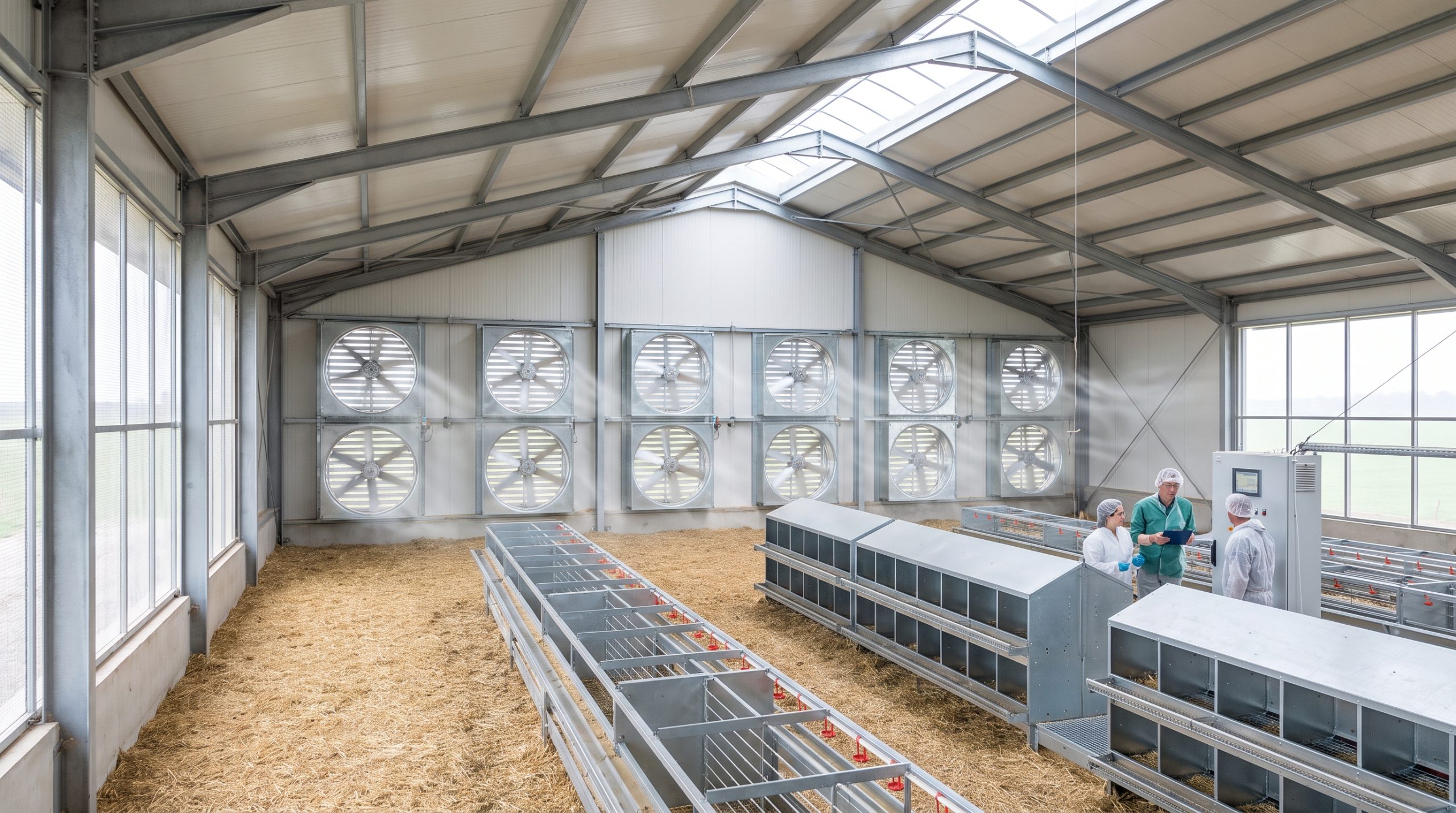
Poultry house ventilation design is the systematic engineering of airflow, pressure, and temperature within a barn to create an optimal living environment for poultry. Investing in a robust poultry house ventilation design ensures your birds receive continuous fresh air while removing harmful waste gases, dust, and excess moisture.
How Do Heat, Moisture, and Gas Affect Your Barn?
Let’s face it: birds constantly generate heat, metabolic moisture, and carbon dioxide, while their litter releases toxic ammonia gas. If these elements accumulate unchecked, they stress the flock’s respiratory systems and invite severe bacterial infections.
- Ammonia (NH3): Damages respiratory linings and suppresses immune response when levels exceed 20 ppm.
- Excess Moisture: Dampens litter, causing paw lesions, breast blisters, and high pathogen counts.
- Carbon Dioxide (CO2): Displaces oxygen, leading to lethargy, ascites, and poor feed consumption.
This accumulation creates a toxic environment that actively degrades your daily yield. Managing these gases immediately is critical to maintaining high welfare standards and stable biological performance.
How Does Airflow Impact Poultry Health and Yield?
Think about it: a bird’s growth rate and feed conversion efficiency are directly tied to its thermal comfort zone. Correct airflow breaks up localized heat pockets and allows birds to dissipate body heat naturally through respiration and convection.
- Lower Feed Conversion Ratio (FCR): Energy is directed toward growth and muscle development rather than thermoregulation.
- Reduced Mortality: Minimizes mortality rates during extreme summer heatwaves and winter cold snaps.
- Uniform Weight Distribution: Promotes even bird distribution and weight gains across the entire building length.
When air moves smoothly over the flock, it prevents clustering and reduces physiological stress. Consequently, your operational yields remain steady and predictable.
What Are the Main Objectives of an Airflow System?
The primary objective of an airflow system is to maintain a stable, uniform microclimate throughout the entire floor plan. Here is the key: your design must seamlessly transition between low-rate winter survival ventilation and high-speed summer cooling.
- Continuous Oxygenation: Delivers fresh air and extracts metabolic waste gases continuously.
- Humidity Control: Regulates relative humidity levels strictly between 50% and 70% to keep litter dry.
- Draft Prevention: Distributes fresh air evenly without creating direct cold drafts on young chicks.
Key Takeaway: Effective ventilation design acts as the primary life-support system of your poultry barn, protecting flock health and securing predictable operational yields.
| Parameter | Target Range | Primary Purpose | |
|---|---|---|---|
| Relative Humidity | 50% – 70% | Keeps litter dry and dust levels manageable | |
| Ammonia (NH3) | < 10–20 ppm | Protects respiratory system and footpads | |
| Carbon Dioxide (CO2) | < 3,000 ppm | Prevents hypoxia and maintains vitality |
Let’s transition to the prerequisites of this process by identifying the critical structural and biological parameters.
What Is Required Before Starting Your Ventilation Design?

Before starting, you must gather detailed biological specifications, structural dimensions, regional climate history, and electrical power capabilities. A customized poultry house ventilation design cannot be executed without these foundational parameters because they dictate the volume of air that must be moved.
What Bird Specifications Dictate Your Needs?
Let’s face it: different poultry types, ages, and stocking densities demand entirely different ventilation profiles. Broilers require rapid heat removal as they mature, whereas layers or breeders need highly stable, draft-free microclimates to protect egg production.
- Flock Type: Broilers, layers, breeders, or pullets each have unique oxygen and heat outputs.
- Stocking Density: Maximum biomass (kg) per square meter dictates the peak oxygen demand.
- Age-Specific Metabolism: Growing chicks require rising ventilation rates matched to their body weight.
Failing to match the mechanical design to your specific bird type risks stunted growth or drop-offs in egg output. Customizing equipment around the flock’s metabolism is critical.
How Do Building Dimensions Influence Airflow?
Think about it: the physical envelope of your barn serves as the primary duct through which all air must flow. The width, length, sidewall height, ceiling shape, and insulation values directly dictate how air behaves as it travels from inlet to exhaust.
- Cross-Sectional Area: Determines the velocity of the air running through the building.
- Insulation R-Values: Affect how much external solar heat penetrates the wall and ceiling panels.
- Interior Obstructions: Posts, columns, or high feeders can disrupt smooth, laminar air streams.
The geometry of the building acts as a structural boundary for fluid dynamics. Understanding these boundaries allows you to configure your equipment positions accurately.
What Climate and Power Data Do Designers Need?
Here is the key: your local weather extremes define the outer boundaries of your ventilation system’s operation. Engineers must review historical meteorological logs alongside local grid reliability to ensure the mechanical components never fail during critical peaks.
- Extreme Temperatures: Maximum wet-bulb and dry-bulb temperatures determine the effectiveness of evaporative pads.
- Seasonal Variations: Severe winter minimums dictate the supplemental heating requirements.
- Utility Specifications: Available electrical phase configurations, voltage stability, and backup generator capacities.
Key Takeaway: Accurately compiling flock, structural, and climatic metrics upfront prevents costly equipment over-sizing or critical system under-performance.
| Input Category | Crucial Metrics | Operational Impact | |
|---|---|---|---|
| Biological Data | Bird type, max weight, stocking density | Determines total oxygen and cooling needs | |
| Structural Data | Width, length, height, insulation R-values | Sets internal volume and air velocity limits | |
| Environmental Data | Extreme temp, humidity, grid reliability | Guides heater, cooling pad, and fan selection |
With these precise design inputs collected, we can now evaluate the most appropriate ventilation system configurations.
Get Your Custom Poultry Ventilation Design Today !
Email:sales@showhoo.com.cn
Phone/WhatsApp: + 86 186 7895 5927
Which Ventilation System Is Suitable for Your Poultry House?
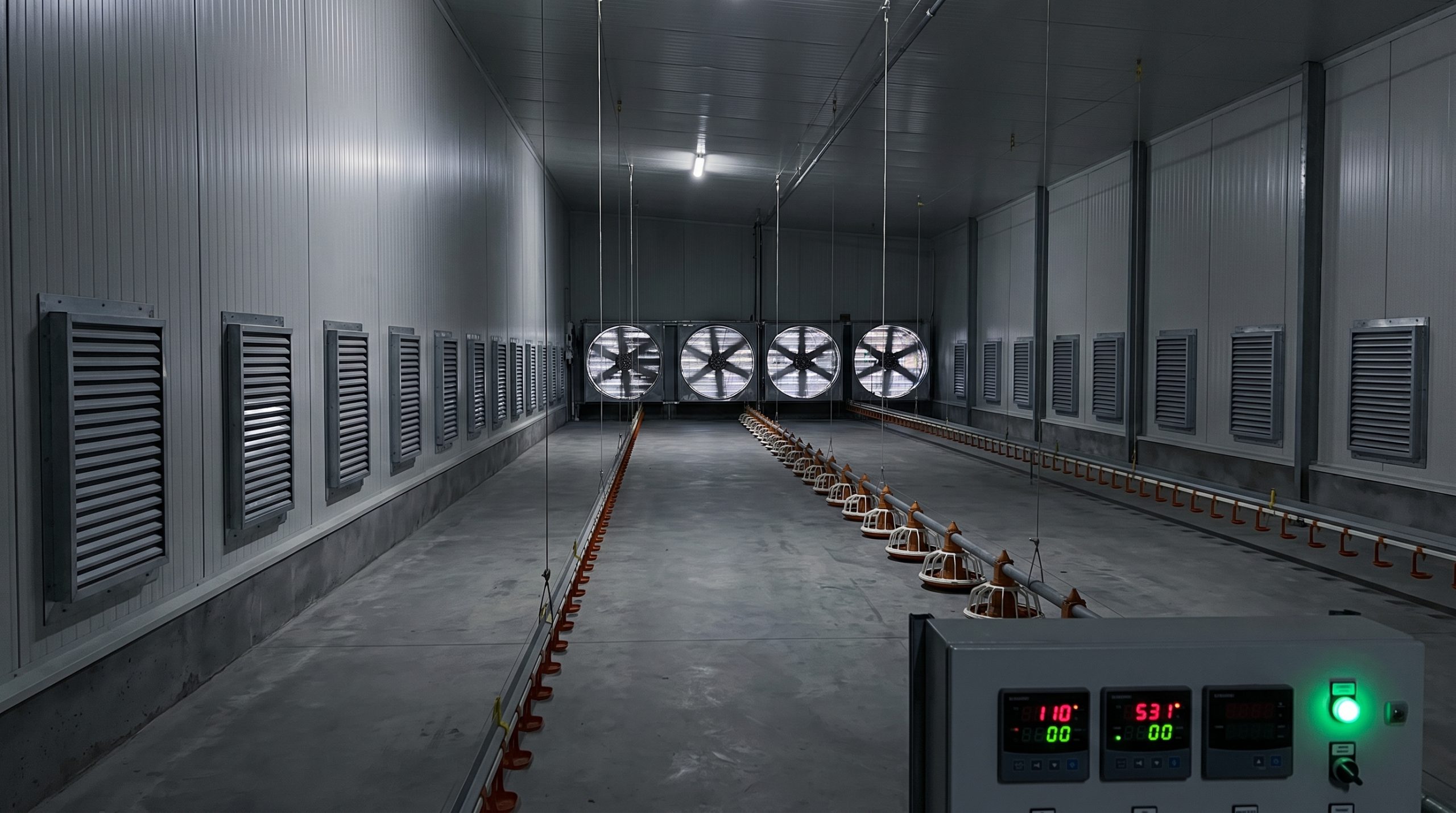
The ideal system depends on your local climate, bird species, and capital budget, ranging from open-sided natural setups to sophisticated mechanical tunnel ventilation. Choosing the right poultry house ventilation design ensures you can control environmental parameters regardless of external weather shifts.
When Is Natural Open-Sided Ventilation Best?
Let’s face it: natural ventilation relies entirely on wind forces and thermal buoyancy, making it highly dependent on the whims of local weather. While it offers extremely low operational and capital costs, it is only suitable for moderate climates with low stocking densities.
- Curtain Adjustments: Uses mechanical winches to raise or lower curtains based on wind.
- Ridge Vents: Allows rising warm air and gases to escape naturally through the roof peak.
- Low Density Restrictions: Requires wide building spacing and lower stocking densities to work safely.
This approach lacks the precision needed for high-yield, modern industrial farming. It remains a viable choice only where climate extremes are rare.
How Do Minimum and Transitional Airflows Work?
But that is not all: during cold seasons or when birds are young, you must use mechanical minimum ventilation to bring in fresh air without chilling the flock. Transitional systems step in as temperatures rise, activating sidewall fans and inlets before full tunnel mode is required.
- Timer Operations: Runs sidewall exhaust fans on intermittent cycles to exchange air while retaining heat.
- Directed Air Jets: Forces cold incoming air toward the ceiling peak to mix with warm air.
- Gradual Transitions: Smoothly activates more fans as birds grow and temperatures climb.
This step-by-step approach prevents thermal shock to the birds. It bridges the gap between cold-weather conservation and hot-weather cooling.
Why Use High-Velocity Tunnel Ventilation?
Think about it: high-velocity tunnel ventilation is the industry standard for hot climates and high-density production. By pulling massive volumes of air down the entire length of the building, it creates a powerful wind-chill effect that keeps adult birds cool and productive.
- End-Wall Exhaust Fans: Clustered at one end of the barn to pull air lengthwise.
- Opposite Air Inlets: Positioned at the opposite end of the barn, often integrated with cooling pads.
- Convective Cooling: Uses high wind speeds (2.5 to 3.5 m/s) to sweep heat away from the birds.
Key Takeaway: Selecting the correct system layout determines your ability to protect birds from seasonal temperature extremes while managing energy expenses.
| System Type | Recommended Climate | Key Mechanical Assets | Control Precision | |
|---|---|---|---|---|
| Natural | Temperate / Mild | Curtains, ridge vents | Low | |
| Minimum / Transitional | Cold to Moderate | Sidewall inlets, exhaust fans | High | |
| Tunnel | Hot / Tropical | End fans, evaporative pads | Excellent |
Let’s move on to the mathematical core of the design process by establishing the vital air exchange formulas.
How Do You Calculate Air Exchange Requirements?
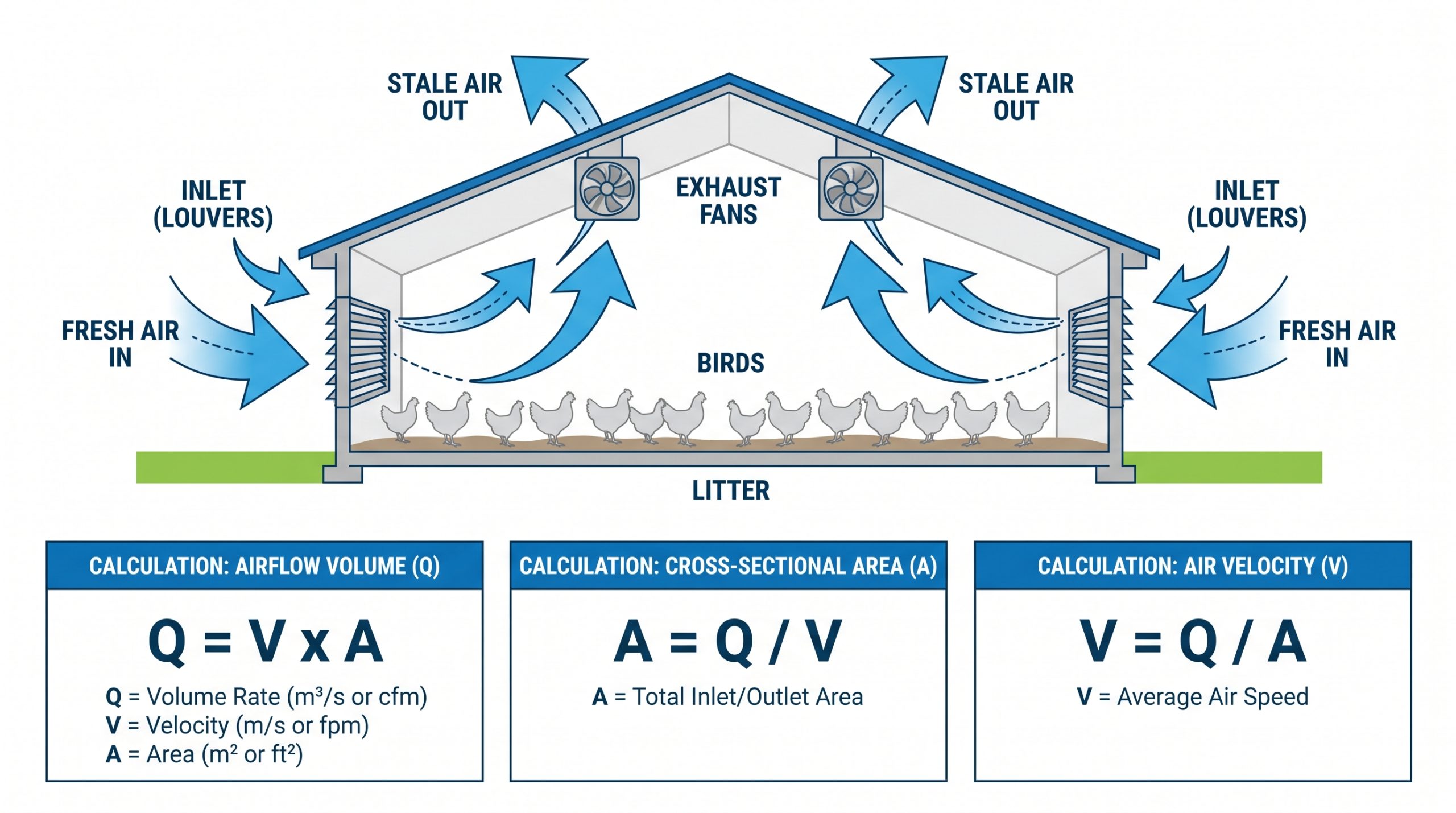
Calculating air exchange requirements involves determining the total volume of air that must be moved through the house per minute to maintain optimal air quality and temperature. Developing a precise poultry house ventilation design ensures you do not waste electrical energy on oversized fans or suffer from stagnant air pockets due to undersized units.
What Are Volume, Exchange, and Air Velocity?
Think about it: airflow is not just about moving any air; it is about moving the correct volume at the right velocity. Volume is the capacity of the house, exchange rate is how fast that entire volume is replaced, and velocity is the physical speed of the wind blowing over your birds.
- Air Volume: Measured in cubic meters (m3) of the internal space.
- Exchange Rate: The frequency of complete air replacement, typically measured in seconds per air change.
- Wind Velocity: Measured in meters per second (m/s) to quantify the convective cooling effect.
Balancing these three elements ensures that cold air does not drop too quickly, and warm air does not stagnate. Each variable must be calculated in sequence.
How to Measure Volume and Cross-Sectional Area?
Let’s face it: calculating these values requires precise physical measurements of your poultry house structure. The cross-sectional area is particularly critical for tunnel ventilation because it dictates the speed of the air moving down the length of the building.
- House Volume (m3): Width (m) × Length (m) × Average Height (m).
- Cross-Sectional Area (m2): Width (m) × Average Wall/Ceiling Height (m).
- Average Height Calculation: Incorporates sidewall height plus half of the ridge-to-eave height.
These geometric values are the non-negotiable baselines for all fluid dynamics calculations. Any error here will cascade through your entire equipment layout.
What Determines Your Required Ventilation Capacity?
Here is the key: your maximum ventilation capacity must be calculated to handle the hottest, most humid days of the year when the flock is at its maximum biomass. This represents the absolute peak load your mechanical systems must support.
- Maximum Biomass: Total bird weight (kg) expected in the house at the end of the growth cycle.
- Volumetric Multiplier: Standard engineering multiplier (typically 5 to 7 m3/hr per kilogram of biomass).
- Air Exchange Target: The need to achieve a complete air exchange in under 45 to 60 seconds during peak summer.
Key Takeaway: Mastering the basic geometric and capacity metrics of your building is the essential first step to executing correct ventilation calculations.
| Variable | Measurement Unit | Primary Application | |
|---|---|---|---|
| House Volume | Cubic Meters (m3) | Determines exchange times for minimum ventilation | |
| Cross-Sectional Area | Square Meters (m2) | Used to calculate tunnel wind velocity | |
| Peak Biomass Capacity | Kilograms (kg) | Calculates total volumetric flow needed for heat removal |
Having defined these parameters, we can now apply them directly to practical, step-by-step ventilation calculations.
How Do You Complete a Poultry Ventilation Calculation?
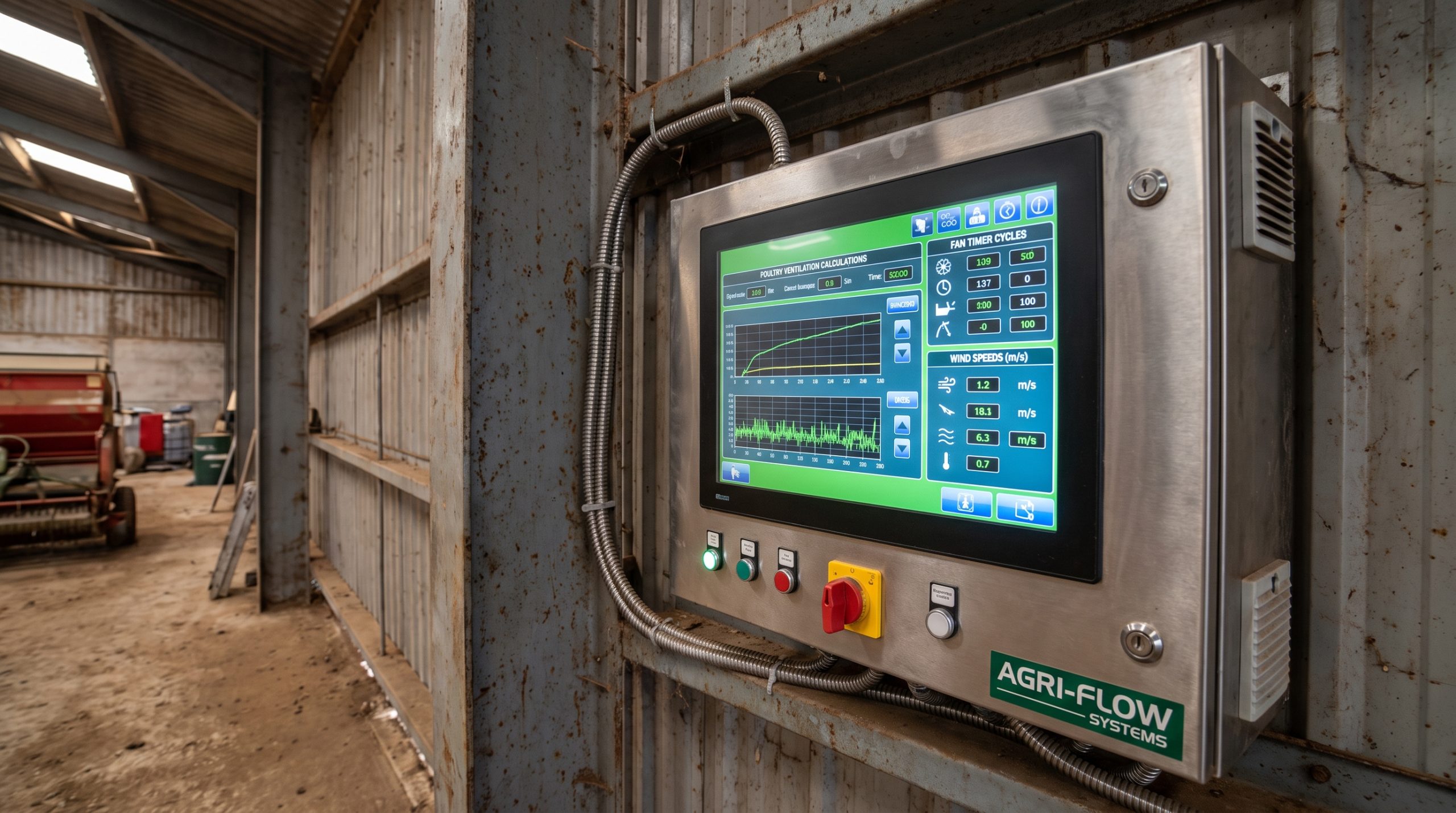
Completing a ventilation calculation requires separate mathematical procedures for minimum winter air exchange and high-velocity summer tunnel cooling. A sound poultry house ventilation design uses these targeted calculations to balance bird health with energy efficiency.
How Do You Calculate Minimum Winter Ventilation?
Think about it: in cold weather, your main goal is to conserve heat while extracting moisture and metabolic waste. Minimum ventilation is calculated based on the total body weight of young chicks or the moisture generation rate of the flock.
- Age-Specific Rates: Identify the minimum ventilation rate per bird age (e.g., 0.1 to 0.2 m3/hr per chick).
- Total Volume Capacity: Multiply this rate by the total number of birds housed to find the total minimum cubic meters per hour (m3/hr).
- Timer Calibration: Set cycle timers on your sidewall fans to run for a specific fraction of every five-minute cycle.
This ensures you bring in enough oxygen to keep litter dry without chilling the room. It prevents excessive heating bills during cold spells.
What Is the Correct Tunnel Ventilation Formula?
Here is the key: tunnel ventilation is calculated to achieve a specific target wind velocity over mature birds, rather than just a simple volumetric exchange. The formula relies directly on your building’s cross-sectional area to determine the total fan capacity required.
- Primary Equation: Required Fan Capacity (m3/s) = Cross-Sectional Area (m2) × Target Air Velocity (m/s).
- Target Air Velocity: Generally set between 2.5 m/s and 3.5 m/s for maximum convective cooling.
- Hourly Conversion: Multiply the cubic meters per second result by 3,600 to get total cubic meters per hour (m3/hr).
This calculation guarantees that your fans can pull air fast enough to create the required wind-chill effect. It is the core formula for hot-climate survival.
How to Adjust Calculations for Resistance?
Let’s face it: air does not move through a poultry house with zero resistance. Static pressure, cooling pads, safety grills, and dirty louvers all degrade fan performance, requiring you to adjust your raw numbers upward.
- Safety Margin: Add a 15% to 20% safety margin to the calculated fan capacity to account for motor aging and dust buildup.
- Pressure Curves: Evaluate fan performance curves at 20 to 30 Pascals (Pa) of static pressure, rather than free-air flow.
- Pad Friction: Ensure cooling pads are sized to keep static pressure drops within acceptable engineering ranges.
Key Takeaway: Executing precise, dual-scenario calculations guarantees that your mechanical systems are perfectly sized for both extreme winter cold and summer heat.
| Scenario | Target Metric | Calculation Formula / Method | |
|---|---|---|---|
| Minimum Winter | 0.1–0.2 m3/hr per chick | Total Birds × Minimum Rate = Total Hourly Volume | |
| Summer Tunnel | 2.5–3.5 m/s velocity | Cross-Sectional Area (m2) × Target Velocity (m/s) × 3,600 | |
| System Resistance | Static pressure margin | Add 15%–20% capacity buffer to compensate for equipment drag |
Once the absolute capacities are calculated, you must design the system to distribute this air uniformly.
How Does Airflow Design Control Direction and Uniformity?
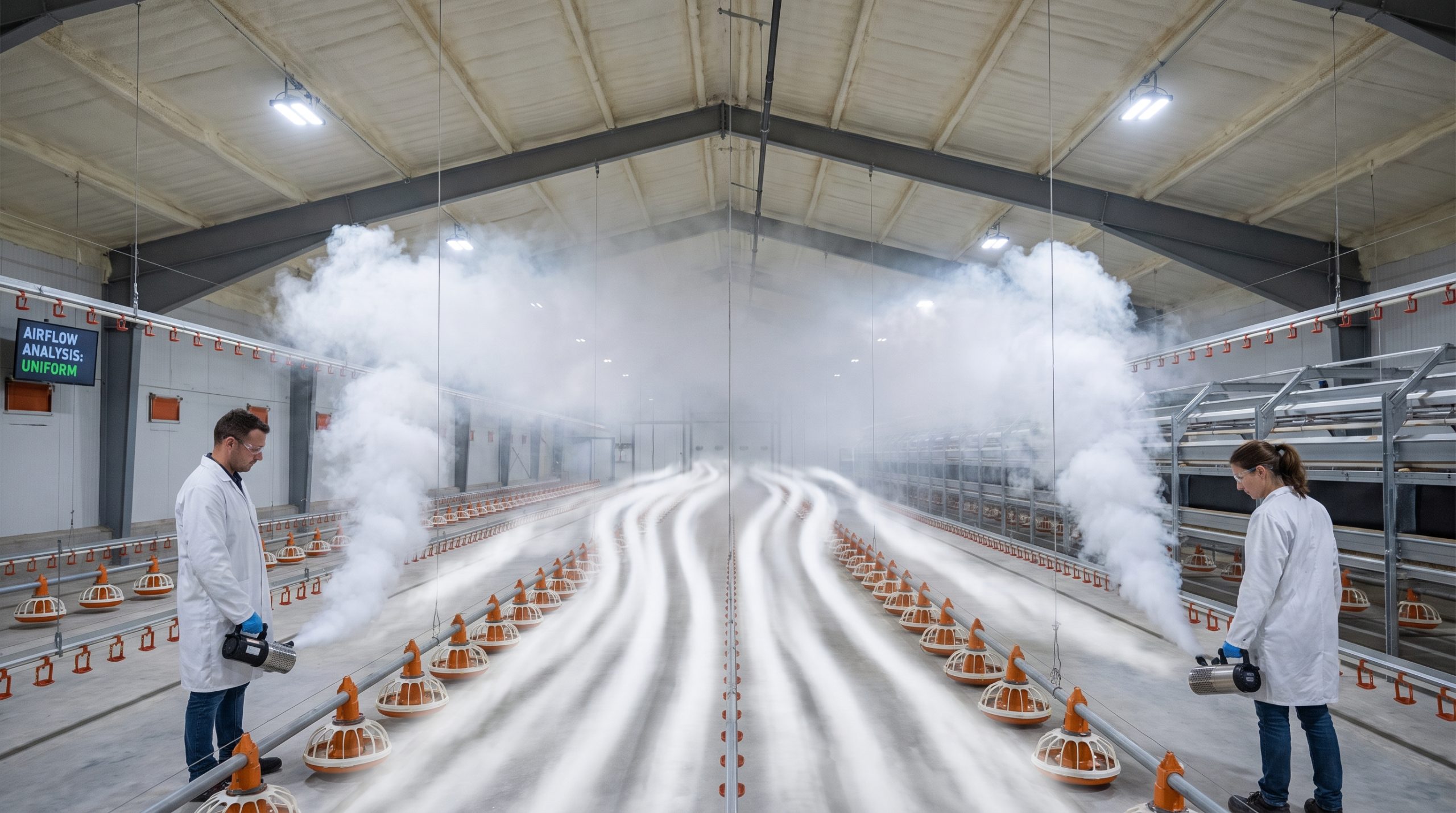
Airflow design controls direction and uniformity by managing pressure differentials and inlet configurations to prevent drafts and stagnant dead zones. Without a meticulous poultry house ventilation design, fresh air will short-circuit directly from inlets to exhaust fans without circulating through the bird zone.
How Should Incoming Air Enter and Mix?
Let’s face it: introducing freezing winter air directly onto warm chicks is a recipe for disaster. Air must enter through highly controlled sidewall inlets at a high speed, directing it upward toward the ceiling peak to mix with warm air before descending gently.
- Static Pressure Target: Maintain a steady pressure differential to shoot air along the ceiling profile.
- Symmetrical Inlets: Place inlets on both sidewalls opposite each other to ensure balanced mixing.
- Adjustable Flaps: Use computerized actuators to adjust openings dynamically as fan speeds change.
This mixing prevents cold air drafts from chilling the birds on the floor. It leverages the heat trapped at the ceiling level to save heating fuel.
How to Prevent Dead Zones and Uneven Airflow?
Dead zones are pockets of stagnant, hot, or toxic air that typically form in building corners, near partitions, or behind structural pillars. These areas cause birds to crowd or avoid certain sections, reducing local stocking densities and stressing the flock.
- Uniform Inlets: Ensure uniform spacing of air inlets along both sidewalls of the house.
- Stir Fans: Position internal circulation fans (stir fans) to keep air moving in stagnant areas.
- Airtight Seals: Inspect and maintain airtight seals on all doors, curtains, and cleanout ports.
Eliminating dead zones ensures that temperature and air quality remain identical throughout the barn. This uniform environment encourages birds to feed and grow at the same rate.
What Are the Best Ways to Test Airflow?
Relying on calculations alone is never enough; you must physically verify how air moves inside the completed structure. Testing airflow visually allows you to adjust inlet positions and verify draft-free zones before housing birds.
- Smoke Testing: Utilizes theatrical smoke generators to trace precise air currents and mixing patterns.
- Ribbon Testing: Places lightweight plastic ribbons on inlets to monitor air direction and velocity.
- Anemometer Sweeps: Uses handheld digital wind meters to measure speed at the bird level.
Visualizing the airflow path lets you spot short-circuiting and dead spots immediately. It is the final verification step before flock delivery.
Key Takeaway: Controlling the trajectory and mixing of incoming air is just as vital as moving the correct total volume of air.
| Airflow Challenge | Engineering Solution | Practical Benefit | |
|---|---|---|---|
| Direct Cold Drafts | Upward-directed sidewall inlets | Air mixes at ceiling peak before reaching floor | |
| Stagnant Pockets | Stir fans / uniform inlet spacing | Promotes uniform bird distribution across barn | |
| Structural Air Leaks | Professional sealing / pressure tests | Ensures incoming air passes only through design inlets |
Now we will discuss how to select and arrange the physical hardware required to achieve these goals.
Get Your Custom Poultry Ventilation Design Today !
Email:sales@showhoo.com.cn
Phone/WhatsApp: + 86 186 7895 5927
How Do You Size and Position Fans, Inlets, and Pads?
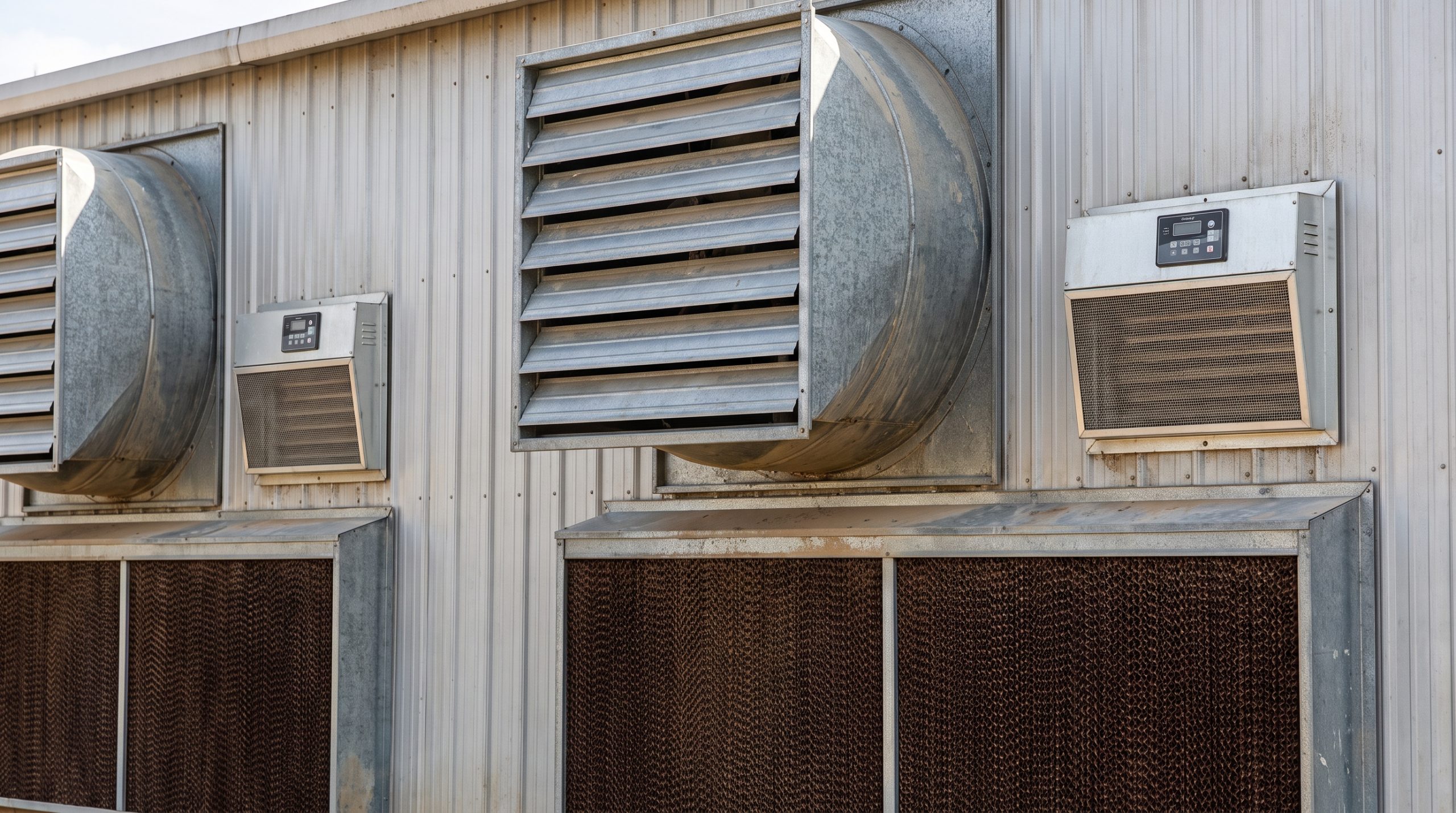
Sizing and positioning fans, inlets, and cooling pads requires aligning their physical capacities with your calculated volumetric flow rates and desired air velocities. Integrating this equipment into your poultry house ventilation design ensures optimal static pressure and smooth transition between cooling stages.
How Do You Select Fans Based on Performance?
Think about it: not all fans are created equal, and choosing based on blade diameter alone is a common mistake. You must select fans based on their verified performance curves at specific static operating pressures, along with their energy efficiency ratings.
- Pressure Rating: Evaluate the volumetric output (m3/hr) at 20–30 Pa of static pressure.
- Independent Certification: Look for BESS Labs ratings or equivalent independent certifications for efficiency.
- Corrosion Resistance: Choose build materials (galvanized steel, fiberglass, or plastic) that resist corrosive ammonia.
Selecting energy-efficient fans reduces your monthly electricity bills. High-quality materials ensure the fans survive the harsh, dusty, and humid barn environment.
What Determines Inlets Quantity and Position?
Here is the key: sidewall inlets must be spaced symmetrically to distribute fresh air evenly across the entire length of the building during minimum and transitional ventilation modes. Their total opening area must perfectly match the exhaust capacity of your active fans.
- High Placement: Space inlets high on opposite sidewalls, typically 2 to 3 meters apart.
- Inlet Velocity: Calculate total inlet area so that velocity through the opening remains around 4 to 5 m/s.
- Automated Control: Utilize computerized actuators to adjust openings dynamically as static pressure changes.
This setup prevents pressure drops and ensures air mixes properly at all fan speeds. Symmetrical placement prevents uneven temperature pockets along the house walls.
How Do You Size Inlets and Evaporative Pads?
Let’s face it: evaporative cooling pads must be sized precisely to prevent excessive static pressure drops while maximizing water contact time. If pads are too small, air velocity through them will be too high, carrying water droplets directly into the barn.
- Face Velocity Target: For standard 150mm (6-inch) pads, keep air face velocity around 1.5 to 1.8 m/s.
- Area Calculation: Total Pad Area (m2) = Peak Tunnel Fan Capacity (m3/s) / Target Pad Face Velocity (m/s).
- End Positioning: Position pads at the opposite end of the tunnel fans to pull cool air down the house’s length.
Proper pad sizing prevents water damage to the litter near the inlets. It optimizes the cooling efficiency of the water evaporation process.
Key Takeaway: Perfectly matching the capacities and positions of your fans, inlets, and cooling pads is critical to keeping static pressure stable and energy costs down.
| Equipment Type | Key Sizing Parameter | Target Operating Specification | |
|---|---|---|---|
| Exhaust Fans | Output at 20-30 Pa pressure | Matches calculated peak volume requirements | |
| Sidewall Inlets | Cross-sectional opening area | Achieves 4.0 – 5.0 m/s incoming air jet velocity | |
| Cooling Pads | Face surface area (m2) | Restricts air velocity through pad to 1.5 – 1.8 m/s |
Next, let’s explore how static pressure and airtightness act as the invisible forces controlling your ventilation system.
How Do Airtightness and Pressure Affect Ventilation?
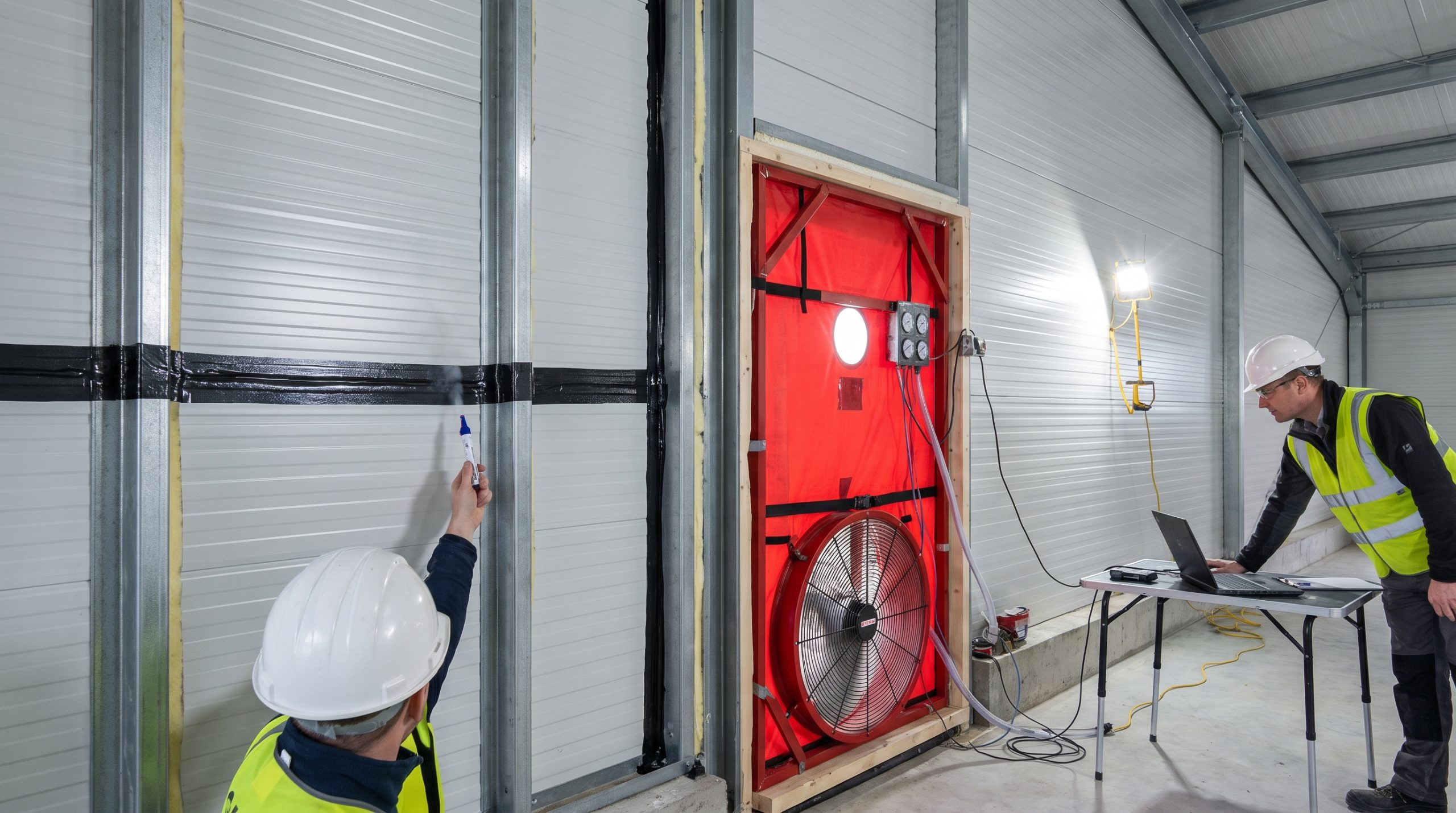
Airtightness and static pressure affect ventilation by creating the physical force required to distribute incoming air uniformly across the entire house. Executing a highly effective poultry house ventilation design is impossible if your building envelope is plagued by air leaks, as these leaks bypass your planned inlets.
Why Does Poultry House Airtightness Matter?
Think about it: if your building is not sealed, air will enter through cracks around doors, feed augers, and curtain seams. This uncontrolled air enters at low velocities, creating wet spots and cold drafts directly on your birds.
- Inlet Control: Forces 100% of incoming air to flow through engineered, adjustable inlets.
- Pressure Stability: Allows you to establish and maintain a precise static pressure differential.
- Energy Savings: Prevents heating energy loss during cold-season minimum ventilation.
An airtight house gives you full control over where and how air enters the building. It is the foundation of mechanical climate control.
How Does Static Pressure Control Inlet Performance?
Static pressure is the difference in air pressure between the inside and outside of the barn. By maintaining a negative pressure inside, you turn every tiny inlet opening into a high-speed air jet that shoots air where it belongs.
- Ideal Pressure Range: Typically 15 to 25 Pascals (0.06 to 0.10 inches of water column).
- Low Pressure Effects: Cold air falls directly onto litter, causing condensation and chilled birds.
- High Pressure Effects: Overworks exhaust fans, reducing their service life and volume.
Monitoring and adjusting static pressure is the only way to guarantee uniform air mixing. The system must adapt automatically as fans turn on and off.
How Do House Width and Height Influence Flow?
Wider houses require higher static pressures to shoot incoming air all the way to the center of the ceiling. If your house is 15 to 20 meters wide, standard inlets will fail to mix air properly without optimized pressure adjustments.
- High-Throw Inlets: Wider houses require larger or specially designed high-throw inlets.
- Dead Space Volume: High ceilings increase the volume of dead space that must be managed.
- Tunnel Velocity: Lower ceilings help maintain high air velocity in tunnel ventilation but limit air mixing.
The physical dimensions of the house dictate the required pressure profile. Your ventilation controller must be programmed with these spatial limits in mind.
Key Takeaway: Building a tightly sealed envelope is the non-negotiable prerequisite for precise, automated static pressure control.
| Indicator | Diagnostic Value | Operational Fix | |
|---|---|---|---|
| Poor Static Pressure | Under 10 Pa with fans active | Seal wall joints, doors, and curtain seams | |
| Optimal Pressure | 15 – 25 Pa (depending on width) | Actuator dynamically adjusts inlet openings | |
| Excessive Pressure | Over 35 Pa (fan stress) | Open additional inlets or clear pad obstructions |
Let’s examine how these principles must be adapted to meet different regional climate challenges.
How Should Ventilation Design Change for Different Climates?
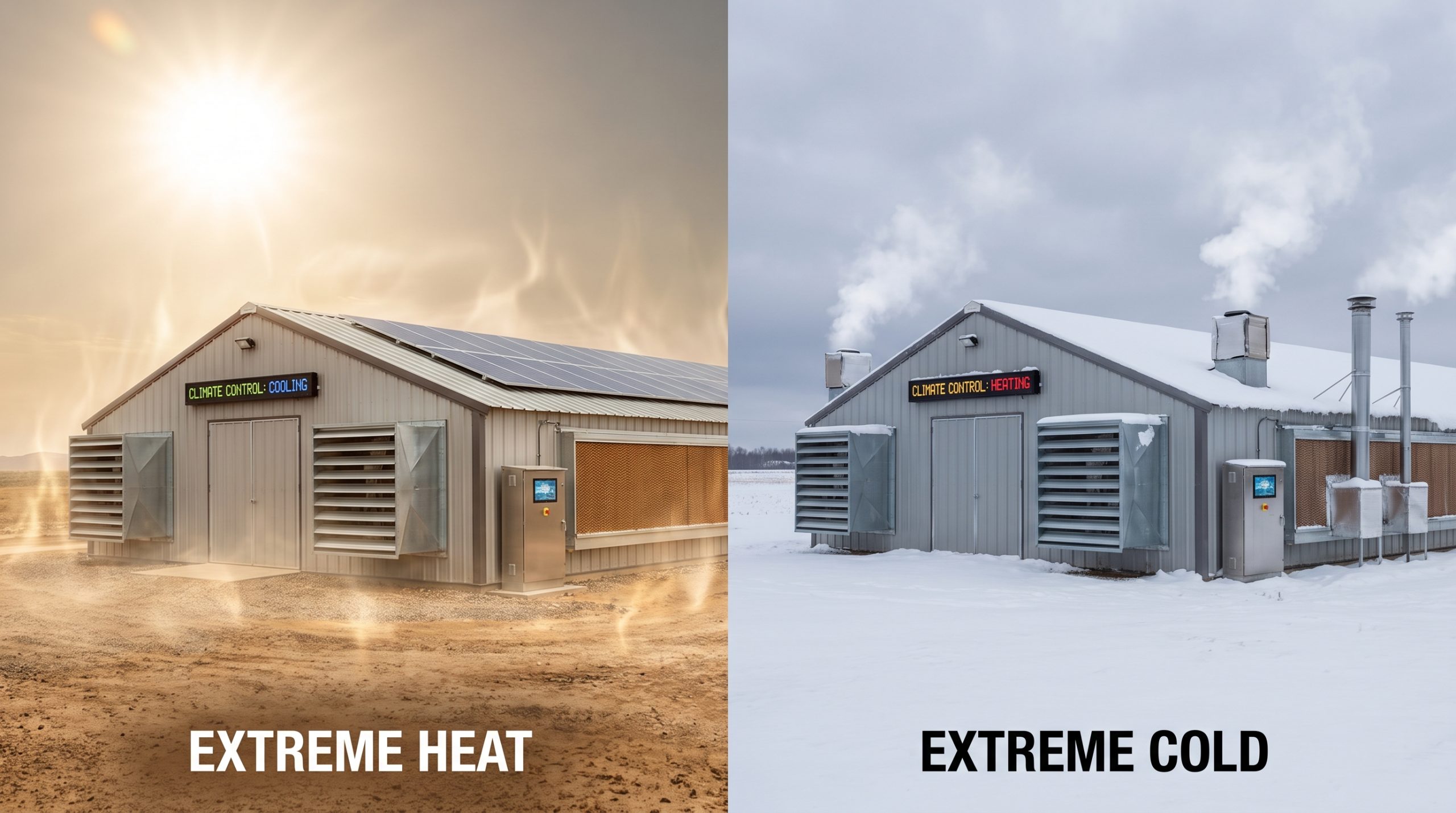
Ventilation design must adapt to regional climate variations to address extreme shifts in ambient temperature, moisture levels, and seasonal volatility. Integrating regional weather patterns into your poultry house ventilation design ensures your flock remains comfortable whether in sub-zero winters or tropical summers.
How Do You Manage Hot and Humid Climates?
Let’s face it: in hot, humid tropical regions, evaporative cooling pads are far less effective because the air is already saturated with moisture. Your primary tool under these conditions is high-speed wind velocity, which maximizes convective cooling directly on the birds’ skin.
- High Wind Speeds: Design for wind speeds of 3.0 to 3.5 m/s directly over the birds.
- Stir Fans: Utilize high-velocity stir fans to break up boundary layers of hot air.
- Reduced Pad Rely: Avoid over-reliance on cooling pads when relative humidity exceeds 80%.
In these regions, wind-chill velocity is the only reliable way to keep mature birds alive. The mechanical design must prioritize fan count over pad surface.
What Is the Best Setup for Hot and Dry Regions?
Hot and dry desert environments are absolutely perfect for evaporative cooling. By pulling hot, dry air through thick, wet cooling pads, you can easily lower the internal barn temperature by 8°C to 12°C.
- Thick Cooling Pads: Utilize thick, high-efficiency 150mm (6-inch) evaporative cooling pads.
- Automated Flushing: Implement automated water cycling to prevent mineral scaling on pads.
- High Water Capacity: Ensure sufficient water supply and pump capacity to keep pads uniformly wet.
This cooling method is highly cost-effective in dry climates. It provides a comfortable climate even during peak summer days.
How Do You Handle Cold and Variable Seasons?
Here is the key: in regions with freezing winters and hot summers, your system must be a true hybrid, capable of shifting seamlessly from minimum to tunnel ventilation. This requires sophisticated, multi-stage controllers that monitor both temperature and humidity.
- Heavily Insulated Panels: Use thick sandwich wall and ceiling panels with high R-values.
- Pre-Heating Systems: Combine space heaters or radiant brooders with minimum ventilation.
- Dynamic Controllers: Program automatic transitions between winter heating and summer cooling.
This versatility prevents seasonal crop losses. It ensures efficient operation through freezing winters and scorching summers alike.
Key Takeaway: Customizing your system architecture to match regional climate realities protects against extreme weather crop losses while optimizing utility expenses.
| Climate Type | Key Design Priority | Primary Equipment Used | |
|---|---|---|---|
| Hot & Humid | Maximum wind-chill speed | Large tunnel fans, stir fans | |
| Hot & Dry | Evaporative cooling | Cooling pad walls, high-capacity water pumps | |
| Cold & Variable | Heating and heat retention | Insulated panels, heaters, dynamic controllers |
We will conclude our engineering review with a practical buyer checklist to evaluate draft designs.
What Should Buyers Check Before Approving a Design?
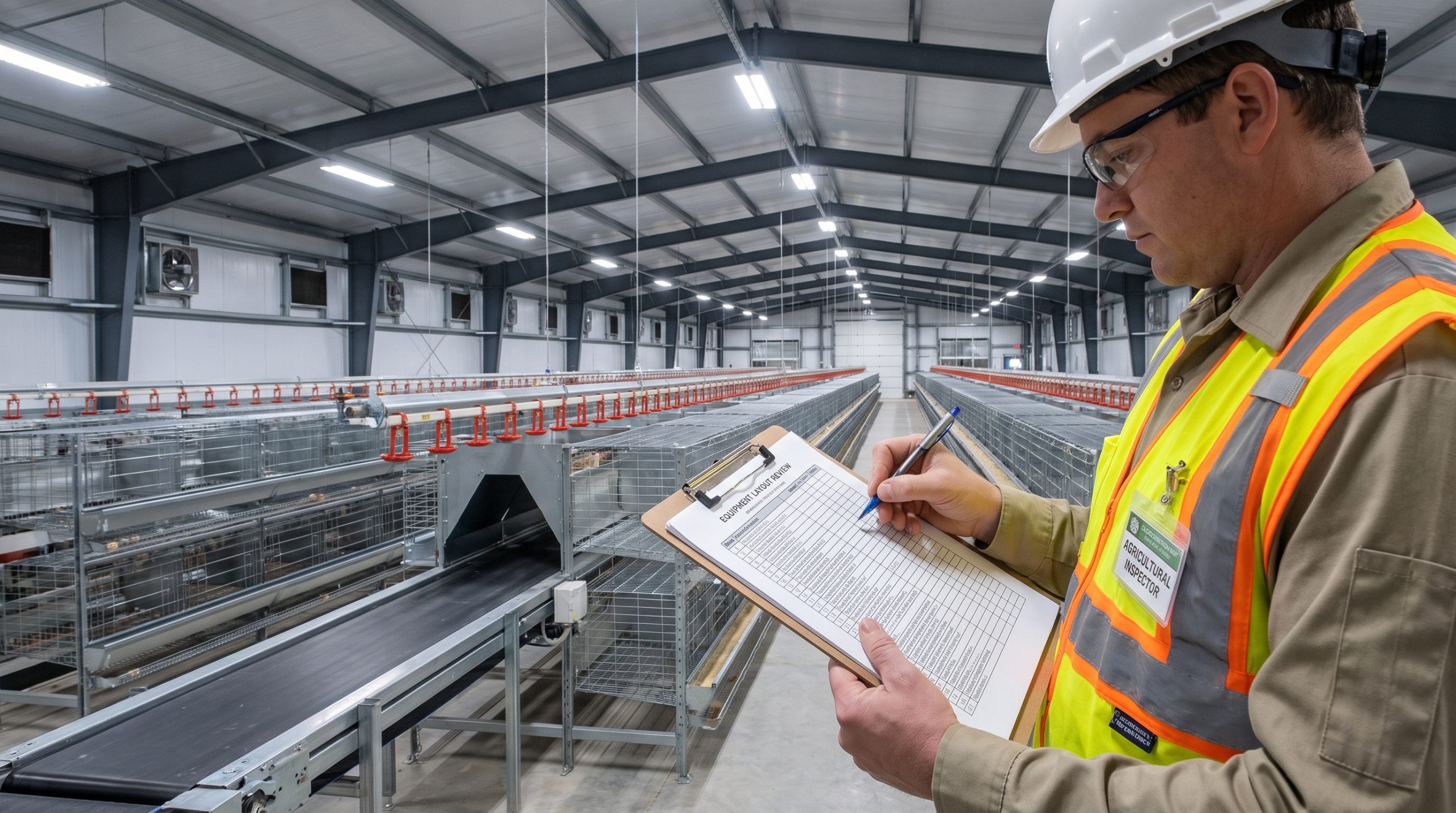
Buyers must thoroughly check design calculations, equipment layouts, structural airtightness plans, and installation support contracts before signing off on any ventilation draft. Developing a rigorous poultry house ventilation design evaluation process guarantees you will avoid costly construction retrofits and performance bottlenecks down the road.
How Do You Review Design Calculations?
Think about it: you do not need to be a professional mathematician to spot obvious calculation errors. Always ask your designer for a clear, written breakdown of their formulas and the underlying assumptions they used for flock density and climate extremes.
- Static Pressure Adjustments: Ensure fan capacity calculations account for 20-30 Pa of resistance.
- Biomass Consistency: Check if peak summer ventilation is based on maximum bird harvest weights.
- Velocity Verification: Double-check that target wind velocities match your house’s cross-sectional area.
Verifying these assumptions protects you from buying undersized equipment. It keeps the designers accountable to your specific farm goals.
What Layout and Equipment Coordination Is Needed?
Let’s face it: even the best paper calculations will fail if the physical equipment is poorly positioned or blocked by structural elements. Ensure there is clear coordination between your ventilation layout, feeding lines, lighting systems, and structural columns.
- Inlet Clearances: Confirm that air inlets are clear of internal structural columns or high light fixtures.
- Fan Discharge Paths: Verify that exhaust fan cones do not discharge directly into adjacent buildings.
- Pad Wind Protection: Check that cooling pads are fully protected from prevailing heavy winds and dust.
This physical coordination prevents installation delays during the construction phase. It ensures air flows through the house without any physical bottlenecks.
What Installation and Support Should You Expect?
But that is not all: buying top-tier equipment is only half the battle; proper installation, commissioning, and ongoing tech support are what keep the system running. Insist on a comprehensive support agreement that includes professional startup testing and control system calibration.
- Pressure Testing: Secure on-site static pressure smoke tests prior to bird placement.
- Manager Training: Demand detailed hands-on training for your farm staff on controller programming.
- Parts Availability: Verify the immediate availability of high-wear spare parts like fan belts and motors.
Key Takeaway: Exercising diligent oversight during the design and contracting phase prevents operational failures and secures a long-term return on investment.
| Review Phase | Verification Target | Action Item | |
|---|---|---|---|
| Mathematical | Dynamic calculation logs | Verify 20 Pa static pressure calculations and velocity goals | |
| Spatial Layout | Structural integration | Ensure inlets, fans, and columns do not interfere | |
| Operational | After-sales & Commissioning | Secure smoke testing, manager training, and spare parts |
Let’s summarize the strategic importance of choosing a robust, engineered approach to poultry barn ventilation.
Conclusion
Designing a modern poultry house ventilation system is a highly precise engineering task that requires balancing biological needs, structural limits, and regional weather patterns. By understanding how airflow operates under static pressure, calculating capacity accurately, and choosing high-performance equipment, you can secure the health of your flock and the profitability of your farm.
Whether you are building a new steel structure poultry project or upgrading an existing house, our expert engineering team is ready to help. To get tailored advice, custom aerodynamic calculations, and high-performance equipment specifications for your farm, get in touch with us to discuss your project requirements. Let’s work together to build a highly efficient, climate-controlled farming future that delivers predictable yields crop after crop.
Get Your Custom Poultry Ventilation Design Today !
Email:sales@showhoo.com.cn
Phone/WhatsApp: + 86 186 7895 5927
Frequently Asked Questions
Can I run a tunnel ventilation system without cooling pads?
Yes, you can run a tunnel ventilation system without cooling pads, but its cooling performance will be limited to wind-chill convective cooling alone. While high wind speed provides significant heat relief for adult birds, in extremely hot climates with temperatures exceeding 35°C, wind velocity alone is often insufficient to prevent severe heat stress without the added temperature reduction provided by evaporative cooling pads.
What’s the best static pressure for a standard poultry house?
The best operating range for a standard modern poultry house is between 15 and 25 Pascals (0.06 to 0.10 inches of water column). This pressure range ensures that incoming fresh air entering through the sidewall inlets has enough velocity to reach the ceiling peak and mix thoroughly with warm air before descending to the bird level, preventing cold drafts from dropping directly onto the litter.
How do I know if my poultry house is sufficiently airtight?
You can verify your poultry house airtightness by conducting a standard static pressure drop test. Close all inlets and doors completely, turn on one 48-inch or 50-inch exhaust fan, and measure the static pressure. A tightly sealed house should easily achieve a static pressure reading of 37.5 Pascals (0.15 inches of water column) or higher, indicating that air is not leaking through cracks.
Can I mix different fan brands in the same ventilation design?
Yes, you can mix different fan brands, but it is generally not recommended due to control system calibration and maintenance complexities. Different fan brands have unique performance curves, electrical draws, and shutter resistance levels, which can complicate static pressure management and make automated step-ventilation programming less precise and more difficult to troubleshoot.
How often should I clean and maintain my air inlets and fan blades?
You should clean your air inlets and fan blades at the end of every flock cycle, which is typically every 6 to 8 weeks. Dust and feathers accumulating on fan blades and shutters can reduce their aerodynamic efficiency by up to 30%, which overworks the motors, increases electrical consumption, and significantly lowers the actual air velocity delivered to your birds.