
The US Poultry Industry Manual for broilers outlines that optimal housing and facilities require a highly controlled, biosecure, and structurally sound environmental envelope to maximize bird health and growth. Many commercial farm operators face sudden profit drops due to drafty walls, soaring heating bills, and uneven flock weight distribution. When a facility lacks proper insulation and ventilation, young chicks struggle to survive, while heavy older birds succumb to heat stress and toxic ammonia buildup. To overcome these costly challenges, you can build a modern broiler chicken house designed with high-efficiency structural frames and precise climate systems.
How is a broiler chicken house structurally built?
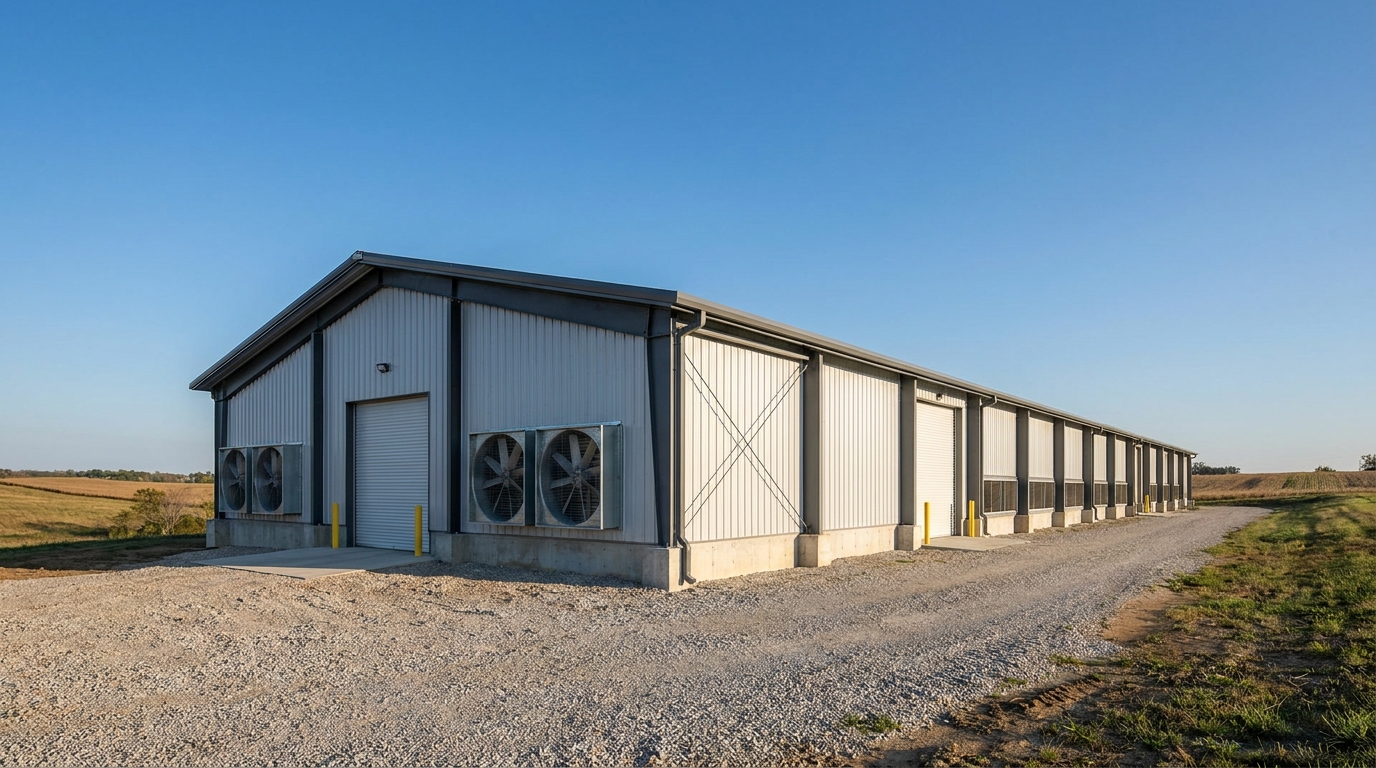
A modern broiler chicken house is structurally built using highly insulated pre-engineered steel or wood frames designed as a closed thermodynamic envelope. This rigid structure protects the flock from unpredictable external weather while supporting heavy automated feeding and ventilation equipment.
Sizing the structural footprint
When planning your facility, you must choose clear-span dimensions that optimize equipment efficiency and bird density. Most commercial operations select a standard 43-foot width to achieve uniform air distribution from the side wall inlets.
Think about it.
- Widths up to 50 feet allow perfect air mixing before dropping to bird level.
- Lengths of 500 to 600 feet maximize feeding line motor efficiency.
- Clear-span designs completely eliminate interior posts that block cleanout machinery.
By avoiding interior columns, you can clean out litter much faster between flock cycles and prevent injury hazards.
Selecting steel versus wood truss systems
You need to evaluate the long-term structural and sanitation differences between steel and wood frame systems. Steel frame trusses offer faster assembly and eliminate potential harboring spots for destructive insects and pests.
Here is the thing:
- Steel trusses provide superior resistance against heavy wind and snow loads.
- Wood trusses can be more affordable initially but require a drop ceiling to seal air.
- Pre-engineered steel frames reduce onsite construction timelines dramatically.
Selecting a galvanized steel frame ensures a perfectly sealed building envelope that preserves internal static pressure over years of operation.
Key Takeaway: Implementing correct dimensions and durable framing is the primary physical step to lowering energy expenses and protecting your vulnerable flock.
| Structural Zone | Minimum Rating / Spec | Recommended Material | Primary Engineering Benefit | |
|---|---|---|---|---|
| Roof Truss | Galvanized Steel Frame | Pre-engineered steel | Resists moisture rot; supports heavy internal machinery | |
| Ceiling Layer | Minimum R-19 rating | Cellulose / Fiber glass | Blocks solar heat; retains brooder heat | |
| Solid Sidewalls | Minimum R-11 rating | Closed-cell spray foam | Stops perimeter cold drafts and air leaks |
This structural baseline proves that thermal resistance directly dictates early-brooding fuel costs.
Why does biosecurity start with a broiler chicken house?
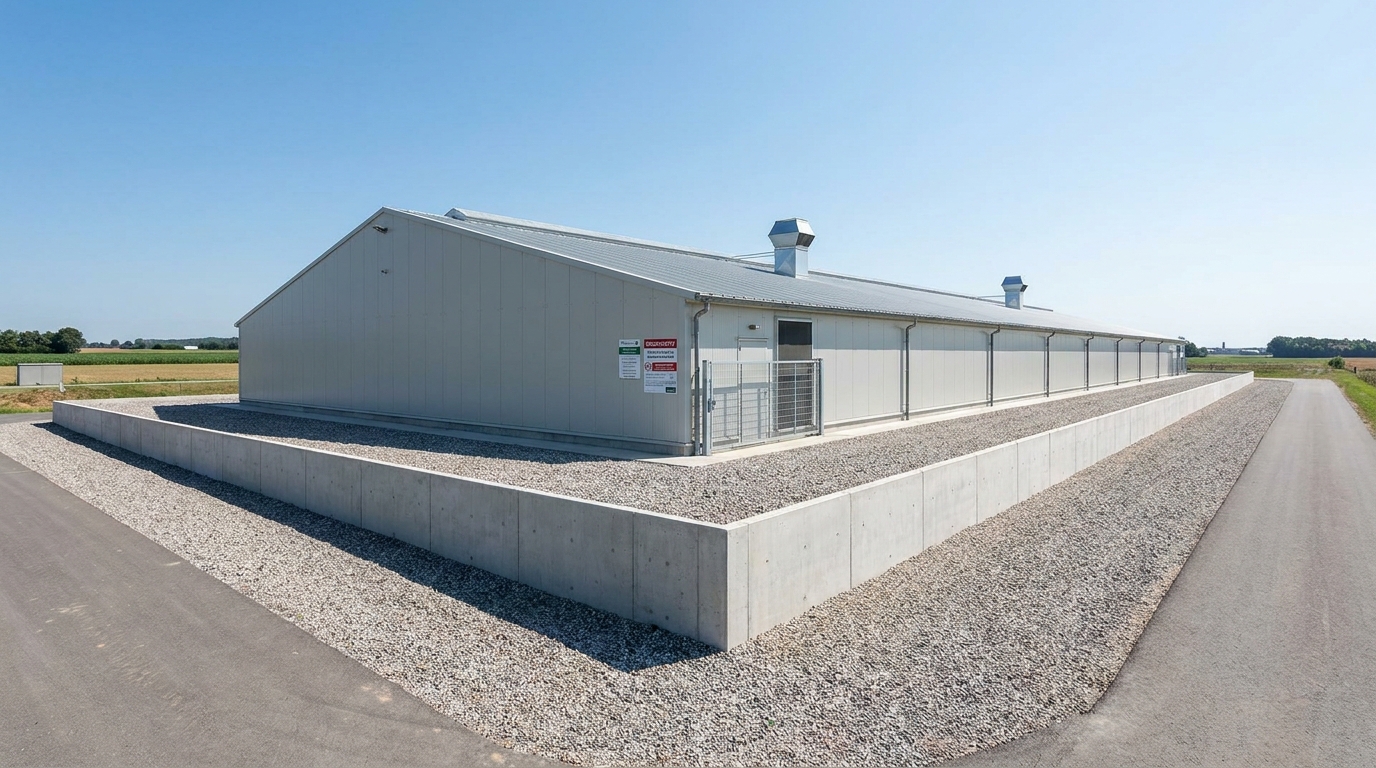
Biosecurity starts with a broiler chicken house because a fully sealed and isolated structure is your primary defense against wild birds, rodents, and airborne pathogens. This physical barrier ensures that external disease vectors cannot contact your flock and compromise their health.
Preventing pest entry with solid concrete footings
You must block rodents and beetles from burrowing into your birds’ living space by installing a continuous concrete footing. This heavy-duty barrier stops mice and rats from chewing through wall insulation and compromising your building’s thermal integrity.
The best part?
- Solid concrete footings eliminate subterranean paths for burrowing pests.
- Curb walls keep wet litter from rotting structural metal panels or wood posts.
- Gravel perimeters around the exterior discourage crawling insects from entering.
You will see a drastic drop in disease risks when you maintain a clean, vegetation-free gravel barrier around the house.
Establishing human and equipment sanitization locks
You can easily spread diseases if you allow personnel and machinery to enter the growing zones without proper disinfection. Installing dedicated wash stations and change-rooms at the main entrance prevents cross-contamination between different age groups.
Here is the thing:
- Disinfectant footbaths must be used at every single entry door.
- All-in, all-out batch management breaks the biological pathogen cycles.
- Washable interior wall panels allow fast, thorough sanitization between flocks.
Taking these active precautions ensures your facility remains free of persistent bacterial infections and virus hazards.
Key Takeaway: A continuous concrete barrier and strict sanitation protocols form an impenetrable line of defense for your growing flock.
| Biosecurity Feature | Targeted Threat | Required Action | Operational Standard | |
|---|---|---|---|---|
| Concrete Curb Wall | Burrowing rats / mice | Pour deep continuous footing | Zero entry points along perimeter | |
| Gravel Perimeter Strip | Litter beetles / insects | Clear 10-foot vegetation-free zone | Weekly inspection for weeds and pests | |
| Sanitation Lock | Pathogens on footwear | Place disinfectant mats at entry doors | Fresh chemical solution changed daily |
This biological defense matrix shows that physical exclusion is more effective than relying solely on chemical treatments.
Build a Smarter Broiler Chicken House—Request a Quote !
Email:sales@showhoo.com.cn
Phone/WhatsApp: + 86 186 7895 5927
What layout works inside a broiler chicken house?
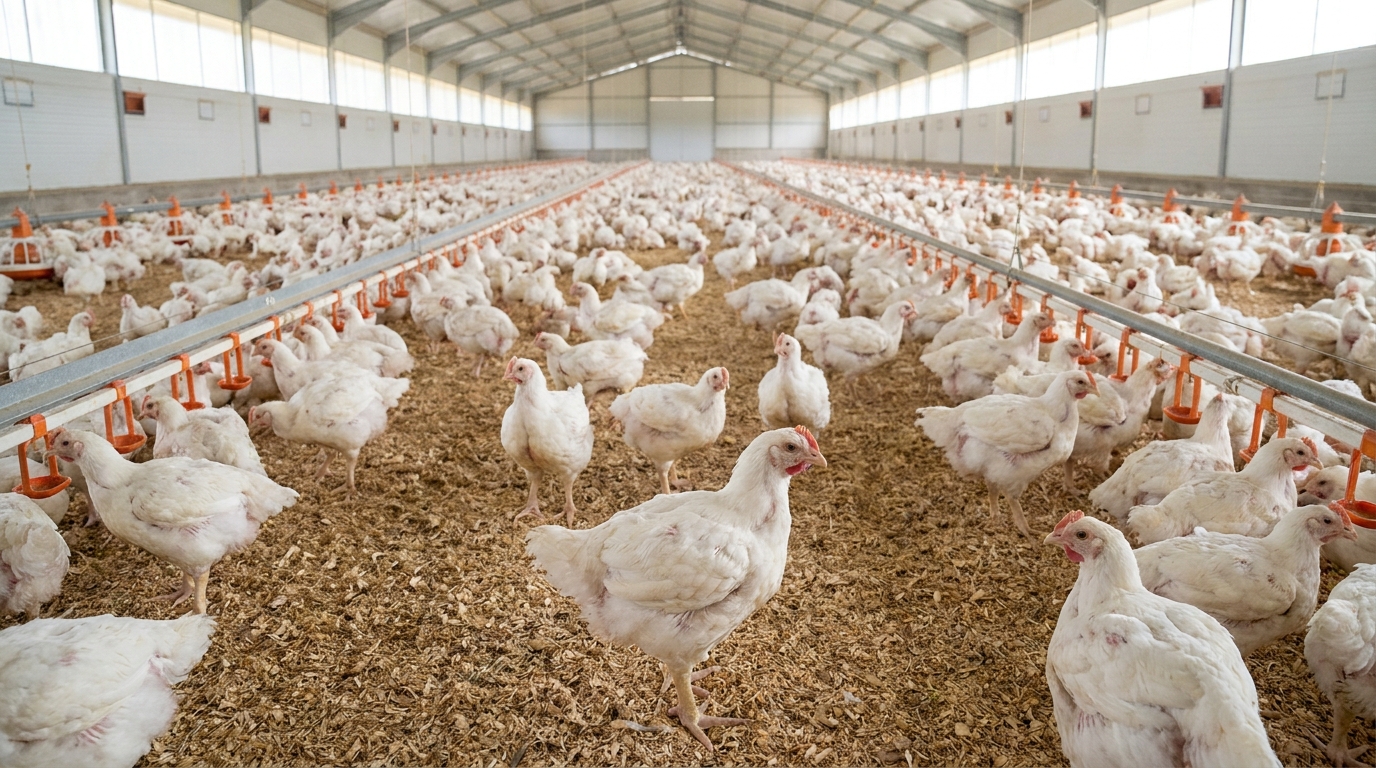
An optimized open-span layout with parallel equipment lines is the best design for a modern broiler chicken house to guarantee unrestricted bird movement and easy maintenance. This clean, symmetrical configuration allows growers to manage feed, water, and air paths without creating dead zones.
Sizing physical interior zones
You must plan the interior zones to make the most of your available floor space and equipment investments. Dividing the house into manageable sections with migration fences prevents birds from piling up near the inlets.
Think about it.
- Migration fences prevent birds from crowding near the cooler inlet end.
- Symmetrical equipment layouts ensure even heat and light distribution.
- Clear-span corridors keep the floor unobstructed for feeding and drinking lines.
By organizing the interior space properly, you ensure all birds have equal access to essential resources.
Allocating floor space based on target bird weights
You must adjust your stocking densities based on the targeted market weight of the birds to prevent crowd stress. Overcrowded environments lead to low weight gain, poor feed conversion, and high mortality rates.
The best part?
- Light birds require only 0.50 sq ft of space per bird.
- Medium broilers need a minimum allocation of 0.85 sq ft.
- Heavy-weight birds require 1.15 sq ftto prevent heat buildup.
Giving your birds the correct amount of space directly improves flock uniformity and carcass quality.
Key Takeaway: Sizing your interior layout to match bird biological requirements is critical to maintaining high growth rates and uniform flocks.
| Target Market Weight (lbs) | Required Floor Space (sq ft) | Recommended Birds per sq ft | Risk of Overcrowding | |
|---|---|---|---|---|
| 3.0 to 4.0 | 0.50 to 0.70 | 1.4 to 2.0 | Minor footpad lesions; high humidity | |
| 5.0 to 6.0 | 0.85 to 0.90 | 1.1 to 1.2 | Lower feed conversion; uneven growth | |
| 7.0 to 8.0 | 1.00 to 1.15 | 0.9 to 1.0 | High heat stress; elevated mortality |
This footprint breakdown shows that matching floor area to target bird weight is essential to prevent overcrowding.
How do LED systems light a broiler chicken house?
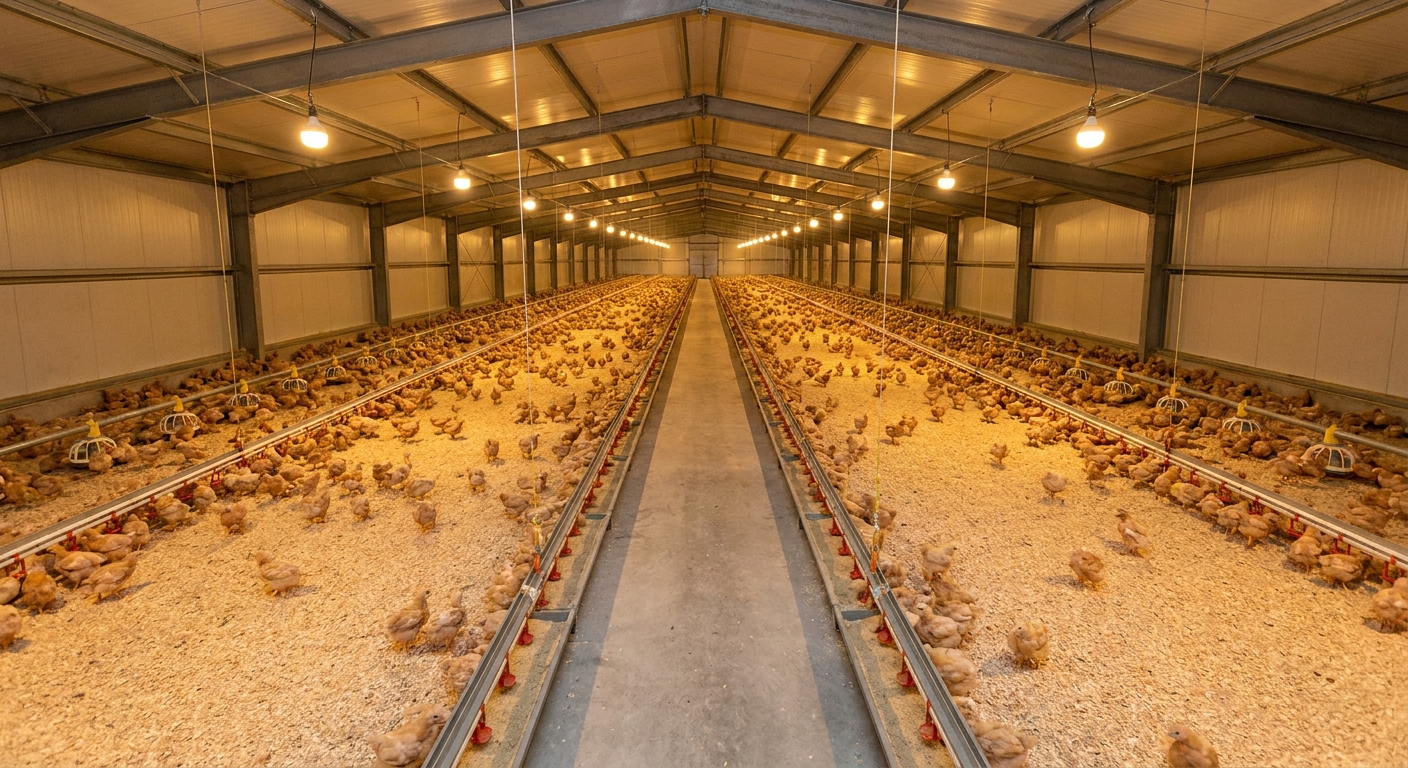
Modern LED systems light a broiler chicken house by distributing a uniform, dimmable spectral output that supports natural diurnal rhythms and stimulates active feeding. This highly efficient technology reduces energy consumption while giving you precise control over light intensity throughout the growing cycle.
Comparing bulb technologies for energy savings
You will reduce your operational power bills significantly by upgrading your lighting fixtures to modern LED technology. Traditional bulbs lose a lot of energy as heat and need to be replaced frequently in dusty agricultural environments.
Here is the thing:
- LED bulbs save up to 85% of electricity compared to incandescent.
- Vapor-proof housings protect LED electronics from high-pressure water washdowns.
- Dimmable drivers allow you to adjust light levels from 2 lux up to 30 lux.
Using rugged LED fixtures ensures your lighting network survives the high humidity of a growing house.
Structuring photoperiod schedules for bird welfare
You must provide dedicated periods of darkness to support the birds’ cardiovascular systems and bone development. Continuous light during the grow-out phase can cause skeletal issues, leg defects, and sudden death.
Think about it.
- Early brooding requires 23 hours of light to help chicks find feed.
- Growing birds need 4 to 6 hours of continuous darkness daily.
- Dark periods trigger melatonin release, which strengthens the birds’ immune systems.
Scheduling natural rest periods helps you raise healthier flocks with excellent leg health and reduced mortality.
Key Takeaway: Implementing a dimmable LED lighting schedule lowers your electrical costs and keeps the birds calm and healthy.
| Light Technology | Average Lifespan (Hours) | Efficiency Rating | Resistance to Moisture / Dust | |
|---|---|---|---|---|
| Incandescent | 1,000 | Very Poor (high heat loss) | Low; glass is highly fragile | |
| Compact Fluorescent | 8,000 | Moderate | Moderate; sensitive to cold starts | |
| Light Emitting Diode | 50,000+ | Excellent | High; sealed housings are waterproof |
This comparison proves that modern LED technology is the most reliable and cost-effective lighting choice for commercial poultry houses.
Which bedding works for a broiler chicken house?
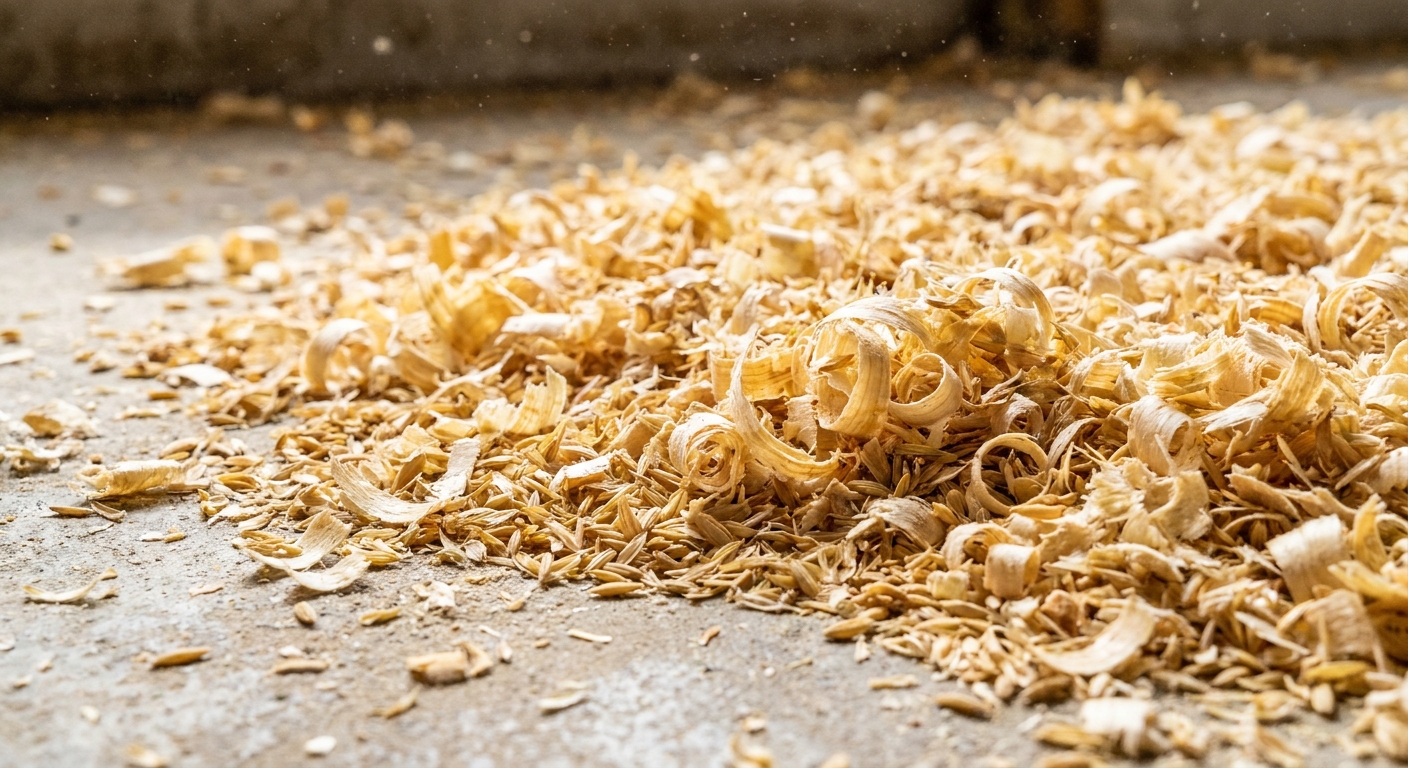
High-quality kiln-dried pine shavings and clean rice hulls are the best bedding materials for your broiler chicken house because they absorb moisture quickly and prevent skin lesions. This soft bedding layer insulates birds from the cold floor and keeps the environment dry and comfortable.
Evaluating absorbency of organic bedding materials
You need a bedding material that absorbs droppings quickly and dries out fast under proper ventilation. Straw and sawdust can pack down and cake, which creates damp surfaces that are harmful to bird health.
The best part?
- Pine shavings are highly absorbent and easy to spread evenly.
- Rice hulls drain exceptionally well and do not create excessive dust.
- Dry bedding prevents bacteria and pathogens from multiplying in the floor litter.
Investing in high-quality materials keeps your litter loose and dry throughout the flock cycle.
Managing litter depth and moisture thresholds
You must maintain the correct bedding depth to insulate your chicks from the cold ground during the early brooding stage. Allowing the litter moisture to rise above 35% will lead to wet, packed floors that burn the birds’ feet.
Here is the thing:
- Spread fresh bedding 3 to 4 inches deep before placing chicks.
- Keep moisture levels between 20% and 30% to prevent dusty air.
- Remove damp, packed “cake” litter quickly to stop ammonia buildup.
Keeping the litter dry protects your birds’ footpads and reduces processing plant downgrades.
Key Takeaway: Choosing absorbent bedding and keeping it dry is the easiest way to prevent painful footpad lesions and breast blisters.
| Bedding Material | Relative Absorbency | Caking Risk | Sourcing & Cost Profile | |
|---|---|---|---|---|
| Pine Shavings | Excellent | Low | High cost; competing industrial demand | |
| Rice Hulls | Good | Very Low | Cost-effective in grain-producing regions | |
| Chopped Straw | Moderate to Poor | Very High | Inexpensive; highly prone to mold and dampness |
This comparison shows that saving money on cheap bedding like straw often leads to higher footpad disease risks.
How is heating optimized in a broiler chicken house?
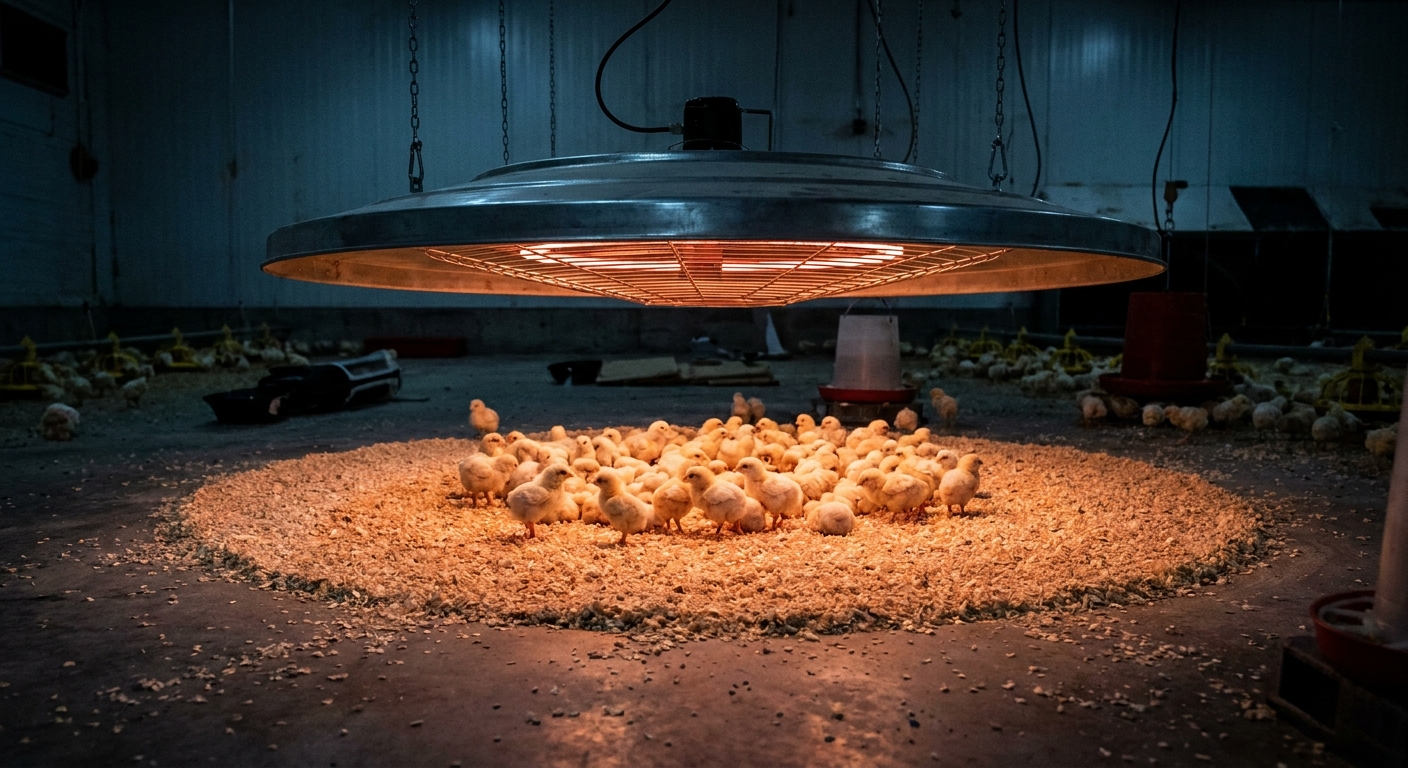
Heating is optimized in a broiler chicken house by combining radiant infrared brooders that warm the floor with space heaters that maintain background air temperatures. This dual heating system creates comfortable thermal zones where young chicks can self-regulate their body temperature.
Radiant heat vs. convection space heaters
You must understand how different heating methods transfer warmth to your birds to manage your heating bills effectively. Space heaters heat the entire volume of air first, which can be slow and expensive during cold winter starts.
Think about it.
- Radiant brooders project warm infrared waves directly to the chicks and bedding.
- Pancake brooders create distinct warm zones, allowing chicks to find their comfort zone.
- Convection space heaters are best for background warmth after the brooding stage.
By using targeted radiant heat, you warm the floor where the chicks live without wasting fuel on high ceilings.
Managing temperature curves during brooding
You need to drop your house temperature slowly as the birds grow and begin to produce their own metabolic body heat. Chicks cannot regulate their own temperature for the first 14 days, so keeping the floor warm is critical to their survival.
The best part?
- Day-one floor temperatures must be kept at 90 ℉ to 92 ℉
- Drop the target temperature by 5℉
- Monitor chick behavior; huddling under heaters means they are cold, while moving to walls means they are too hot.
Keeping your temperature changes gradual prevents flock stress and supports steady growth.
Key Takeaway: Using radiant brooders to target floor temperatures ensures young chicks stay warm while lowering your overall heating bills.
| Heater Configuration | Heat Transfer Mode | Primary Floor Pattern | Fuel Efficiency Level | |
|---|---|---|---|---|
| Pancake Brooder | Radiant (Infrared) | Concentrated warm ring | High; warms birds and litter directly | |
| Forced-Air Heater | Convection (circulated air) | Uniform throughout air volume | Moderate; must heat entire house air mass | |
| Radiant Tube | Radiant (broad line) | Long uniform heat lanes along floor | High; requires precise mounting height |
This thermal analysis shows that radiant heating systems are the most efficient option for early-stage brooding.
Build a Smarter Broiler Chicken House—Request a Quote !
Email:sales@showhoo.com.cn
Phone/WhatsApp: + 86 186 7895 5927
What feeder system fits a broiler chicken house?
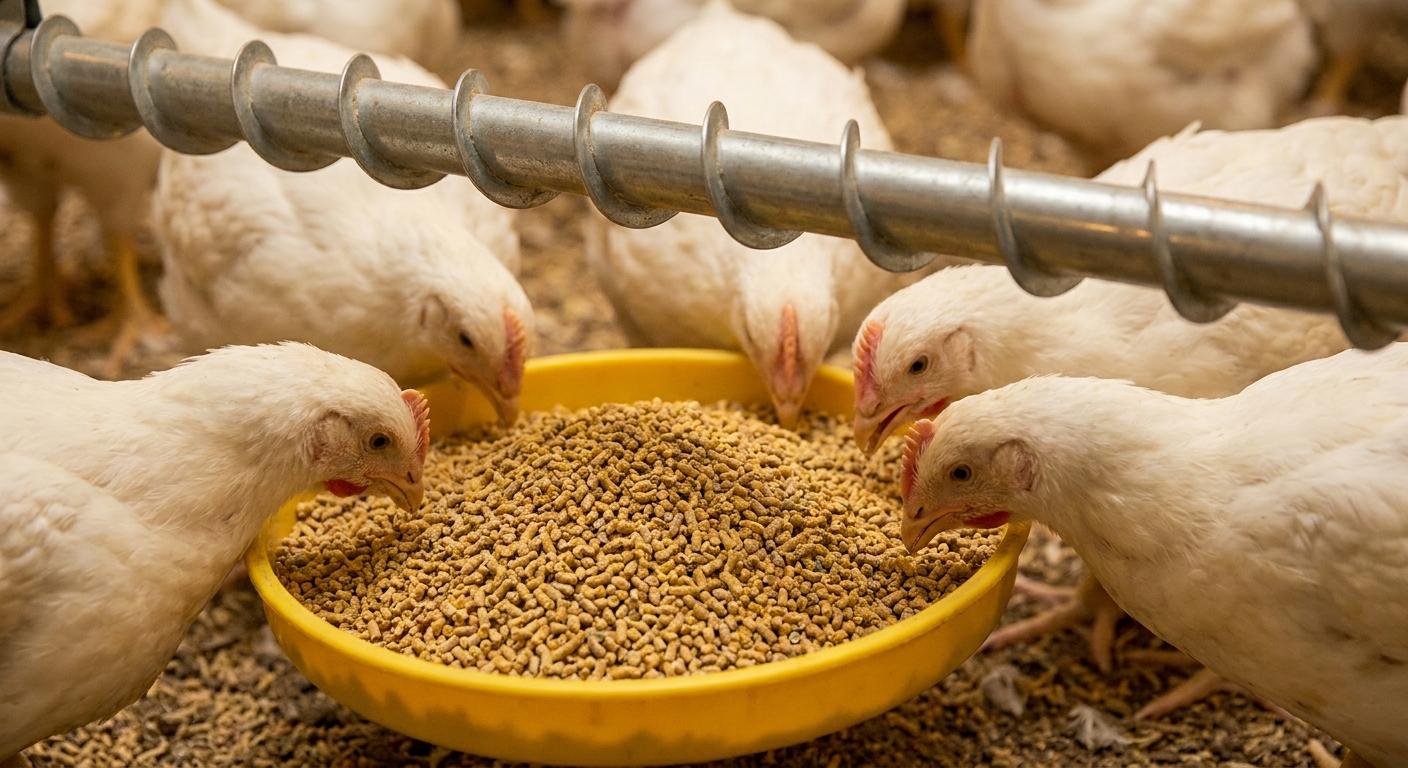
An automated coreless auger system with round plastic pans is the best feeder design for a broiler chicken house to ensure fast feed delivery and prevent waste. This closed transport system keeps feed clean and fresh while giving all birds equal access to nutrition.
Calculating feeding lines and bird density ratios
You should design your feeding layout to match your house width so birds do not have to walk too far to find food. Insufficient feeding space leads to competition, which hurts flock uniformity and leaves some birds underweight.
Here is the thing:
- A standard 42-foot wide house requires at least 2 parallel feed lines.
- Wider houses of 50 to 65 feet need 3 to 4 feed lines.
- Each 12-inch pan supports approximately 45 to 80 birds depending on their size.
Spacing your feed lines correctly prevents birds from crowding around a few pans and ensures even growth.
Regulating automated augers with control pans
You must keep your feeding lines adjusted so the pans do not overflow and waste valuable feed. Installing automated control pans at the end of each line keeps the system filled without human intervention.
Think about it.
- Control pans use sensitive trigger switches to turn the auger motor on and off.
- Closed auger tubes keep the feed dry and free of pest contamination.
- Winch systems let you raise the feed lines daily to match the birds’ growth.
Adjusting the pan height to match the birds’ back level prevents feed scratching and waste.
Key Takeaway: Adjusting your feed pan height daily keeps feed clean and prevents birds from wasting expensive feed.
| House Width (Feet) | Recommended Feed Lines | Birds per 12-inch Pan | Key Operational Goal | |
|---|---|---|---|---|
| 42 feet | 2 lines | 45 to 80 birds | Prevent physical barriers to feed access | |
| 50 to 65 feet | 3 to 4 lines | 45 to 80 birds | Ensure even bird distribution across floor | |
| 85 feet | 5 lines | 45 to 80 birds | Support high-density multi-line houses |
This feed line setup proves that pan height adjustments are critical to reducing daily feed waste.
How do drinker lines run in a broiler chicken house?
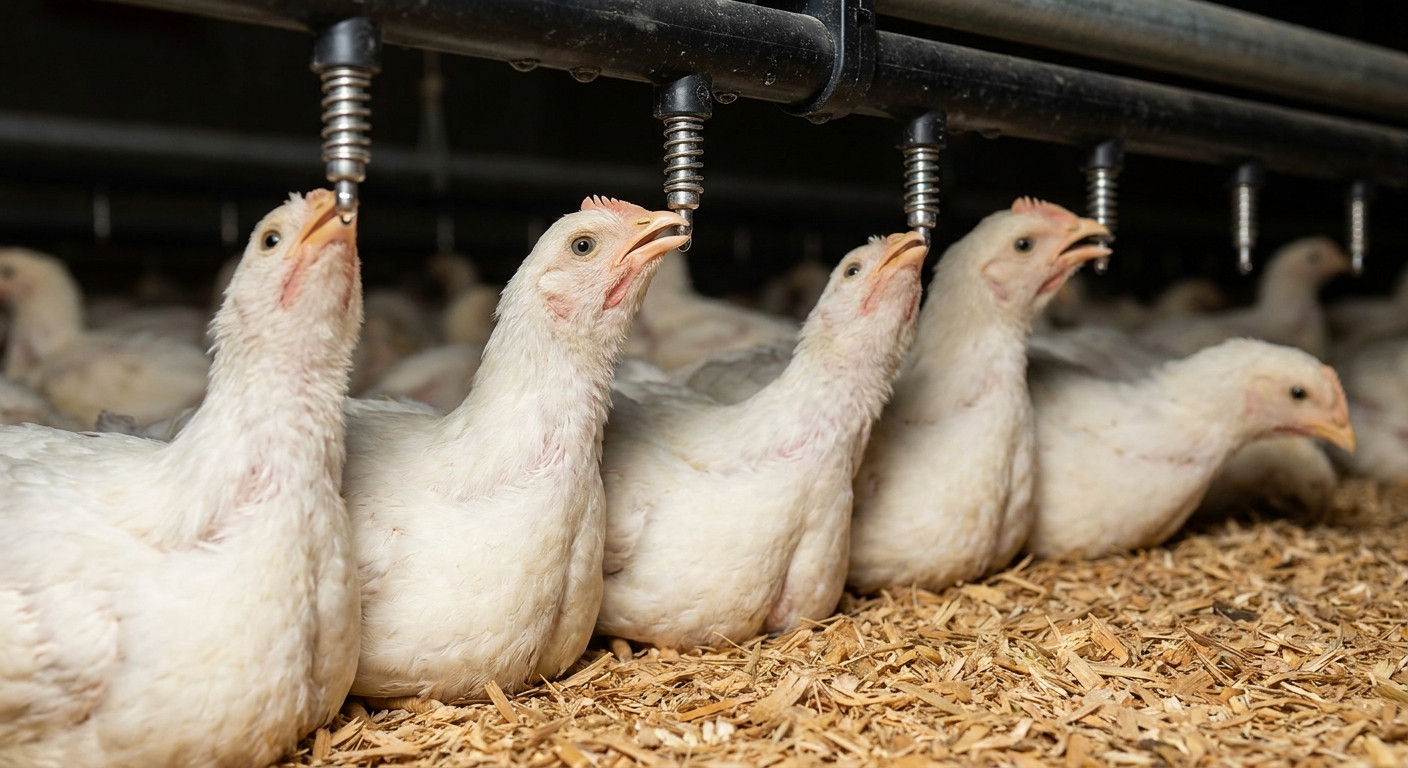
Drinker lines run in a broiler chicken house using enclosed, pressurized water lines fitted with metal trigger nipples to deliver clean water directly to the birds. This closed system keeps the water supply sanitary and prevents leaks that can ruin your litter.
Comparing low-flow and high-flow nipple systems
You can choose between low-flow and high-flow drinker systems depending on your target harvest weight and litter management style. Older open-water bell drinkers are no longer recommended because they easily get contaminated with dirt and feed.
The best part?
- Low-flow nipple systems operate at 2.0 fl oz/min and keep litter dry.
- High-flow systems use drip cups to catch excess water and support heavy birds.
- Enclosed water pipes keep dust, feed particles, and bacteria out of the water.
Using modern nipple lines ensures your flock always has access to clean, cool, and sanitary drinking water.
Adjusting line heights and water pressure daily
You must adjust your water pressure and drinker line heights daily as your birds grow. If the water lines are too low, the birds will bump the triggers and cause leaks; if they are too high, smaller birds will not be able to reach them.
Here is the thing:
- Drinker lines should be raised so birds must stretch slightly to drink.
- Keep the birds’ feet flat on the floor; they should never have to stand on their tip-toes.
- Adjust water regulators to increase flow as the birds grow and need more water.
Maintaining the correct line height and pressure keeps your litter dry and prevents water waste.
Key Takeaway: Raising your drinker lines daily ensures easy water access and prevents spills that cause wet litter.
| Drinker System | Target Flow Rate | Bird Capacity per Nipple | Litter Moisture Risk | |
|---|---|---|---|---|
| Low-Flow Nipples | Up to 2.0 fl oz/min | ~10 birds | Extremely Low (no drip cups needed) | |
| High-Flow Nipples | Above 2.0 fl oz/min | ~12 birds | Low to Moderate (uses drip cups) |
This drinker comparison shows that low-flow nipple lines are the most effective way to keep your litter dry.
Why use controllers in a broiler chicken house?
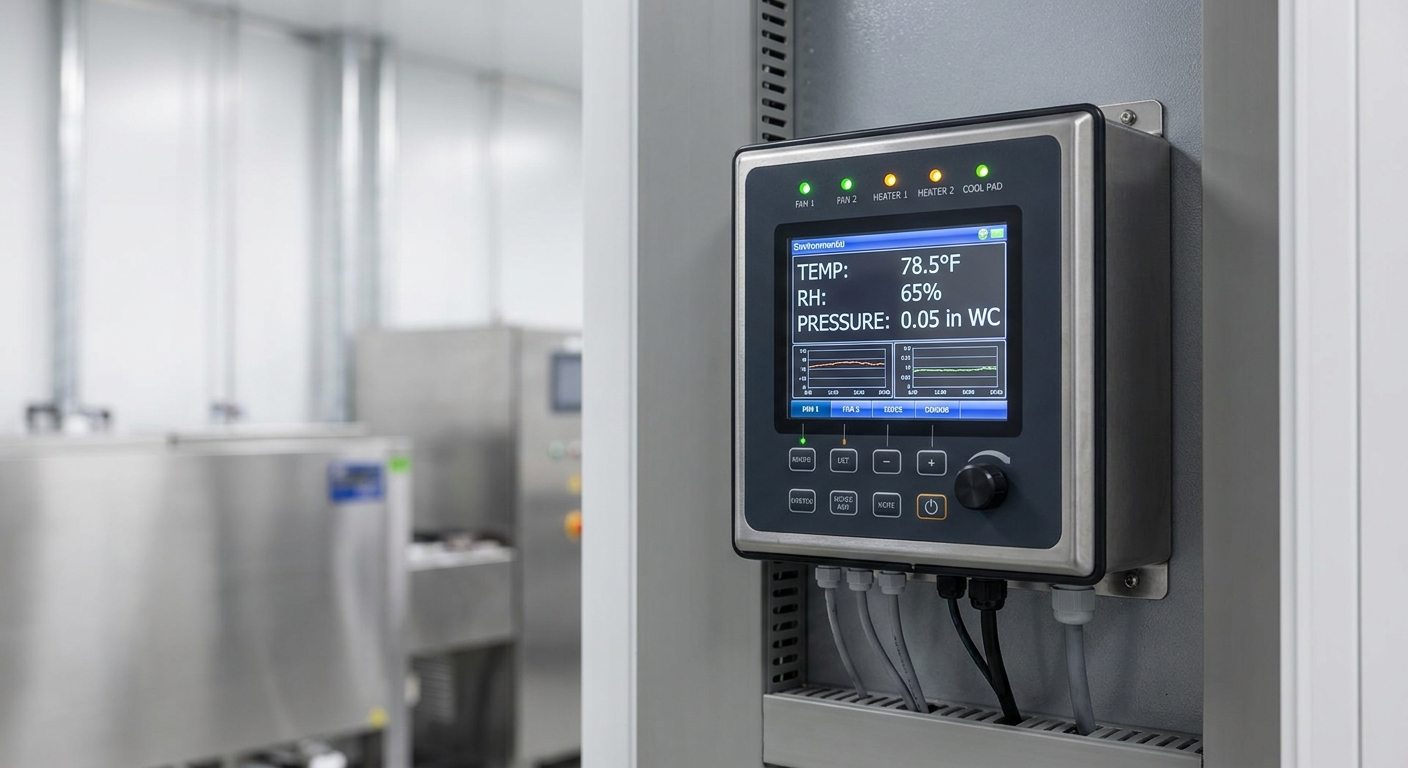
You should use integrated computerized controllers in your broiler chicken house to automatically coordinate fans, heaters, and inlets based on real-time sensor data. This automated system monitors indoor conditions 24 hours a day to keep your birds comfortable and prevent human errors.
Processing sensor data for climate control
You can place multiple temperature, humidity, and static pressure sensors throughout your house to monitor bird-level conditions. These sensors send instant data to the controller, which adjusts equipment to keep conditions stable.
Think about it.
- Temperature probes placed at bird height prevent cold draft pockets.
- Static pressure monitors track the air vacuum to adjust wall inlets.
- Humidity sensors activate ventilation fans to remove excess moisture.
Connecting these sensors to a central controller ensures your indoor climate stays perfectly balanced.
Reviewing data logs to improve farm performance
You can analyze the history logs stored in your controller to identify and fix performance bottlenecks. These detailed logs record daily highs and lows for temperature, water use, and equipment runtimes.
The best part?
- Tracking daily water intake is the fastest way to spot early disease signs.
- Reviewing fan runtimes helps you identify areas where you can save energy.
- Alarm systems alert you instantly via phone if there is a power failure or temperature spike.
Using these data logs helps you make informed management decisions and protect your flock.
Key Takeaway: Computerized controllers remove human error by automatically adjusting your climate systems to keep conditions stable.
| Sensor Parameter | Ideal Target Range | Automated Controller Reaction | Safety Alarm Trigger | |
|---|---|---|---|---|
| Ambient Temp | Matches growth curve | Activates heaters or tunnel fans | Deviation>5 ℉ from target | |
| Static Pressure | 0.05 to 0.12 inches wc | Adjusts wall air inlet openings | Pressure drops below 0.03 inches wc | |
| Daily Water Flow | Escalates with bird age | Detects sudden spikes or leaks | 10% deviation in hourly consumption |
This sensor network shows how automation keeps your birds comfortable and protects them from mechanical failures.
How does airflow cool a broiler chicken house?
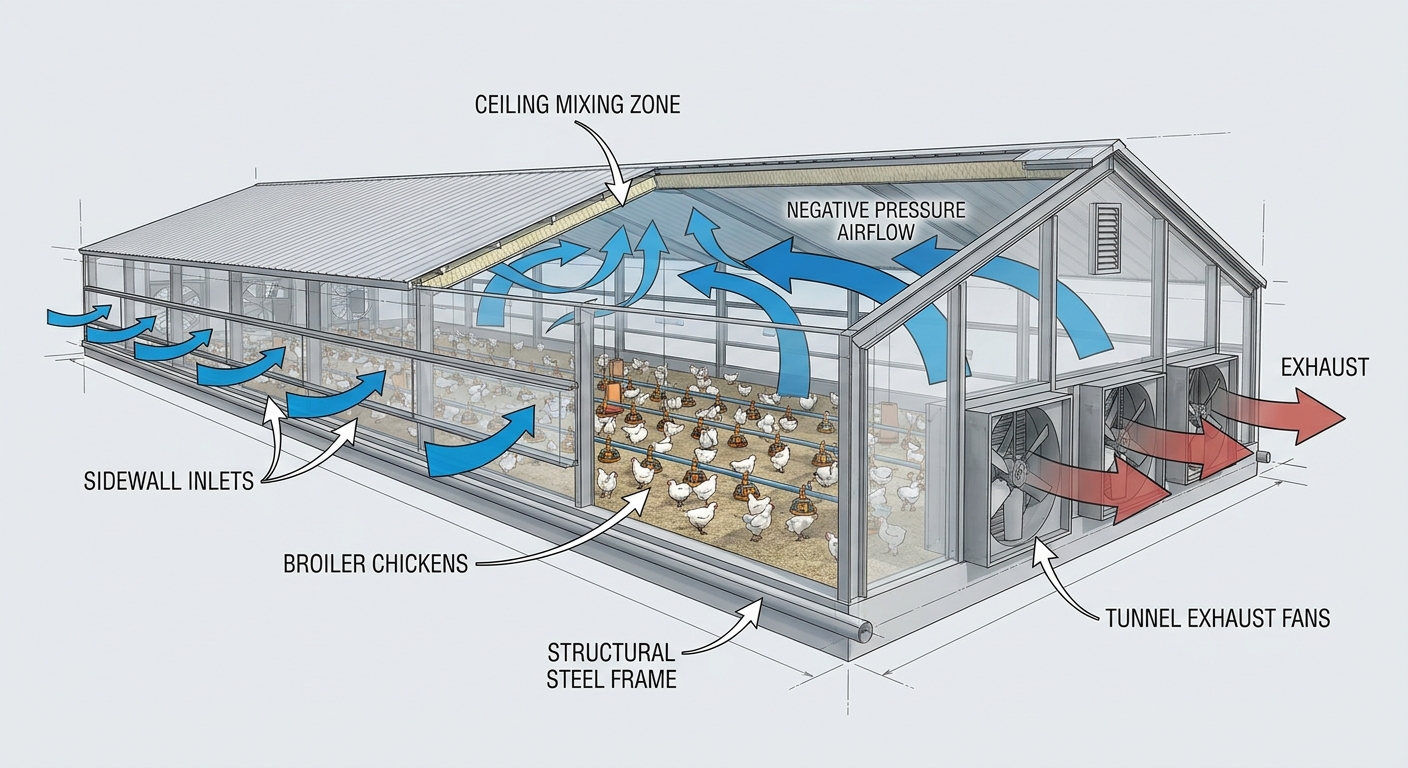
Airflow cools a broiler chicken house by pulling fresh air through the building at high speeds, using negative pressure to remove heat and moisture. This high-velocity movement creates a wind-chill effect that lowers the birds’ effective temperature during hot summer weather.
Managing minimum and transitional ventilation stages
You must use different ventilation stages depending on your birds’ age and the outdoor weather. Minimum ventilation uses basic timers to bring in fresh oxygen and remove moisture without chilling young chicks.
Here is the thing:
- Timer-driven fans run during cold weather to keep the house dry.
- Transitional ventilation opens side inlets as the birds grow and produce more heat.
- Directing incoming air toward the ceiling allows it to warm up before touching the birds.
Managing these early stages carefully prevents drafts while keeping ammonia levels low.
Creating cooling wind chill with tunnel ventilation
You need high-velocity tunnel ventilation to keep older, heavier birds cool when summer temperatures soar. This system pulls a large volume of air down the entire length of the house, working like a high-speed wind tunnel.
Think about it.
- Tunnel fans pull air down the house at 500 to 600 feet per minute .
- This fast-moving air creates a wind-chill effect that cools the birds down by up to 10°F.
- Evaporative cooling pads add extra cooling when the air is dry and hot.
Using high-speed tunnel airflow is essential to prevent heat stress and protect your flock during summer.
Key Takeaway: Switching to tunnel ventilation during hot weather creates a cooling wind-chill effect that keeps older birds comfortable.
| Ventilation Phase | Primary Control Trigger | Required Air Speed / Pressure | Main Environmental Benefit | |
|---|---|---|---|---|
| Minimum | 5-minute repeat timer | 0.05 to 0.08 inches wc | Clears moisture and CO2 without drafts | |
| Transitional | Temperature sensors | 0.08 to 0.12 inches wc | Blends fresh air at ceiling level as birds grow | |
| Tunnel | Over-temp override | 500 to 600 feet per minute | Provides direct wind-chill cooling in hot weather |
This ventilation schedule demonstrates how matching airflow to bird age is key to maintaining stable indoor conditions.
B2B Article Summary & Conclusion
Running a highly profitable poultry operation requires treating your building, climate systems, and bird management as one integrated ecosystem. From structural insulation and biosecurity barriers to automated feeding, watering, and ventilation, every detail directly affects your flock’s feed conversion and survival rates. By upgrading to modern steel structures and precise automated systems, you can eliminate cold spots, control wet litter, and protect your birds from heat stress. Contact us today to work with our experienced agricultural engineering team, request custom building designs, or find high-performance equipment to take your farm to the next level of profitability. Let us build a reliable, efficient, and highly profitable future for your poultry business.
Build a Smarter Broiler Chicken House—Request a Quote !
Email:sales@showhoo.com.cn
Phone/WhatsApp: + 86 186 7895 5927
B2B Frequently Asked Questions (FAQ)
Can I use standard sawdust if clean pine shavings are too expensive?
Yes, you can use clean sawdust as an alternative, but it requires much closer management. Sawdust is much finer than pine shavings, which means it absorbs moisture quickly but can pack and cake if ventilation is poor. Fine dust can also cause respiratory issues for young chicks, so we recommend mixing sawdust with coarser bedding whenever possible to maintain litter quality.
What’s the best way to determine when to switch from transitional to tunnel ventilation?
The best approach is to use your automated controller to monitor bird age and temperature. The system should switch to tunnel ventilation when the birds reach 21 to 28 days of age and the indoor temperature rises 4°F to 5°F above the target setpoint. Tunnel ventilation relies on high-velocity wind chill to cool birds, so it should only be used once birds are fully feathered to avoid draft chilling.
How do I know if my broiler chicken house has air leaks?
You can identify air leaks by checking your static pressure gauge while running your exhaust fans with all wall inlets closed. If the pressure reading doesn’t reach 0.15 inches wc , air is leaking in through unsealed gaps in the walls, doors, or ceiling. You can locate these leaks by scanning the perimeter for drafts, light leaks, or by using a theatrical smoke machine inside the sealed house.
Can I build a successful broiler chicken house with a compacted dirt floor instead of concrete?
While compacted soil floors have lower installation costs, concrete floors offer vastly superior performance. Dirt floors hold moisture from the soil and are nearly impossible to sanitize completely, which increases disease carryover between batches. Compacted soil also allows rodents to burrow in and can shift over time, which compromises the house’s structural stability.
What’s the best lighting schedule to reduce early-stage mortality without sacrificing weight gain?
The best approach is a step-down lighting schedule. Provide 23 hours of light at 20 to 30 lux during the first 7 days to help chicks find feed and water. On Day 8, drop the light level to 5 to 10 lux and introduce 4 to 6 hours of continuous darkness. This dark period slows early growth slightly to prevent cardiovascular issues and supports bone strength, leading to lower mortality rates and better feed conversion.