
Choose a workshop manufacturer by testing its engineering control, fabrication evidence, delivery scope, and response to project-specific risk. A contractor sourcing an export workshop can receive three similar prices, yet one quote may omit crane reactions, coating preparation, erection drawings, or destination-code review. Those gaps tend to surface after the deposit, when redesign, rework, and freight changes are harder to negotiate. This guide shows how to choose a steel structure workshop manufacturer through documents and acceptance evidence rather than sales claims.
1. Which project inputs should lead the supplier search?

The search should start with a controlled design basis that lets every bidder price the same building. Record site location, use, dimensions, bay spacing, clear height, crane data, equipment loads, environmental loads, code basis, fire strategy, envelope, openings, utilities, delivery route, and erection boundary. A manufacturer cannot price structural risk accurately when those inputs remain informal.
What belongs in the bid package?
Issue a revision-controlled RFQ with drawings, performance criteria, requested exclusions, and a return schedule for clarifications. For crane-supported work, align the data with a heavy-duty steel workshop design before asking suppliers to size runway beams or frame columns.
- Crane capacity, duty class, wheel loads, hook approach, and surge forces
- Soil report or stated foundation assumptions
- Local wind, snow, seismic, temperature, and durability inputs
- Required design, fabrication, shipment, and erection deliverables
What fails when inputs stay vague?
An omitted crane side thrust can produce undersized bracing or connections; the failure becomes a redesign, steel change, and programme delay. A missing corrosion environment can yield the wrong preparation and coating system, followed by premature breakdown at the destination. The buyer should own the input register, while the engineer of record approves structural criteria and the manufacturer records every assumption.
2. How do you verify engineering responsibility?

Verify engineering responsibility through a signed matrix, not a general promise that design is included. The matrix should allocate code checks, global analysis, connection design, secondary steel, cladding support, foundations, crane interfaces, temporary stability, and local professional review. It should also name the party who closes comments and controls revisions.
Which calculations reveal real capability?
Request a sample calculation index and drawing register from a comparable building, with confidential project data removed. A credible workflow connects analysis reactions to member schedules, connection forces, base plates, bracing, and the workshop production layout that controls openings and equipment interfaces.
- Design basis and load-combination register
- Analysis model review notes and reaction schedule
- Connection calculation schedule
- Design-change and technical-query log
Where does the interface usually break?
If the supplier designs the frame but excludes crane brackets or foundation reactions, neither party may check the full load path. That gap can cause local overstress, anchor changes, or site drilling. Freeze the responsibility matrix before commercial award and require revised reactions whenever geometry or equipment data changes.
3. What proves welding quality before award?

Welding quality is proven by qualified procedures, qualified personnel, inspection planning, traceability, and records tied to each fabrication lot. A certificate alone does not show that the procedure matches the steel grade, thickness, joint, process, position, or governing specification for your workshop.
Which records should the bidder submit?
Ask for a proposed welding dossier: procedure specifications, supporting qualification records, welder qualifications, consumable controls, repair procedure, inspection plan, and sample reports. ISO 3834 concepts can structure welding-quality requirements, while AWS D1.1 may govern qualification and inspection when adopted by the contract.
- WPS, PQR, and welder qualification register
- Material and consumable batch traceability
- Fit-up, visual inspection, and NDT reports
- Weld-repair log with reinspection evidence
How does poor control become a site problem?
Excess heat input or weak sequencing can distort rafters and end plates; distorted assemblies then lose bolt-hole alignment during erection. Uncontrolled repairs can conceal recurring discontinuities and weaken confidence in the inspection lot. The inspection and test plan should identify witness and hold points before welding starts.
4. How should fabrication capacity be tested?

Test capacity by comparing your release schedule with the manufacturer’s loaded production plan, bottleneck machines, subcontracted processes, and inspection resources. Monthly tonnage is too broad because a shop may cut steel quickly yet lack drilling, welding, blasting, painting, or document-control capacity at the required dates.
What should a factory audit examine?
Walk one order from material receipt to dispatch and sample the records created at each step. Compare machine capability with member size, plate thickness, hole accuracy, weld access, coating system, and container limits in your project.
- Material quarantine and identification areas
- Cutting, drilling, fit-up, welding, straightening, and trial assembly
- Inspection-tool calibration and nonconformance control
- Blasting, coating, curing, storage, and packing flow
Which promise needs schedule evidence?
A crowded paint bay can delay dispatch even when welding is on plan, while outsourced galvanizing can add an uncontrolled queue. Ask for a resource-loaded manufacturing schedule, planned release lots, inspection dates, and recovery logic. The commercial schedule should link payment milestones to accepted evidence rather than unverified production percentages.
5. What coating evidence should you request?
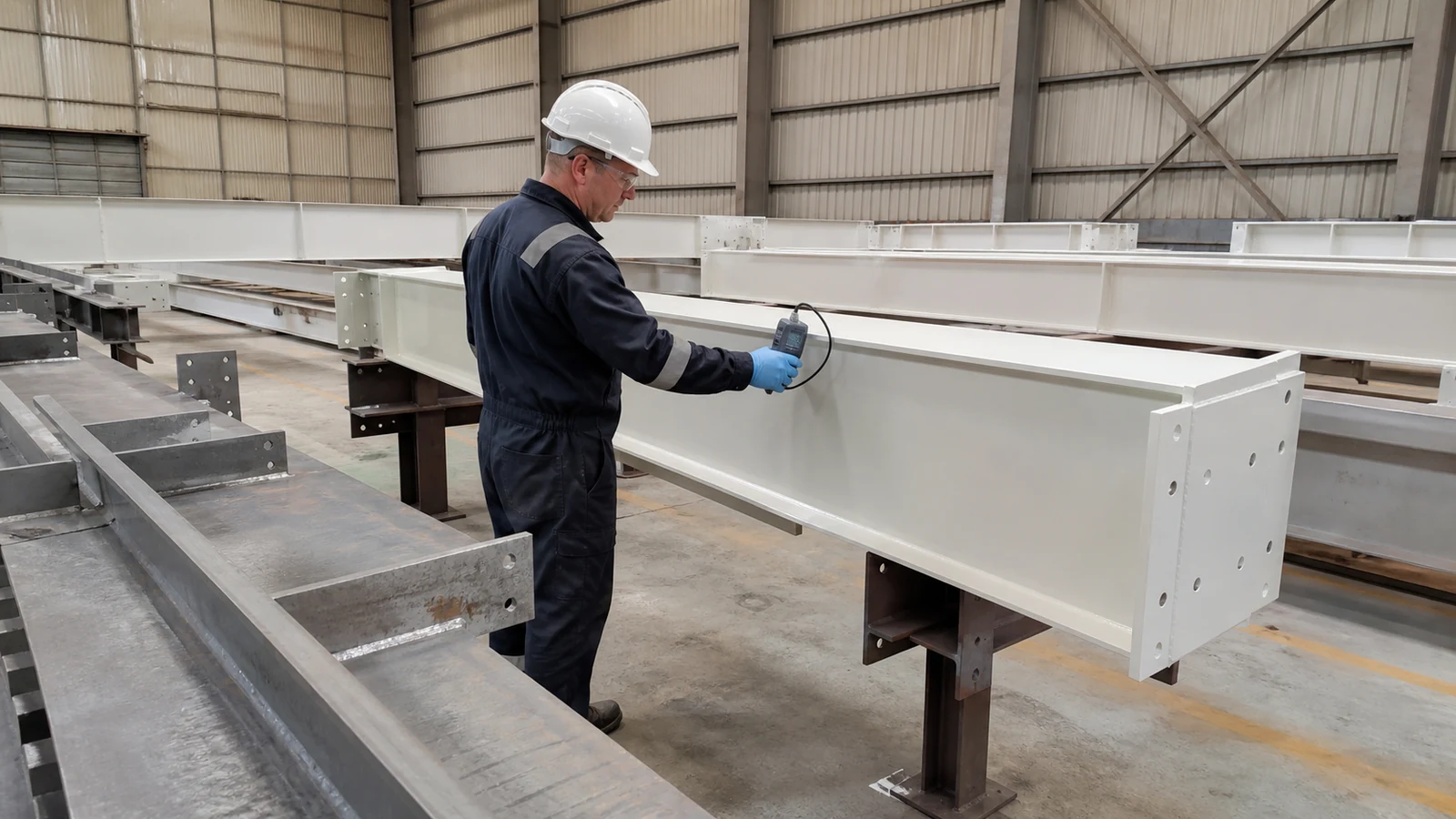
Request a coating specification tied to exposure, target service conditions, substrate preparation, stripe coats, total film build, repair method, and inspection records. Paint brand and color do not establish durability; adhesion depends heavily on surface condition, preparation, environmental control, application, and curing.
Which inspection points affect service life?
The purchaser should require records for abrasive cleanliness or other specified preparation, surface profile, ambient conditions, wet or dry film readings, defects, repairs, and release for packing. A weather-protection plan should also coordinate roof, wall, flashing, and corrosion interfaces.
- Approved coating data sheets and batch records
- Surface-preparation and profile evidence
- Calibrated dry-film thickness readings by member or lot
- Repair map and final visual release
What failure chain matters to an importer?
Residual scale or contamination can reduce adhesion; coating then blisters or flakes after exposure, creating repair cost and access disruption. Packing members before adequate cure can imprint or bond surfaces, causing damage during unpacking. Define inspection lots and packing-release criteria in the purchase order.
6. How do you compare quotations on equal scope?

Compare quotations with a normalized scope sheet that separates design, steel, connections, coatings, cladding, accessories, packing, freight, supervision, erection, taxes, and exclusions. A low total can reflect missing work rather than a more efficient supply chain.
Which commercial clarifications expose gaps?
Ask each bidder to return quantities, steel grades, coating areas, delivery terms, design boundaries, document schedule, inspection allowance, and change-order rates. Reconcile those items against a steel workshop price framework before selecting the commercial baseline.
- Included tonnage and member categories
- Connection hardware, fastener grades, and spares
- Cladding trims, sealants, gutters, and accessories
- Freight basis, container plan, unloading, and erection support
Why can the cheapest quote cost more?
If one price excludes local engineering endorsement or crane brackets, the buyer later procures them without competitive pressure. If the coating scope omits preparation or repair materials, site rectification can interrupt erection. Use a bid-tabulation register that assigns every deviation a cost, schedule effect, and owner.
7. What should the quality plan contain?

The quality plan should turn contract requirements into inspection stages, acceptance criteria, responsible parties, records, and release gates. It should cover incoming material, fabrication, welding, dimensional checks, protective treatment, trial fit where needed, packing, and document handover.
How should traceability work?
Material certificates should connect heat or batch identification to cutting lists, part marks, assemblies, and shipment lots at the level required by the specification. If markings disappear during blasting, an approved transfer method should preserve identity.
- Material receipt and certificate review
- Part-mark transfer and cutting traceability
- Nonconformance, concession, repair, and closeout records
- Calibrated inspection-equipment register
What invalidates acceptance evidence?
An out-of-calibration gauge can make dimensional or coating results unreliable, leaving the buyer unable to defend acceptance. Missing part identification can mix grades or shipment zones, causing erection errors. Include document review in each release gate, not as a paperwork exercise after dispatch.
8. How do logistics and erection affect supplier choice?

Logistics and erection affect member segmentation, splice locations, pack sequence, corrosion protection, lifting points, temporary stability, and document timing. A fabricator that ignores container geometry or site access may create pieces that are costly to transport or unsafe to handle.
Which documents should travel before the steel?
The site team needs erection drawings, bolt schedules, pack lists, lifting data, temporary-bracing requirements, survey tolerances, and installation method boundaries before unloading. Part marks should match both drawings and packing records.
- Container or truck loading plan by erection zone
- Pack list with member weights and lifting points
- Erection sequence and temporary-stability notes
- Anchor survey and field-bolt inspection forms
What happens when packing ignores sequence?
If roof bracing sits behind late-zone columns, crews may unload and restack many packs, increasing damage and lost time. Weak dunnage can allow movement that chips coatings or bends light members. Review a sample load plan and require photo evidence at container closure.
9. Which contract controls reduce buyer risk?

Contract controls reduce risk when payments, approvals, deviations, changes, inspections, and shipment release are tied to named evidence. The purchase order should define document precedence, governing language, acceptance rights, warranties, spare materials, and responsibility for rejected work.
Who provides which evidence?
Use a responsibility matrix so the team can see who prepares, reviews, approves, witnesses, and retains each record.
| Decision or record | Buyer | Engineer | Manufacturer | Inspector or erector |
|---|---|---|---|---|
| Design basis | Provides use and site data | Approves criteria | Records assumptions | Reviews buildability |
| Shop drawings | Reviews interfaces | Approves structural content | Prepares and revises | Uses controlled issue |
| Welding dossier | Sets contract scope | Confirms code basis | Produces records | Witnesses stated points |
| Shipment release | Confirms commercial gate | Closes design comments | Compiles dossier | Verifies physical status |
Which late changes cause the most harm?
A crane change after material purchase can alter columns, brackets, bracing, foundations, and shipment sequence. A door-size change after shop drawing approval can affect frame stiffness and cladding support. Require written change notices that state technical effect, price, programme, superseded documents, and approval status before work resumes.
10. How should you issue a defensible workshop RFQ?

Issue a defensible RFQ by combining a frozen input register, responsibility matrix, deliverable schedule, inspection plan, commercial scope sheet, and bid-return format. This package gives qualified manufacturers a fair basis and makes deviations visible before award.
What does an illustrative review look like?
Illustrative scenario: An overseas contractor is buying a crane workshop for containerized delivery. During bid review, one supplier identifies that the crane wheel loads conflict with the assumed column reactions, while another accepts the drawings without a query. The contractor asks both bidders for revised reactions, connection scope, packing zones, welding records, coating evidence, and a resource-loaded schedule; the response quality becomes part of the award decision.
What should you send next?
Send the project location, dimensions, use, crane and equipment data, governing code, geotechnical information, envelope requirements, coating environment, delivery route, and target programme. To obtain a document-based technical review, submit your project specifications with the RFQ register attached. Strong workshop procurement turns promises into traceable decisions before steel reaches the site.
Send Your Workshop Specs for a Technical Review !
Email:sales@showhoo.com.cn
Phone/WhatsApp:+86 186 7895 5927
Frequently Asked Questions
Can I compare manufacturers before drawings are complete?
Yes, with limits. Compare engineering method, quality controls, document samples, and stated assumptions, then request a revised commercial offer after the design basis is stable.
What’s the best proof of welding control?
A connected dossier is stronger than one certificate. Review applicable procedures, qualifications, traceability, inspection stages, calibrated tools, repair records, and sample reports.
How do I know if production capacity is credible?
Check a resource-loaded schedule against active orders, machine bottlenecks, coating space, inspection staffing, subcontracted work, and dispatch dates.
Can I rely on a manufacturer certificate alone?
No. Verify scope, issuer, validity, project applicability, and the records showing that certified controls are used on your order.
What’s the best way to compare two prices?
Use a normalized scope matrix. Price every exclusion and deviation, then compare accepted deliverables, schedule risk, quality evidence, freight basis, and field support.