
The best size for an indoor riding arena is typically 80’ x 200’ for professional use, though a minimum of 60’ x 120’ is standard for personal training. Training your horse outdoors often feels like a gamble where rain, wind, and poor footing can ruin your schedule. You likely feel the frustration of a cramped space where every turn feels tight and safety is a constant concern. Designing a professional horse arena size facility provides the ultimate solution for year-round performance and horse safety.
What factors influence your horse arena size?
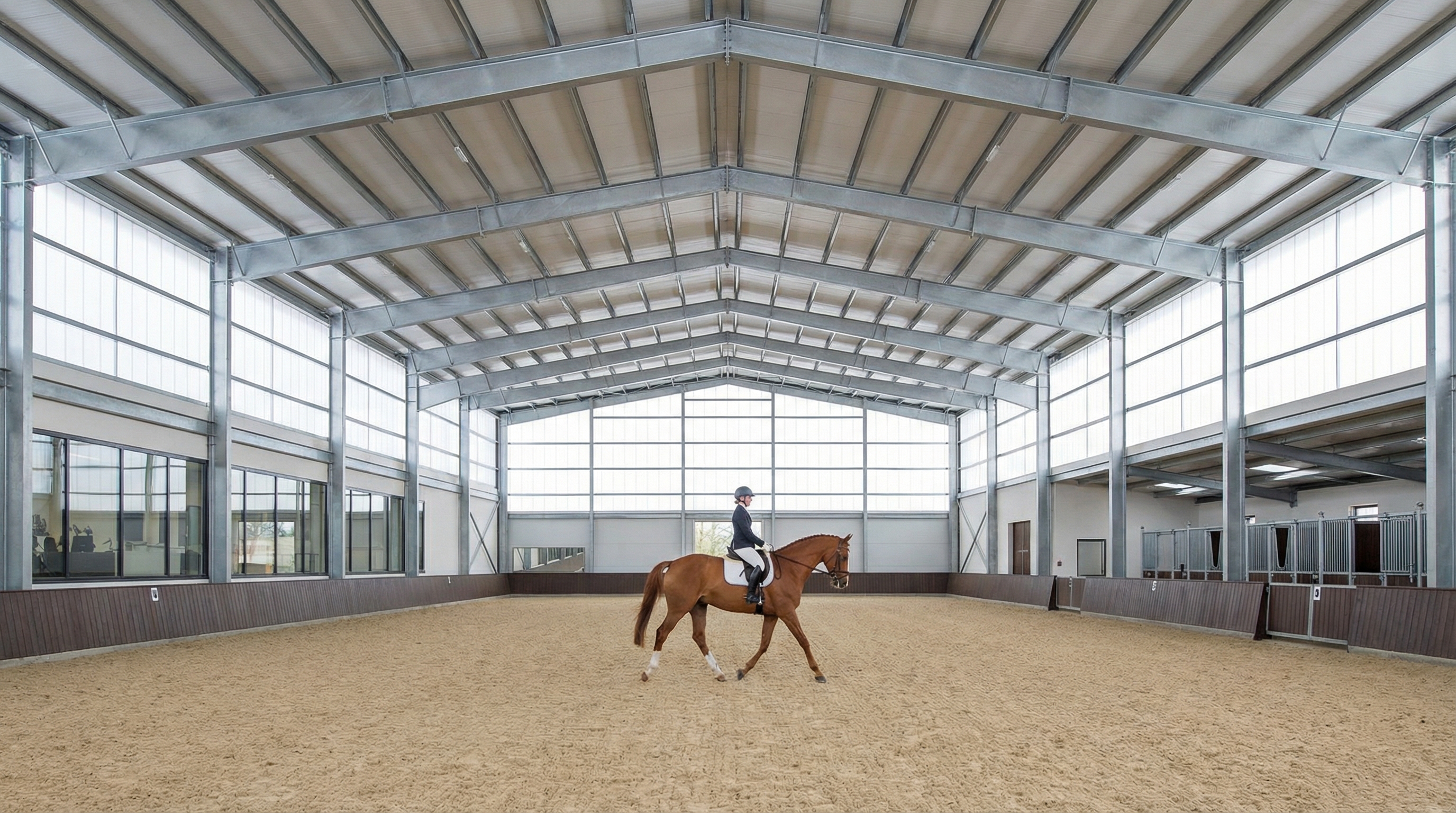
Your primary riding discipline, horse count, and budget are the leading factors that dictate your footprint. Determining the right horse arena size requires a deep understanding of your horse’s turning radius and stride length. You must also consider the height required for your specific style of riding. Balancing these needs with your available acreage ensures a functional layout.
Discipline-Specific Needs
Every equestrian activity demands a specific spatial volume to ensure safety and flow. While a pleasure horse might manage in a smaller ring, a competition horse needs ample room for extended gaits.
Site and Financial Planning
Think about it: The bigger the building, the more you will spend on high-quality footing and site preparation. You should evaluate your long-term goals before committing to a final dimension.
- Local setback requirements.
- Drainage system capacity.
- Future expansion goals.
Key Takeaway: Planning requires a balance between your current discipline needs and your long-term property budget.
| Factor | Impact on Size | Consideration | |
|---|---|---|---|
| Discipline | High | Affects width and length | |
| Horse Stride | Medium | Impacts turning safety | |
| Budget | Critical | Limits total square footage |
Choosing a size based on your most demanding discipline prevents expensive retrofitting in the future.
What is the minimum indoor horse arena size?
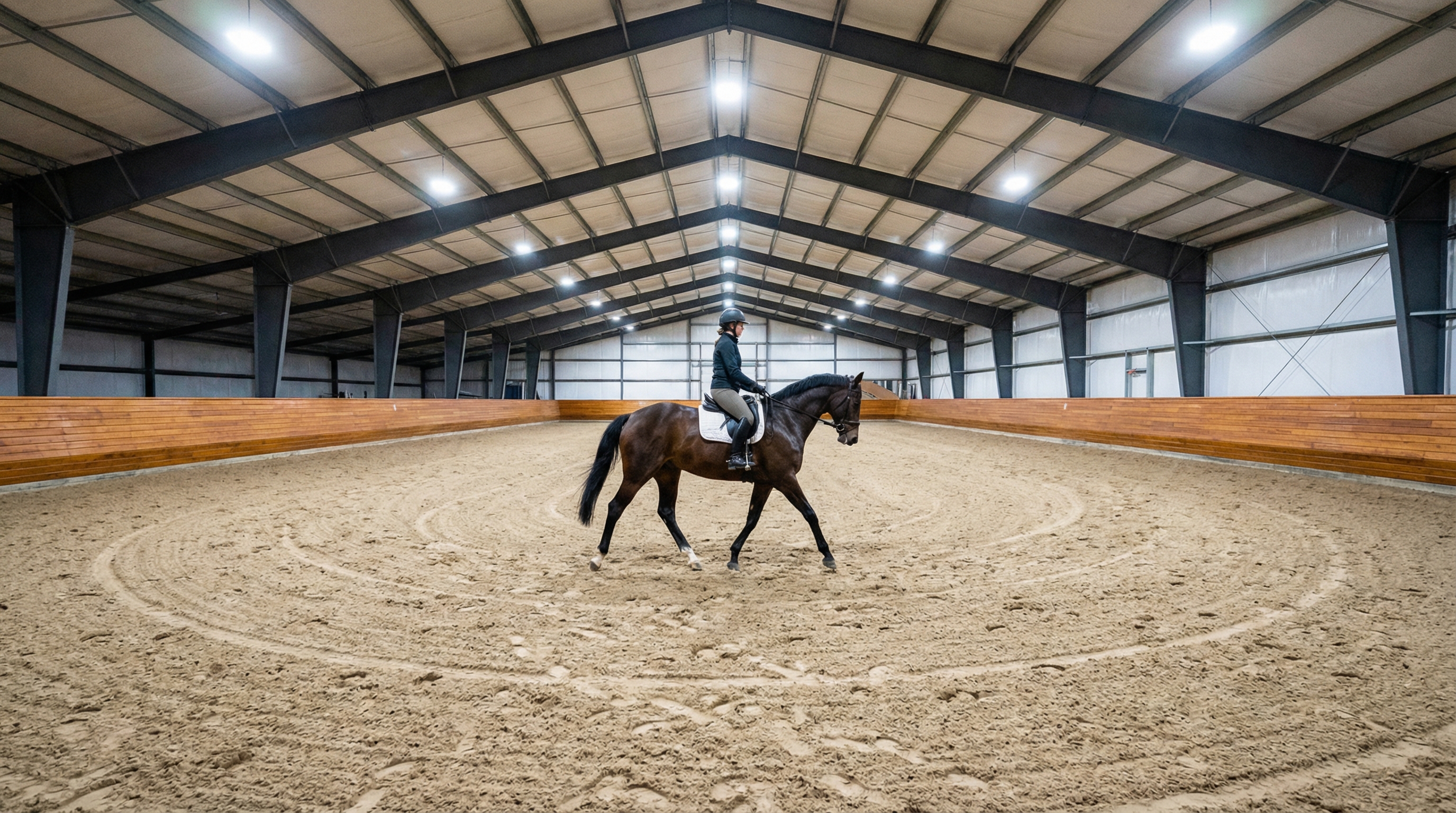
For a standard horse, the minimum width is 60 feet to ensure safe 20-meter circles. Choosing a smaller horse arena size can lead to physical strain on your horse’s joints due to excessively tight turns. This 60-foot standard is widely considered the baseline for any functional indoor facility. It provides just enough clearance for basic flatwork and exercise.
The 60′ Width Standard
This width is the “magic number” because it accommodates the most common training circles without the horse hitting the walls. If you go narrower, you risk the horse losing balance and confidence during training sessions.
Safety and Maneuverability
But here is the kicker: A minimum size works for one horse, but it becomes dangerously crowded if you add a second rider. You must account for the space taken up by a rider guard and mounting blocks.
- 20-meter circle diameter.
- Rider guard thickness.
- Safe passing distance.
Key Takeaway: A 60-foot width is the absolute minimum required to maintain the physical health of a working horse.
| Arena Type | Dimensions | Best For | |
|---|---|---|---|
| Minimum | 60′ x 120′ | Single horse flatwork | |
| Standard | 70′ x 140′ | Training and small jumps | |
| Small Pro | 80′ x 150′ | Multiple riders |
Minimum dimensions are best suited for private owners with limited land who prioritize basic exercise.
How does horse arena size vary by discipline?
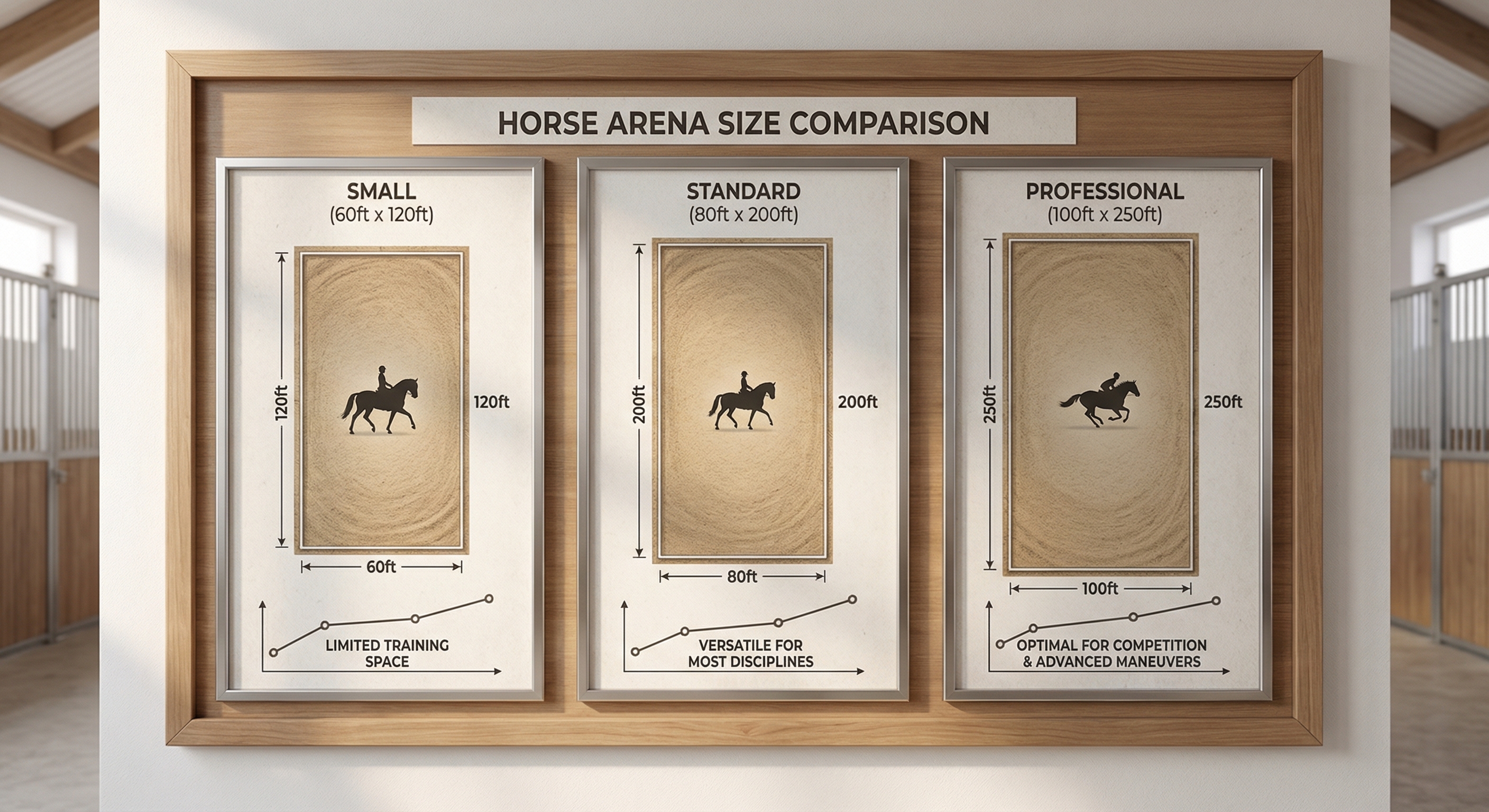
Dressage usually requires a 20m x 60m area, whereas jumping needs more width and length for technical courses. When selecting a horse arena size , you must align the dimensions with the specific patterns your discipline requires. Western riding often needs longer straightaways for maneuvers like sliding stops. English disciplines may focus more on the precision of circles and lateral movements.
Training for Western vs English
Western reining often demands a length of at least 150 to 200 feet to allow for full speed. In contrast, English hunters and jumpers require width to navigate complex lines of fences safely.
Professional Layouts
Look at the numbers: Professional facilities often exceed standard dimensions to accommodate multiple riders and specialized equipment. You should think about how your specific sport’s governing body defines a “standard” ring.
- Reining sliding stops.
- Hunter/Jumper lines.
- Dressage lateral work.
Key Takeaway: Your discipline’s competitive standards should be the primary guide for your building’s footprint.
| Discipline | Ideal Width | Ideal Length | Purpose | |
|---|---|---|---|---|
| Dressage | 66′ | 197′ | Competition standard | |
| Jumping | 80′ | 200′ | Safe course flow | |
| Reining | 100′ | 250′ | Sliding stop distance |
Matching your arena size to your discipline ensures that your training translates directly to the show ring.
What horse arena size works for jumping?
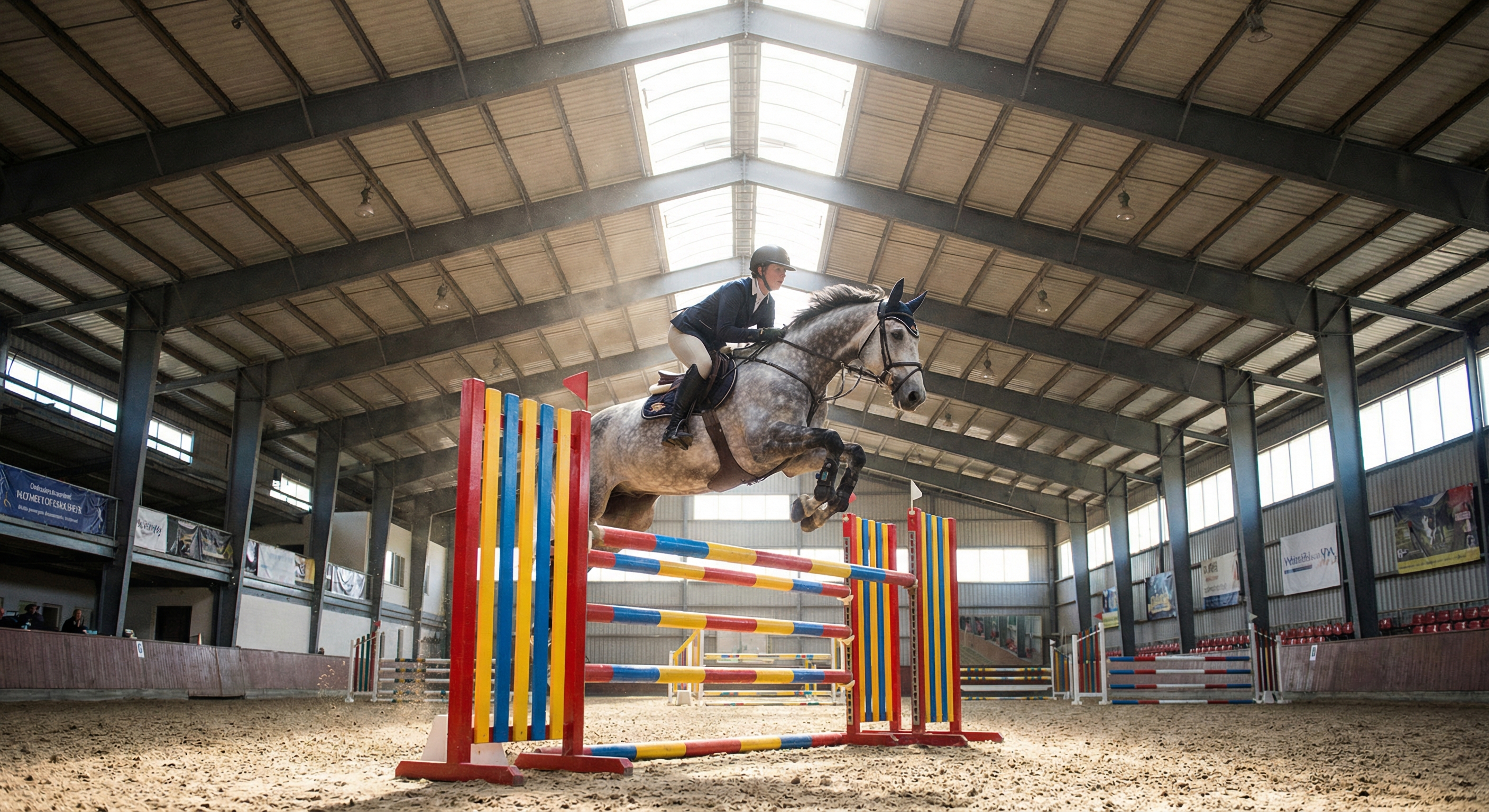
A jumping arena should ideally be at least 80’ x 200’ to allow for safe distances between fences. Vertical horse arena size is just as critical as floor space when you are clearing high obstacles. You need a minimum of 18 feet of interior height to prevent horses from feeling trapped or hitting the ceiling. Professional jumpers often prefer 20 feet or more for maximum safety during peak flight.
Vertical Clearance Requirements
When a horse jumps, the combined height of the animal and rider can reach significant levels. Low trusses create a psychological barrier that can make a horse hesitate or “shut down” during training.
Safety for Mounted Riders
You might be wondering: Why is 200 feet the standard length for jumping facilities? It is because you need room for a minimum of three strides between fences and space for safe turns at the end.
- Peak jump height.
- Landing zone length.
- Truss clearance safety.
Key Takeaway: Jumping requires both horizontal length and significant vertical clearance to protect horse and rider.
| Component | Standard Height | Jumping Height | Reason | |
|---|---|---|---|---|
| Ceiling | 16′ | 20′ | Peak flight safety | |
| Door Header | 14′ | 16′ | Mounted clearance | |
| Walls | 4′ | 4′ – 5′ | Rider guard height |
Ample vertical space is the defining characteristic of a high-quality steel horse arenas jumping facility.
Is a dressage horse arena size different?
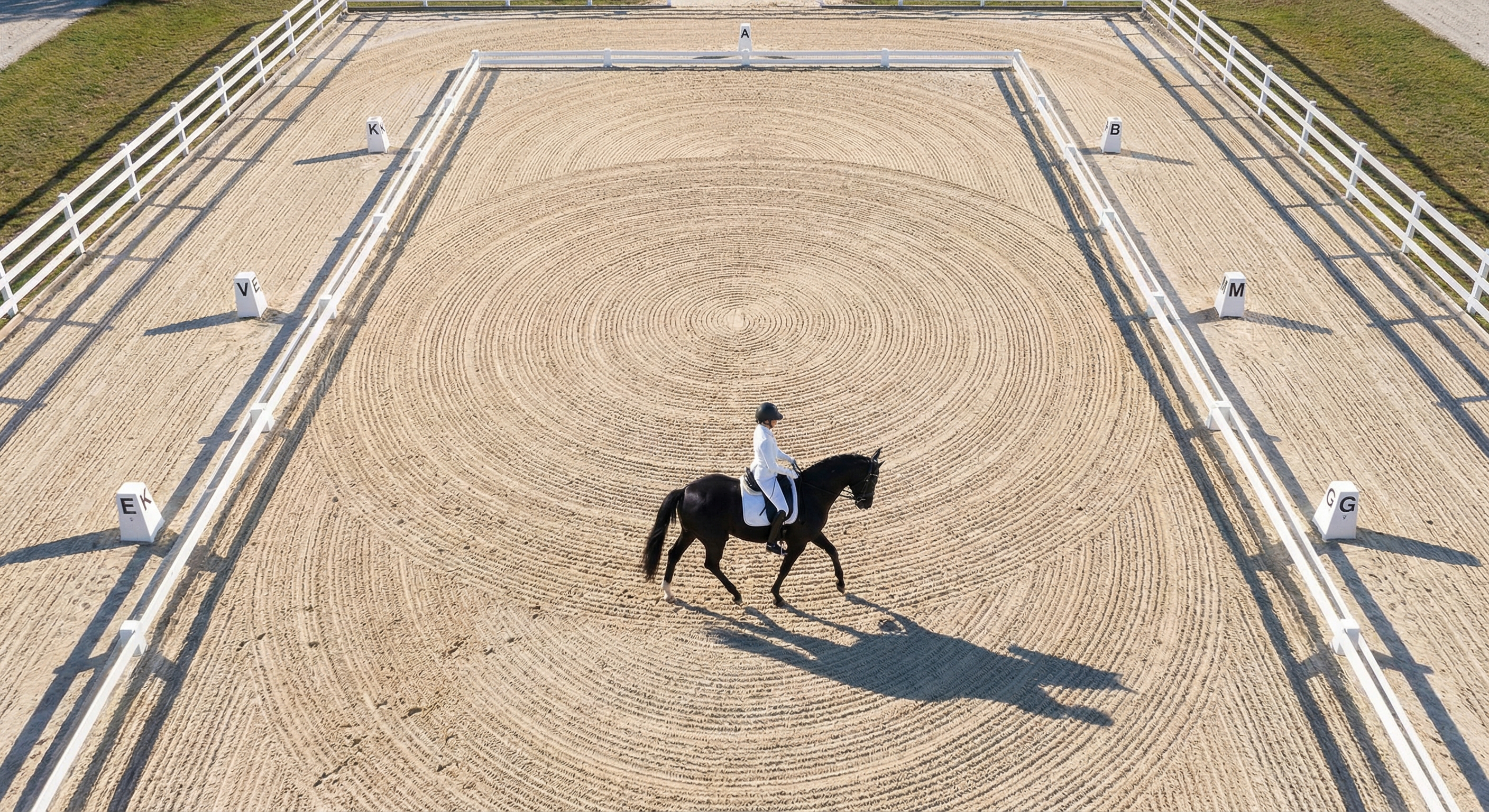
Yes, dressage utilizes precise international measurements, typically 20m x 40m or 20m x 60m. Choosing an exact horse arena size is mandatory if you plan to train for recognized competitions. A small arena (20m x 40m) is perfect for lower-level tests and young horse training. For Grand Prix movements, you absolutely need the full 20m x 60m professional layout.
Standard 20m x 40m Dimensions
This layout is favored for its efficiency in smaller horse barn designs. It allows you to practice basic lateral work and collection without the maintenance cost of a larger ring.
Professional 20m x 60m Layouts
That’s not all: The 60-meter length is vital for practicing the diagonal lines and extended movements required at higher levels. If you build too small, you won’t be able to fit the standard dressage letters properly.
- Arena letter spacing.
- Mirror placement.
- Judging box area.
Key Takeaway: Precision is the hallmark of dressage, requiring dimensions that match international competition standards.
| Arena Class | Metric Size | Imperial Size | Use Case | |
|---|---|---|---|---|
| Small | 20m x 40m | 66′ x 132′ | Basic Training | |
| Large | 20m x 60m | 66′ x 197′ | Competition | |
| Oversized | 80′ x 200′ | 80′ x 200′ | Warm-up area |
Standardizing your dressage arena size ensures that your horse learns the correct spatial cues for competition success.
How to pick horse arena size for multiple riders?
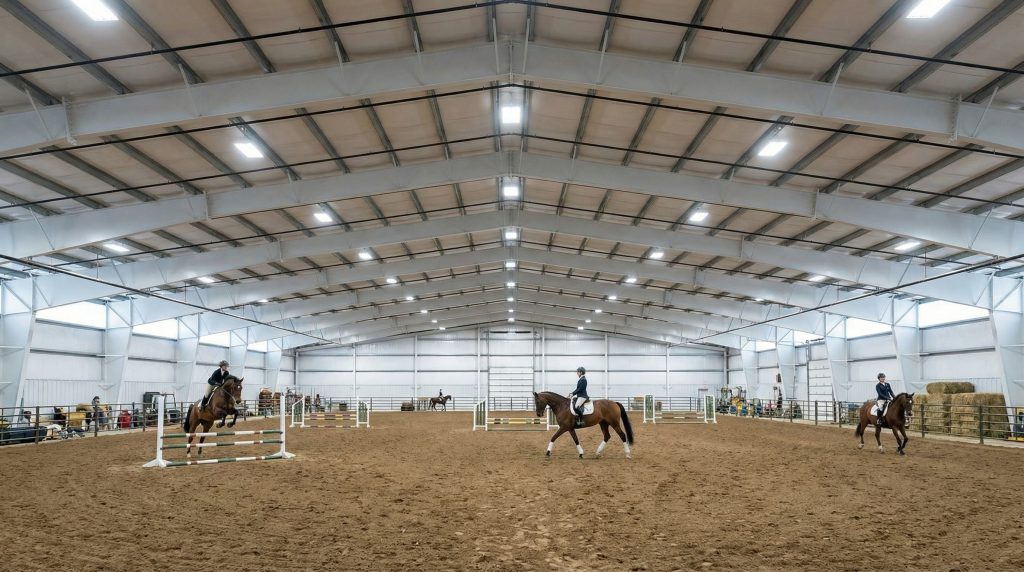
Facilities hosting group lessons should aim for a width of at least 80 feet. A standard horse arena size of 60 feet quickly becomes dangerous when multiple horses are trotting or cantering in different directions. You need the extra 20 feet of width to allow for safe passing lanes without interfering with maneuvers. This is especially true for boarding stables where different disciplines might share the ring.
Managing High Traffic
When you have more than two horses in the ring, the “straight-away” space disappears quickly. An 80-foot width provides the safety margin needed to avoid collisions and rider frustration.
Safety Distances
The reality is: Crowded arenas lead to spooking and accidents that can be avoided with proper planning. You should design for your peak usage hours rather than your average daily traffic.
- Safe passing width.
- Viewing gallery space.
- Mounting block safety.
Key Takeaway: Multi-rider facilities must prioritize width to create a safe, low-stress training environment.
| Rider Count | Min Width | Min Length | Safety Level | |
|---|---|---|---|---|
| 1 Rider | 60′ | 120′ | High | |
| 2-3 Riders | 70′ | 150′ | Moderate | |
| 4+ Riders | 80′ | 200′ | High |
Designing for peak capacity ensures that your facility remains a safe and professional environment for all clients.
Does horse arena size affect door dimensions?
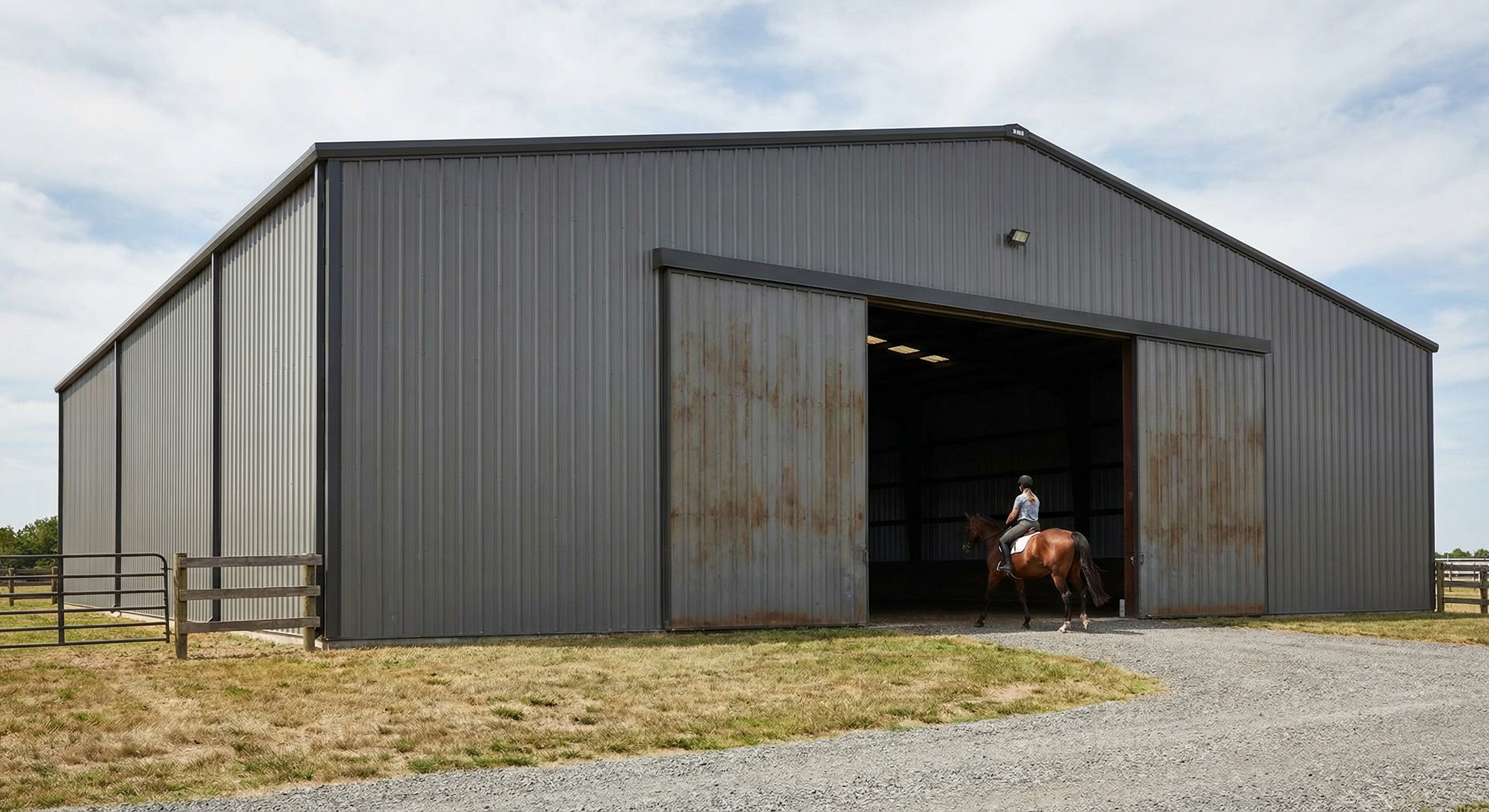
Large arenas require oversized doors, typically 16’ wide by 15’ high, for equipment and safety. As your horse arena size increases, so does the scale of the machinery needed to maintain it. You must ensure your doors are tall enough for a mounted rider to enter without bowing their head. Narrow doors create a bottleneck and a safety hazard for horses that might spook while entering.
Equipment Access Needs
A professional arena requires a tractor and footing drag to keep the surface level. If your doors are too small, you will find it impossible to perform the necessary maintenance to protect your horse’s legs.
Mounted Rider Safety
Better yet: Installing large sliding doors provides excellent ventilation and allows for a “flush” transition between your indoor and outdoor spaces. This prevents the horse from being startled by tight openings.
- 16′ wide openings.
- 15′ high headers.
- Sliding door tracks.
Key Takeaway: Your door dimensions must scale with your arena’s size to facilitate maintenance and ensure rider safety.
| Door Type | Width | Height | Best Use | |
|---|---|---|---|---|
| Standard | 12′ | 12′ | Small equipment | |
| Equestrian | 16′ | 15′ | Mounted riders | |
| Professional | 20′ | 16′ | Large machinery |
Large, well-placed entrances enhance the overall functionality and safety of your equestrian structure.
Can steel structures optimize horse arena size?
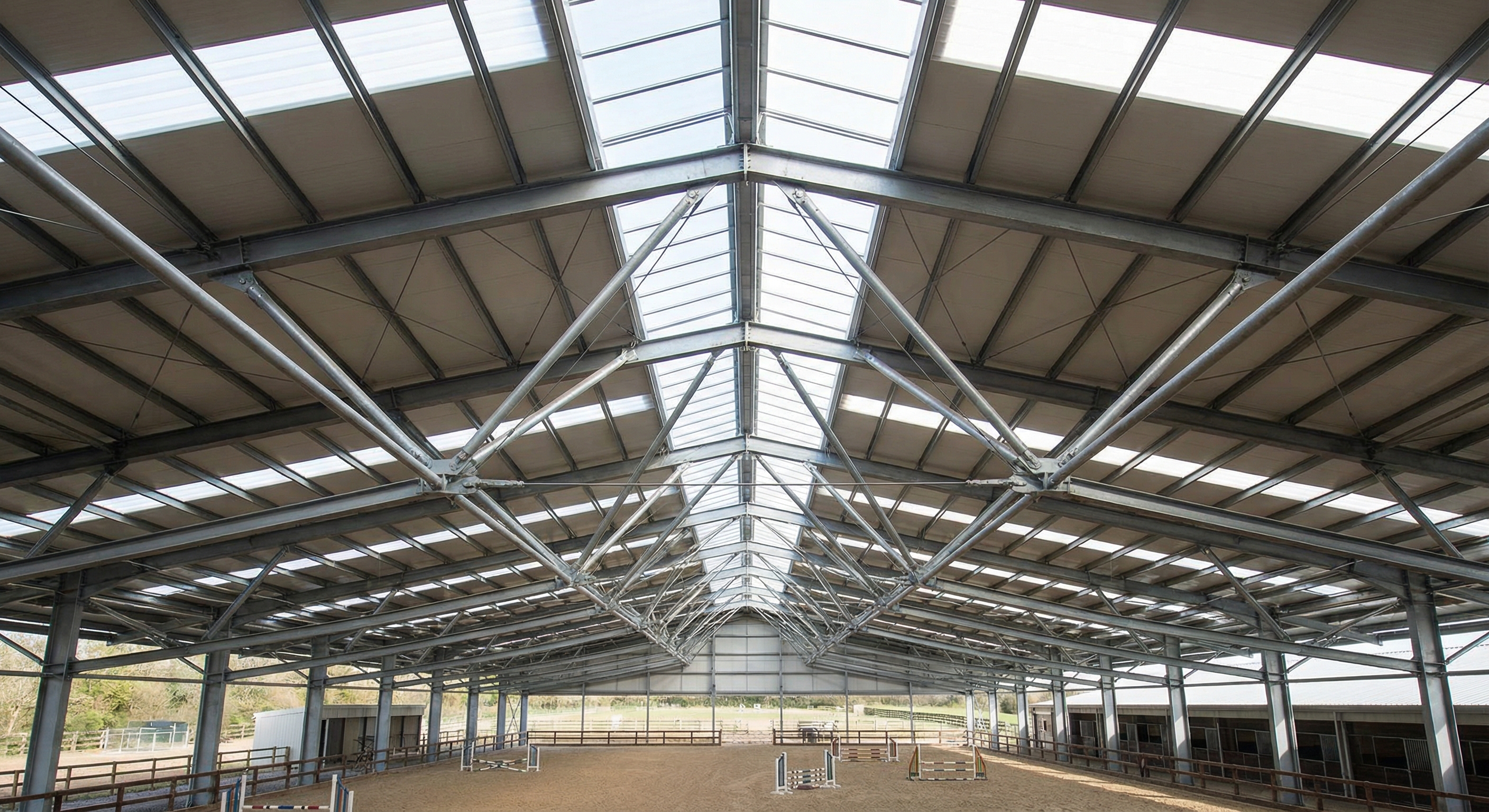
Steel is the superior choice because its clear-span design eliminates internal columns. When planning your horse arena size, you want an unobstructed floor where you can ride anywhere without hitting a post. Steel frames can span over 200 feet without needing any middle supports. This maximizes every square foot of your investment for training and performance.
Clear-Span Engineering
Traditional wood structures often require support poles for wide spans, which are a major collision risk. Steel allows for a completely open interior that feels airy and professional.
Long-term Durability
Here’s why it matters: Steel structures offer high fire resistance and are impervious to termites, protecting your horses for decades. You will also spend much less on long-term maintenance compared to wood or fabric.
- Column-free interior.
- 50+ year lifespan.
- High wind/snow load.
Key Takeaway: Clear-span steel is the only way to achieve a professional, obstruction-free riding environment at scale.
| Material | Max Span | Durability | Safety | |
|---|---|---|---|---|
| Steel | 200’+ | Very High | Excellent | |
| Wood | <90′ | Moderate | Good | |
| Fabric | 150′ | Low | Moderate |
Steel engineering provides the structural integrity needed to support the massive widths required for equestrian sports.
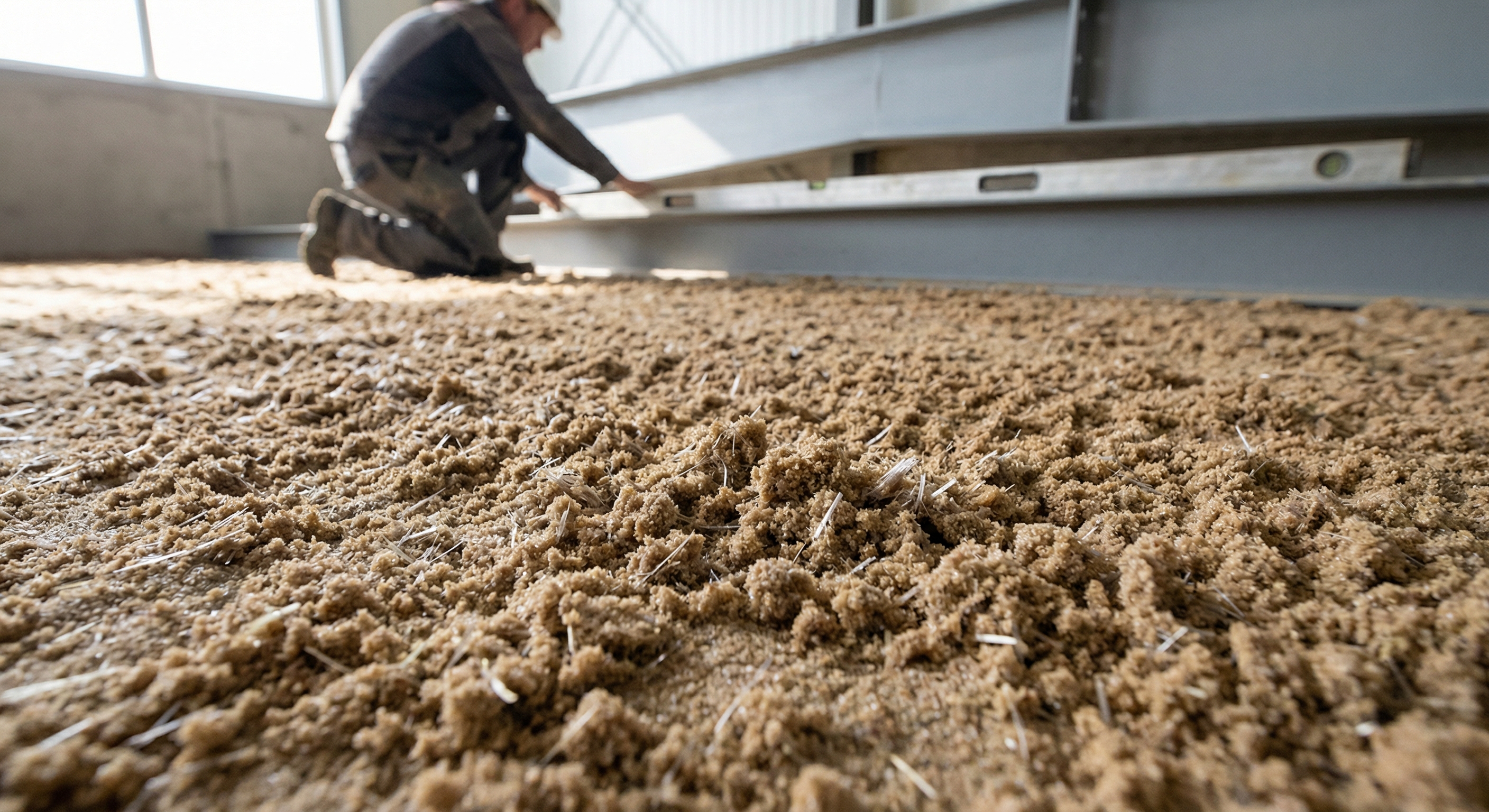
Footing materials and specialized lighting are the primary hidden costs of larger footprints. When you increase your horse arena size , you are adding significant volume to the base and topsoil layers. High-performance footing, such as silica sand and fiber, can cost several dollars per square foot. You must also account for the increased number of LED fixtures needed to eliminate shadows.
Footing and Drainage
A larger arena surface collects more water runoff from the roof, requiring a more complex drainage system. If you ignore this, you will end up with a muddy, unusable facility that damages your horses’ hooves.
Electrical and Land Demands
Think about this: Every extra foot of width increases the cost of your lighting and electrical installation. You should also consider the cost of leveling a larger area of land during the site prep phase.
- Silica sand volume.
- LED light count.
- Excavation grading.
Key Takeaway: The “sticker price” of the building is only part of the investment; footing and lighting scale with size.
| Expense Category | Scale Factor | Cost Driver | |
|---|---|---|---|
| Footing | Area ($/sq ft) | Material quality | |
| Lighting | Area (Wattage) | Fixture count | |
| Site Prep | Volume (Cubic yards) | Grading time |
Budgeting for high-quality footing ensures that your large arena size actually provides a safe riding surface.
How to plan for future horse arena size growth?
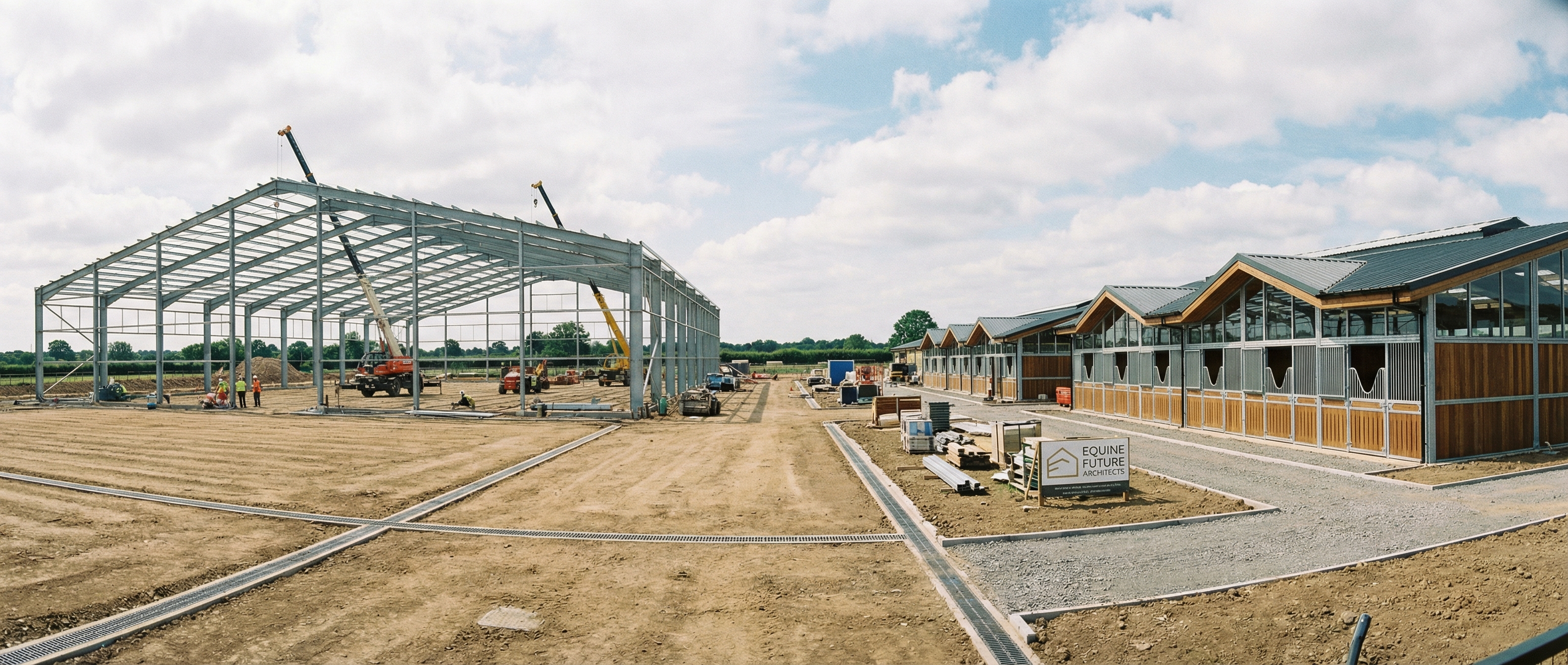
You should engineer your initial prefabricated-buildings frame to allow for easy end-wall expansion. If your budget only allows for a 120-foot length today, you can design the steel structure to be extended by another 80 feet later. This strategy allows you to start training immediately while keeping your long-term horse arena size goals achievable. You must ensure the site is graded for the full final footprint from day one.
Designing for Expansion
End-walls can be built as “removable” components that allow for seamless attachment of new bays. This prevents you from having to tear down your original structure when you are ready to grow.
Site Preparation
The point is: It is much cheaper to move dirt once during the initial build than to bring heavy machinery back later. You should also pre-run your utilities to the far end of the property.
- Removable end-walls.
- Utility extensions.
- Full-site grading.
Key Takeaway: Future-proofing your design today saves thousands in construction costs when your business expands.
| Expansion Type | Difficulty | Cost | Requirement | |
|---|---|---|---|---|
| Length Ext. | Low | Moderate | End-wall prep | |
| Width Ext. | High | Very High | New roofline | |
| Height Ext. | Impossible | Extreme | Full rebuild |
Planning for growth ensures that your facility remains a valuable asset as your equestrian goals evolve.
Selecting the ideal dimensions for your equestrian facility is a critical step in ensuring the safety and performance of your horses. We solve the problem of cramped, unsafe riding environments by providing engineered steel solutions tailored to your specific discipline. We do more than just build shells; we design professional-grade facilities that stand the test of time. Our vision is to empower every rider with a safe, clear-span environment that makes year-round training a reality. To start your journey toward a world-class facility, contact us today for a professional consultation.
Frequently Asked Questions
What’s the best size for a private training arena?Judgement suggests that 70’ x 140’ is the most versatile size for a private owner who needs room for both flatwork and small jumps. This footprint provides enough room for standard maneuvers while keeping footing maintenance costs manageable.
Can I build a 40-foot wide arena for a large horse?No, you should avoid widths under 60 feet as they force the horse into a turning radius that can cause long-term lameness and joint strain. A 40-foot width is only suitable for small ponies or limited lunging work.
How do I know if I need a professional 80-foot width?Judgment indicates that if you plan to host more than two riders at once or train for high-level jumping, the 80-foot width is necessary for safety. This extra space allows for passing lanes and the wider turns required at higher speeds.
What’s the best height for an indoor arena?A minimum height of 16 feet is required for most flatwork, but you should aim for 18 to 20 feet if your facility will be used for jumping or high-level reining. Higher ceilings improve ventilation and the psychological comfort of the horse.
Can I extend my arena length in the future?Yes, but you must ensure that your initial steel frame is engineered with a removable end-wall and that your site prep accounts for the additional footprint. Planning for this during the first phase of construction will save you significant time and money.