
Managing healthcare facility construction is an administrative nightmare, as traditional methods cause delays, massive budget overruns, and severe operational bottlenecks that compromise patient care. You face the constant pressure of rising development costs and rigid floor plans that cannot adapt to evolving medical technologies, leaving your investment at risk of early obsolescence. By leveraging modern structural steel, you can build high-performance hospital buildings that assemble 30% faster, reduce lifetime maintenance costs, and provide the open-span flexibility needed for future medical advancements.
Why are hospital buildings so highly complex?
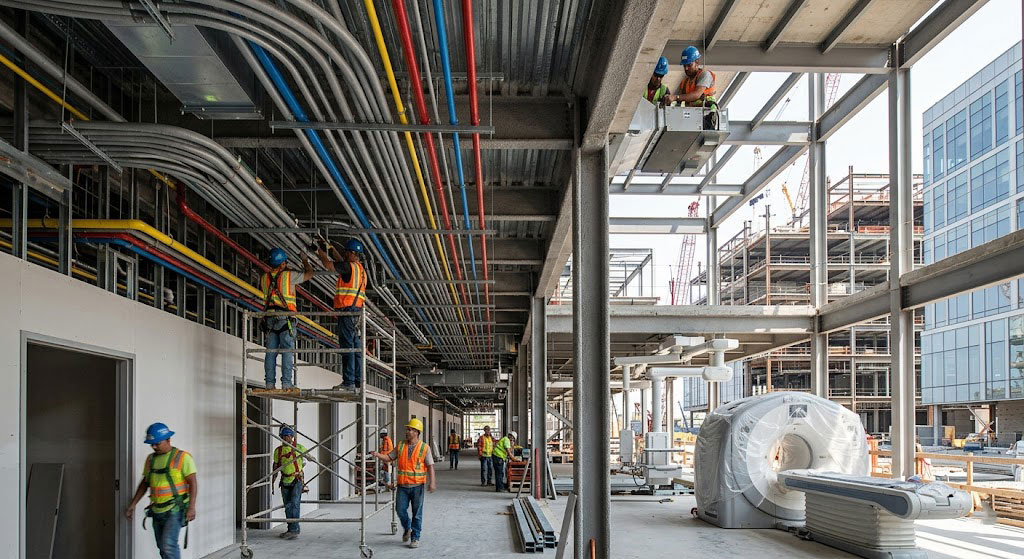
Hospital buildings are highly complex because they must integrate diverse clinical services, complex mechanical, electrical, and plumbing (MEP) pathways, and strict infection control standards within a single footprint. Building these high-demand hospital buildings requires a deep understanding of functional zoning to prevent clinical work from interfering with administrative operations. By utilizing prefabricated steel framing, you can accommodate heavy medical equipment while ensuring structural stability.
How do clinical and hospitality zones coexist?
Let’s break it down: healthcare facilities must seamlessly combine sterile, high-performance surgical environments with comfortable, hospitality-grade patient recovery suites. To achieve this balance, your design team must divide the facility into distinct, isolated zones that prevent cross-contamination.
- Surgical Suites: Require high positive pressure, ceiling-suspended medical booms, and heavy structural reinforcement.
- Inpatient Wards: Focus on acoustics, natural light, and comfortable room layouts to support patient healing.
- Imaging and Diagnostic Areas: Demand heavy-duty radiation shielding, vibration isolation, and high electrical loads.
What makes healthcare MEP engineering so challenging?
Think about it. A modern hospital requires complex mechanical, electrical, and plumbing systems to maintain safe indoor air quality and constant power redundancy. These massive duct networks and backup power systems must remain easily accessible for maintenance crews without ever disturbing sterile patient environments.
- Heavy HVAC Ventilation: High air change rates (ACH) require deep ceiling cavities to route large ductwork.
- Medical Gas Pipelines: Oxygen, vacuum, and nitrous oxide lines must run seamlessly through structural partitions.
- Electrical Redundancy: Dual power feeds and emergency generator systems must have dedicated, fire-protected vertical risers.
Key Takeaway: Integrating clinical zones and heavy MEP systems requires a versatile structural framework that accommodates high utility loads and provides deep ceiling plenum space.
| Evaluation Metric | Prefabricated Steel | Traditional Concrete | Wood Framing | |
|---|---|---|---|---|
| Spatial Adaptability | Excellent | Moderate | Poor | |
| MEP Routing Ease | High (Open Web Trusses) | Low (Solid Slabs) | Moderate | |
| Structural Load Support | High | High | Low |
By choosing an open structural steel layout, you can eliminate bulky load-bearing interior concrete walls and easily route complex mechanical ducts throughout the building.
Which codes govern modern hospital buildings?

Modern hospital buildings are governed by a complex matrix of local general building codes, Facility Guidelines Institute (FGI) standards, federal energy mandates, and high-consequence structural safety regulations. Navigating these overlapping layers of regulation is critical during the early planning stages of your project. If your hospital buildings do not meet these strict safety and efficiency standards, you risk failing local building inspections and delaying operational licensing.
Why do FGI guidelines control clinical spacing?
Here is why this matters: the Facility Guidelines Institute (FGI) establishes the benchmark for healthcare design, dictating minimum room sizes, corridor widths, and acoustic performance profiles. Your design must match these dimensions to ensure both patient safety and regulatory approval.
- Corridor Widths: Main corridors must be wide enough (typically 8 feet) to allow two patient gurneys to pass.
- Acoustic Performance: Patient rooms must meet specific Sound Transmission Class (STC) ratings to protect privacy.
- Clearances: Surgery and exam rooms require designated operational clearances around tables and clinical equipment.
How do energy mandates impact building envelopes?
But that is not all. Modern public and private facilities must comply with federal efficiency targets, such as the Energy Policy Act of 2005 (EPACT) and other strict sustainable design directives. These regulations demand a high-performance building envelope that reduces thermal bridging and energy consumption.
- Insulation Performance: Demands high R-value insulation in all external walls to lower heating and cooling loads.
- Glazing Standards: Requires double or triple-pane glass to limit solar heat gain.
- Mechanical Efficiency: Mandates energy-recovery ventilators (ERVs) to recapture heat from exhaust air.
Key Takeaway: Compliance with FGI guidelines and federal energy mandates ensures your facility protects patient safety while operating at peak thermal efficiency.
| Regulation Standard | Primary Objective | Impact on Structural Design | Compliance Priority | |
|---|---|---|---|---|
| FGI Guidelines | Patient Safety & Spacing | Dictates minimum room sizes and column grid dimensions | Mandatory | |
| EPACT / EISA | Energy Conservation | Mandates high-efficiency insulated wall panel envelopes | High | |
| IBC Category IV | Disaster Resilience | Requires robust seismic bracing and high-strength steel | Mandatory |
Designing your structural frame to match these stringent codes from the outset prevents expensive retrofits and accelerates your building’s operational approval.
“Boost Your Projects Now – Get a Free Quote Today!”
Email:sales@showhoo.com.cn
Phone/WhatsApp:+86 186 7895 5927
How to balance functions in hospital buildings?
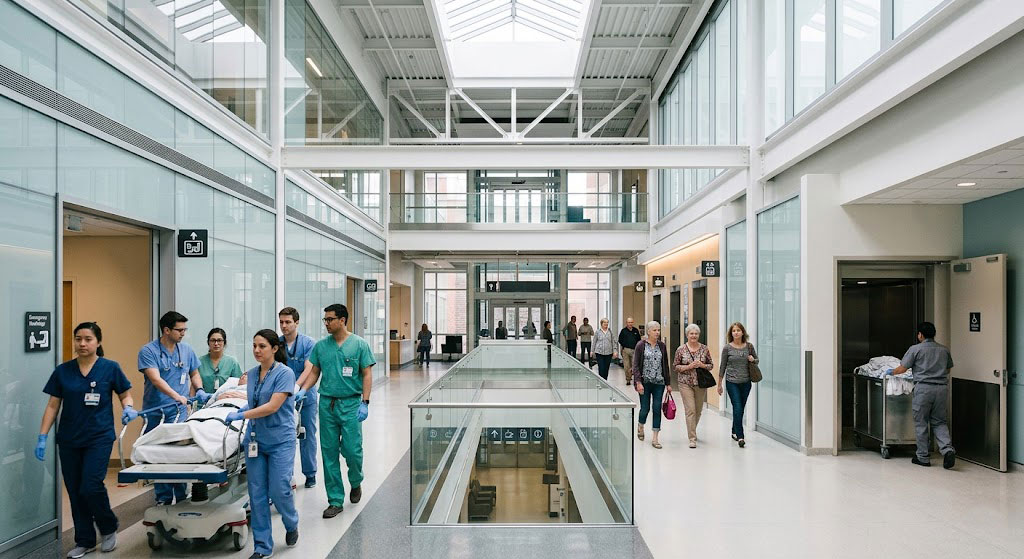
You can balance functions in hospital buildings by designing an integrated layout that strictly separates public, clinical, and utility support workflows. Planning efficient adjacencies ensures that medical staff can move patients quickly while keeping service traffic hidden in the background. Incorporating this zoning in your hospital buildings is easier when you use long-span steel frames that eliminate the need for heavy interior load-bearing walls.
Can zoning improve inpatient and outpatient flows?
Let’s break it down: separating outpatient clinics from emergency and inpatient areas reduces cross-contamination and simplifies wayfinding for visitors. When outpatients can access their destinations directly, they do not interfere with high-stakes clinical workflows.
- Dedicated Entrances: Direct patients and visitors away from ambulance bays and emergency loading docks.
- Vertical Transportation: Separate elevators for public use, patient transport, and service delivery prevent congestion.
- Shared Diagnostics: Place imaging and laboratory units in central locations accessible to both departments.
How do you optimize logistics and service paths?
Think about it. Clean linen, medical supplies, trash, and food services must move constantly throughout the facility without crossing path-of-travel routes used by patients. Creating dedicated service corridors and elevators ensures these background logistics run smoothly and quietly.
- Service Corridors: Must be wide enough to allow supply carts to pass without blocking exit pathways.
- Central Sterile Supply: Requires direct, clean elevator access to surgical suites above.
- Waste Management: Dedicated chutes and secure docks keep hazardous waste away from public eyes.
Key Takeaway: Strategic spatial zoning and dedicated service pathways protect clinical sterile zones while improving overall staff workflow efficiency.
| Flow Category | Primary Route | Key Design Strategy | Spatial Separation | |
|---|---|---|---|---|
| Clinical Flow | Surgery, ICU, Emergency | Centralized, secure corridors with restricted access | Absolute | |
| Public Flow | Atriums, Clinics, Cafeteria | Clear wayfinding and direct access from parking | High | |
| Service Flow | Food, Supply, Waste | Hidden utility corridors and back-of-house docks | Complete |
Using a flexible steel grid allows you to design open hallways and logical pathways that dramatically reduce patient transfer times and staff fatigue.
Are steel hospital buildings more cost-effective?
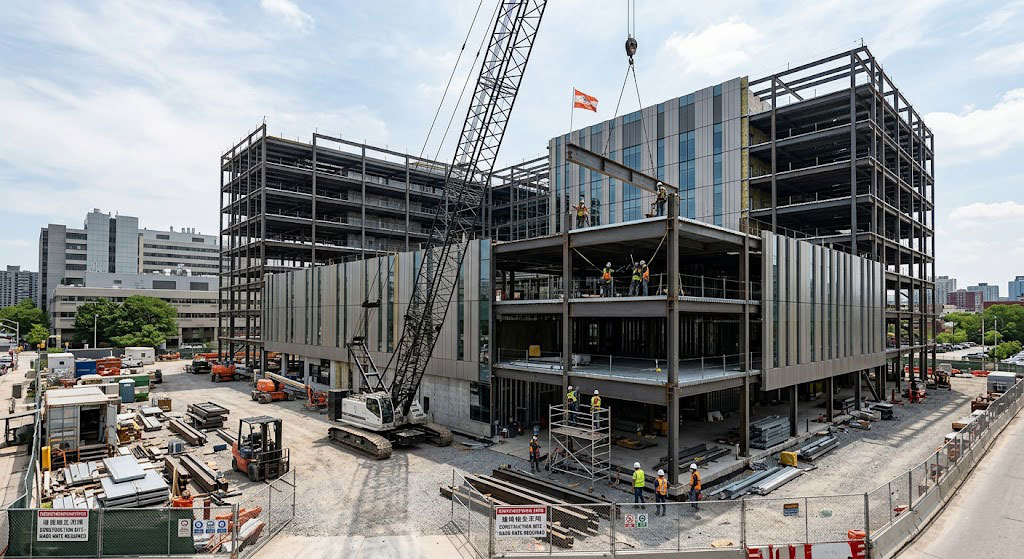
Steel hospital buildings are significantly more cost-effective because off-site prefabrication accelerates construction timelines and lowers long-term building lifecycle costs. By manufacturing framing components in a controlled factory setting, you reduce onsite labor requirements and eliminate material waste. These modern, high-strength hospital buildings provide long-term durability that ensures your healthcare facility remains financially viable for decades.
How does prefabrication accelerate project timelines?
Here is why this matters: prefabricated structural components are delivered to the site ready for rapid bolt-together assembly, saving you months of on-site labor. Working with an experienced steel building manufacturer ensures that all columns, trusses, and wall panels fit together perfectly on the first try.
- Off-Site Manufacturing: Fabrication occurs in parallel with site excavation, shaving up to 30% off your overall schedule.
- Weather Independence: Factory fabrication eliminates delays caused by rain, wind, or freezing temperatures.
- Reduced On-Site Crew: Rapid assembly requires fewer specialized welders and laborers on the active job site.
Can steel frames reduce long-term maintenance costs?
But that is not all. Structural steel is highly resistant to pests, decay, and moisture damage, which are common issues that cause costly repairs in traditional buildings. Industrial-grade protective coatings applied at the factory protect the structural frame for its entire lifecycle, keeping maintenance costs low.
- Corrosion Resistance: High-performance coatings prevent rust in damp clinical or storage environments.
- Pest Proofing: Steel is impervious to termites, rodents, and mold growth.
- Structural Stability: Minimal settling over time prevents cracks in interior drywall and finish materials.
Key Takeaway: Choosing a prefabricated steel structure reduces initial construction delays and lowers ongoing maintenance costs for the life of the facility.
| Evaluation Metric | Prefabricated Steel System | Cast-in-Place Concrete | Traditional Wood | |
|---|---|---|---|---|
| On-Site Assembly Speed | Exceptional | Slow (Requires Curing) | Moderate | |
| Lifespan Maintenance | Very Low | Moderate | High | |
| Structural Strength | Superior | High | Low |
By shifting structural fabrication from the chaotic construction field to a controlled factory, you can lock in predictable budgets and accelerate your facility’s opening.
Why is flexibility key for hospital buildings?
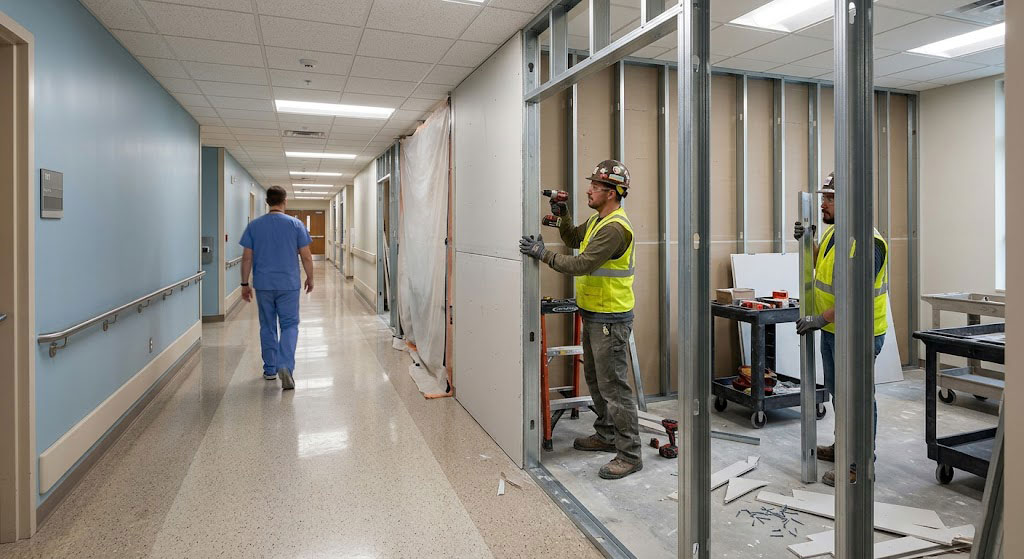
Flexibility is key for hospital buildings because rapid advancements in medical technology require the structural space to adapt and expand without expensive demolition. Designing rigid interior concrete walls locks your facility into a single layout that will quickly become obsolete as medical practices change. Building modern, adaptable hospital buildings allows you to easily reposition interior walls and reconfigure clinical departments as your service offerings grow.
How do modular grids support future upgrades?
Let’s break it down: a consistent column-and-beam planning grid (such as a 30-foot by 30-foot bay) allows you to convert spaces from administrative offices to patient rooms with ease. High-strength steel frames support these wide, open spans, removing load-bearing interior barriers.
- Non-Load-Bearing Walls: Interior partitions can be moved or removed without affecting the building’s structural integrity.
- Standardized Room Sizes: Designing rooms with standard dimensions makes it simple to transition from exam rooms to utility storage.
- Wide Clear Spans: Allows you to install large, heavy medical imaging equipment without needing extra supporting columns.
Can structural steel allow vertical expansions?
Think about it. If your community’s population grows, your medical facility must expand to handle the increased patient volume. By choosing robust, modular prefabricated steel structures , you can design a foundation and structural columns that are pre-engineered to support future vertical floors.
- Over-Engineered Foundations: Pre-designed to carry the load of future upper stories without settling.
- Spliced Steel Columns: Columns are left with splice plates to easily bolt on new vertical structural framing.
- Minimal Facility Disruption: Assembling steel frame additions is much quieter and cleaner than pouring concrete.
Key Takeaway: Designing with wide-span steel frames and pre-engineered columns ensures your medical center can easily adapt and expand as healthcare demands grow.
| Adaptability Feature | Steel Hybrid Framing | Heavy Concrete Core | Traditional Timber Frame | |
|---|---|---|---|---|
| Clear Span Capacity | Excellent (Up to 30m) | Moderate | Poor | |
| Future Vertical Additions | Simple (Bolt-on splicing) | Complex (Requires reinforcing) | Extremely Difficult | |
| Interior Wall Mobility | High (No interior loads) | Low (Load-bearing walls) | Low |
By planning for future modifications today, you protect your capital investment from premature obsolescence and save millions in future renovation costs.
Can green designs optimize hospital buildings?

Yes, green designs can optimize hospital buildings by drastically reducing ongoing utility costs, improving indoor air quality, and creating healing environments that speed up patient recovery. Because medical facilities operate 24 hours a day, they consume massive amounts of energy and water compared to standard commercial buildings. Incorporating sustainable architectural designs into your hospital buildings helps protect natural resources while lowering your facility’s monthly overhead.
How do insulated panels lower operating costs?
Here is why this matters: prefabricated insulated polyurethane (PU) wall panels form an airtight barrier that prevents thermal bridging and reduces the load on your heating and cooling systems. By pairing these high-performance panels with a structural steel frame, you create a highly efficient exterior shell.
- Continuous Thermal Barrier: Eliminates cold drafts and hot spots, keeping internal clinical climates stable.
- Lower HVAC Requirements: Reducing energy waste allows you to install smaller, more affordable heating and cooling units.
- Moisture and Mold Resistance: Closed-cell polyurethane core prevents water vapor from penetrating the walls.
Can natural daylighting speed up patient healing?
But that is not all. Designing structural frames that support massive, high-efficiency glass curtain walls allows natural daylight to reach deep into clinical spaces and patient recovery areas. Studies show that patients exposed to daylight experience shorter recovery times and require less pain medication.
- Large Structural Spans: High-strength steel beams easily support heavy, double-glazed glass facades.
- Reduced Artificial Lighting: Maximizing daylight reduces daytime electrical consumption throughout the facility.
- Improved Staff Morale: Exposure to natural sunlight helps medical staff stay alert and focused during long shifts.
Key Takeaway: Combining high-efficiency insulated wall panels with large glazed facades reduces utility expenses while supporting patient recovery.
| Green Target Area | Steel Frame Solution | Traditional Wood Solution | Environmental Benefit | |
|---|---|---|---|---|
| Energy Reduction | PU Insulated Panels (R-30+) | Standard Batt Insulation | Lowers heating and cooling costs | |
| Resource Recycling | 100% Recyclable Steel | Hard to Recycle/Waste-heavy | Reduces landfill waste and carbon footprint | |
| Indoor Air Quality | Zero-VOC Factory Finishes | Field-applied Paints/Glues | Lowers risk of respiratory issues |
Using high-performance green envelopes on your steel framing ensures your clinical environment meets both sustainability goals and strict financial budgets.
“Boost Your Projects Now – Get a Free Quote Today!”
Email:sales@showhoo.com.cn
Phone/WhatsApp:+86 186 7895 5927
How to secure supply chains for hospital buildings?
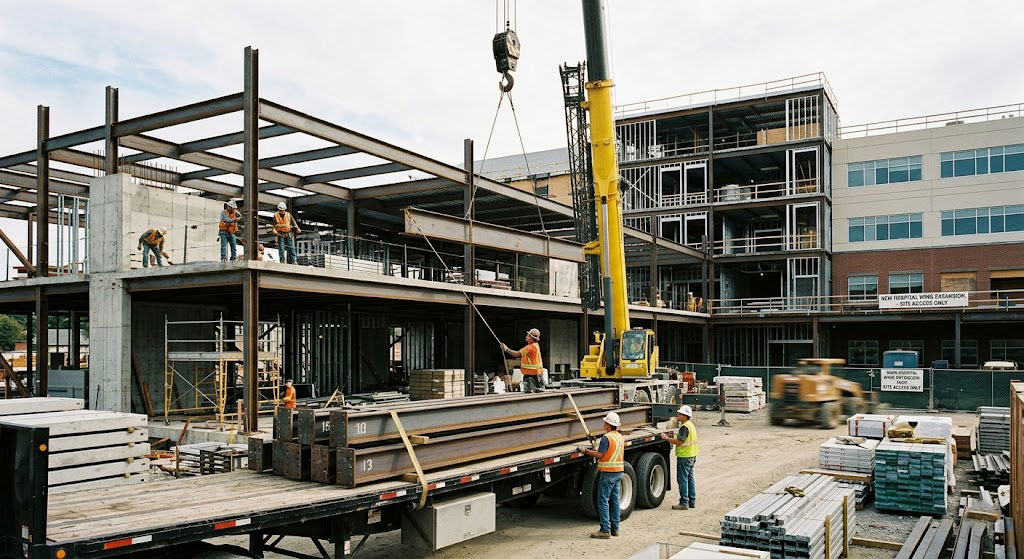
You can secure supply chains for hospital buildings by partnering with an experienced global manufacturer that manages fabrication, certified quality inspections, and sequenced shipping. Managing a massive logistics network is one of the most stressful parts of a healthcare construction project. When designing high-stakes hospital buildings , ensuring that structural components arrive in the correct order prevents costly field delays and keeps your labor crews working efficiently.
Why is sequenced logistics planning so critical?
Let’s break it down: a crowded urban construction site has very little space to store extra structural columns, steel panels, and beams. Receiving your materials in pre-planned, sequenced shipments allows you to lift components straight from the delivery truck and bolt them directly into place.
- Just-In-Time Delivery: Materials arrive exactly when they are needed, reducing the space required for on-site storage.
- Sequenced Packaging: Heavy columns and main beams are loaded and shipped first, followed by roof trusses and wall panels.
- Reduced Handling Risks: Moving components directly from the shipping container to the frame reduces the risk of material damage.
Why do structural steel certifications protect your project?
Think about it. Healthcare facilities must withstand high wind loads, seismic activity, and severe weather while protecting vulnerable patients and staff. Partnering with a supplier that offers custom design support and certified structural steel ensures your facility passes all local inspections.
- International Quality Standards: Ensures all steel columns and beams match ISO 9001 and SGS performance benchmarks.
- Mill Test Certificates (MTC): Verifies the chemical composition and yield strength of every steel component used in your frame.
- Reduced Structural Liability: Using certified materials protects your investment and ensures long-term building safety.
Key Takeaway: Working with an experienced global steel fabricator ensures your materials are delivered on schedule and certified to pass strict building codes.
| Logistics Phase | Critical Milestone | Quality Control Metric | Documentation Required | |
|---|---|---|---|---|
| Fabrication | Precision structural welding | Ultrasonic and magnetic testing | ISO & CE Weld Credentials | |
| Shipping | Sequenced ocean container loading | Matching packing lists per container | Customs Clearance Papers | |
| On-Site Arrival | Inspection of coatings and dimensions | Damage-free arrival verification | Mill Test Certificates (MTC) |
Securing a reliable, factory-certified supply chain protects your construction timeline and keeps your hospital project on schedule.
What structural forms suit hospital buildings?
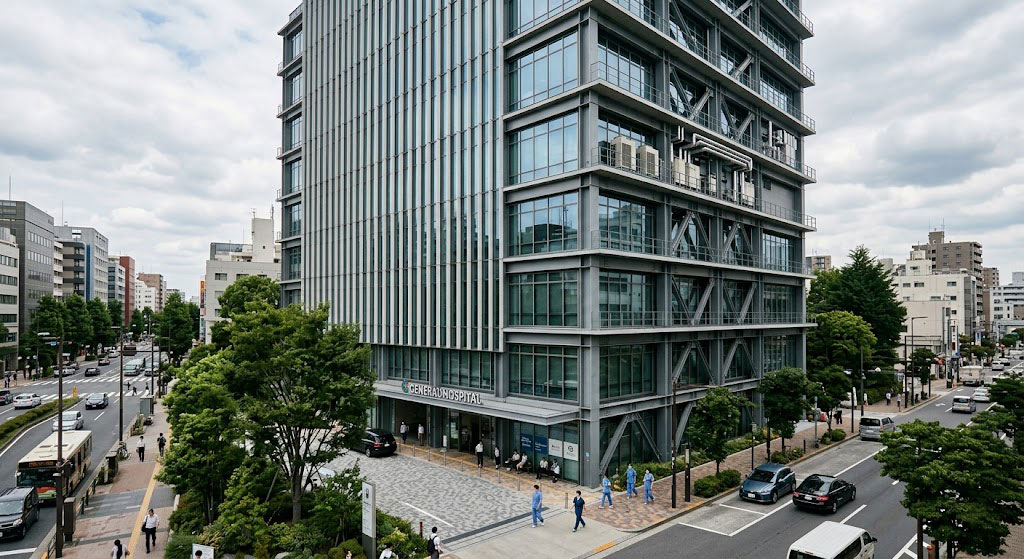
Compact vertical structures combined with long-span hybrid steel framing are the ideal structural forms to suit hospital buildings. Moving away from sprawling horizontal layouts allows you to make the most of your real estate while centralizing critical clinical care areas. These modern, vertical hospital buildings utilize a strong steel structure to handle heavy mechanical loads while maintaining a compact footprint.
Why are horizontal hospital shapes becoming obsolete?
Here is why this matters: sprawling, single-story healthcare designs increase walking distances for medical staff, which slows down response times and increases fatigue. Vertical buildings keep critical departments close together, using high-speed service and patient elevators to speed up transit.
- Centralized Logistics: Stacked floor plans allow you to route utility lines, medical gases, and laundry chutes straight down.
- Optimized Land Use: Vertical designs leave more land open for emergency parking, ambulance access, and future expansions.
- Shorter Transit Times: Moving patients between floors using elevators is much faster than pushing gurneys down endless corridors.
How do steel-concrete composite floors control vibration?
But that is not all. Sensitive medical equipment, such as electron microscopes, MRI scanners, and robotic surgical tools, must be kept completely still to function properly. Installing composite steel-concrete deck floors provides a highly rigid floor system that stops vibrations from foot traffic and heavy HVAC systems from affecting these devices.
- In-Floor Vibrational Damping: Rigid composite decks absorb vibrations, ensuring precise imaging and surgery.
- Heavy Load Support: Easily handles the immense weight of MRI machines and shielding walls.
- Integrated Fire Barriers: Concrete-filled steel decks act as natural fire barriers between clinical floors.
Key Takeaway: Designing a compact, multi-story steel frame with rigid composite floors optimizes clinical workflows and protects sensitive medical devices.
| Structural System | Floor Thickness | Vibration Control Level | Best Department Fit | |
|---|---|---|---|---|
| Composite Steel Deck | Standard Profile | Excellent | Surgical Suites, Imaging | |
| Open Web Steel Truss | Deep Profile | Moderate | Inpatient Wards, Offices | |
| Solid Concrete Slab | Heavy Profile | Good | Ground Floor Radiology |
Choosing the right structural steel floor system ensures your medical staff can operate sensitive equipment without worrying about building vibrations.
Who manages risk when building hospital buildings?
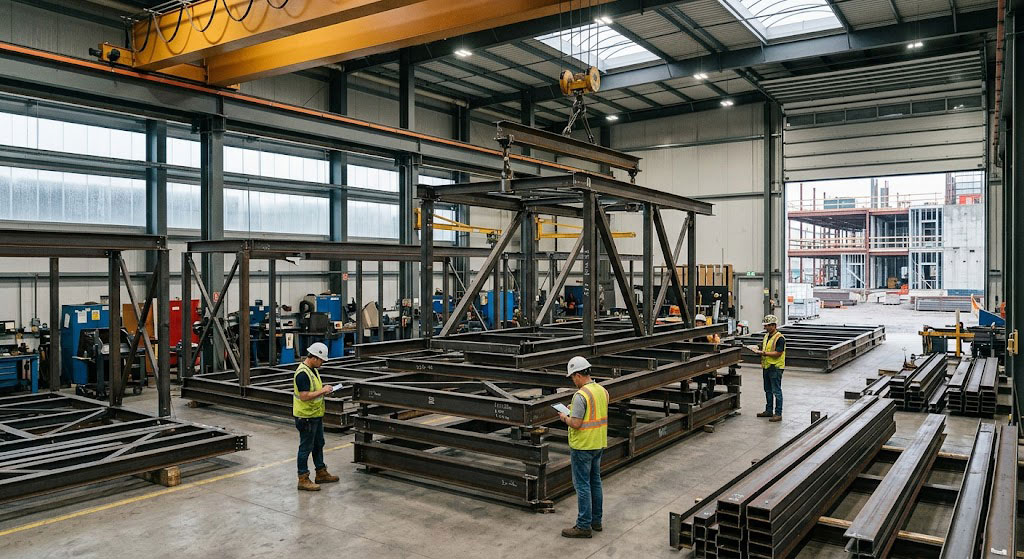
Your integrated design-build team manages risk when building hospital buildings by shifting structural fabrication from the active construction site to a quality-controlled factory. On-site building errors, poor weather conditions, and labor shortages are major risks that can quickly ruin your project’s budget. By using prefabricated steel systems to construct your hospital buildings, you transfer these complex risks to a manufacturing facility that guarantees precise dimensions.
How does prefabrication reduce expensive change orders?
Let’s break it down: when structural components are fabricated to exact tolerances in a factory, you eliminate the need for costly field modifications and on-site welding. Every steel beam and column is checked against your architectural 3D CAD files before it ever leaves the plant.
- Digital Modeling (BIM): Detects design conflicts between structural steel and MEP ducts before fabrication begins.
- Quality-Controlled Welding: Factory-certified welding under ideal indoor conditions eliminates structural defects.
- Fixed Material Costs: Pre-ordering prefabricated steel helps you lock in your material costs and avoid inflation.
Can steel designs overcome tight urban site limits?
Think about it. Building a healthcare center in a crowded city center means working around active streets, overhead power lines, and neighboring buildings. Unlike massive concrete projects that require wide staging areas, steel components can be delivered from dedicated steel structure workshops using just-in-time delivery.
- No Storage Required: Structural beams are lifted straight from the delivery truck and bolted onto the building frame.
- Low Sound and Noise Pollution: Bolting structural steel together is much quieter than pouring concrete, which keeps neighbors happy.
- Compact Staging Footprint: Requires very little land to assemble the frame, which is perfect for tight urban lots.
Key Takeaway: Factory-fabricated steel systems protect your budget from costly change orders and make it easier to build on tight, urban sites.
| Project Risk Category | On-Site Concrete Risk | Factory Steel Prefab Solution | Project Safety Level | |
|---|---|---|---|---|
| Budget Cost Overruns | High (Field modifications) | Low (Fixed factory pricing) | Exceptional | |
| Construction Delays | High (Weather-dependent curing) | Low (All-weather steel erection) | High | |
| Structural Defect Risk | Moderate (On-site labor variations) | Very Low (Strict factory QA checks) | Exceptional |
Shifting your structural engineering to a factory-controlled environment reduces risks for investors, operators, and general contractors alike.
How to begin planning new hospital buildings?
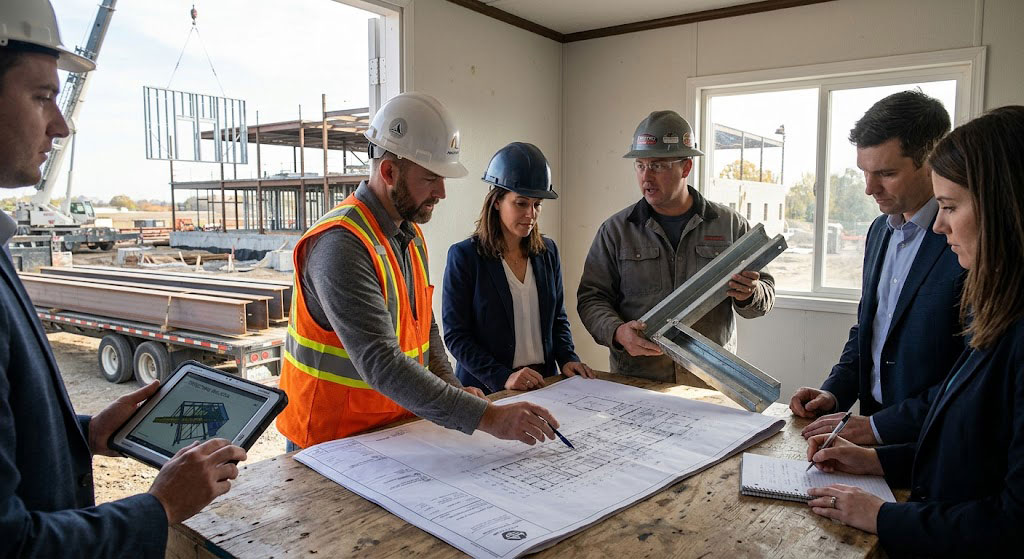
You can begin planning new hospital buildings by collaborating early with an industrial steel manufacturer to develop detailed spatial requirements and structural calculations. Starting with a clear, coordinated plan prevents expensive design changes down the road. Engaging with technical steel specialists early helps you optimize your structural design, ensuring your hospital buildings are both highly functional and cost-effective.
Why must you plan space requirements early?
Here is why this matters: your structural columns, ceiling heights, and floor loads must be designed around the specific medical equipment and clinical workflows your hospital will use. Planning these details early prevents structural issues when installing heavy machinery later in the project.
- Equipment Load Mapping: Identify where heavy MRI machines, surgical robots, and imaging suites will be located.
- Path-of-Travel Planning: Design wide corridors, doorways, and patient elevator bays to ensure smooth transport.
- Ceiling Height Requirements: Allocate enough ceiling space for complex HVAC ductwork and utility networks.
How does early budget coordination prevent overruns?
But that is not all. Working directly with your structural steel supplier from the very beginning allows you to match your architectural vision with practical, real-world construction budgets. This collaborative design approach ensures you use steel efficiently, avoiding over-engineering and keeping your project on track.
- Optimized Weight-to-Strength: Selects the exact steel sizes needed to handle structural loads without adding extra cost.
- Reduced Manufacturing Waste: Engineering components to precise dimensions minimizes raw material waste at the factory.
- Predictable Construction Timelines: Coordinated delivery plans help you lock in construction schedules and lower financing costs.
Key Takeaway: Early design planning with your steel manufacturer helps you optimize column grids, control costs, and prepare for smooth on-site assembly.
| Planning Phase | Primary Milestone | Key Project Deliverable | Stakeholders Involved | |
|---|---|---|---|---|
| 1. Feasibility & Zoning | Map hospital beds and departments | Project budget and site master plan | Healthcare Operators, Investors | |
| 2. Architectural Design | Establish column grids and spaces | 3D BIM models & detailed floor plans | Architects, Clinical Directors | |
| 3. Structural Engineering | Calculate floor loads and member sizes | Approved factory fabrication drawings | Steel Fabricator, Structural Engineers |
Investing time in detailed early engineering ensures your healthcare construction project proceeds smoothly without unexpected costs or field delays.
Conclusion
When you are ready to build a cutting-edge healthcare facility that meets strict medical codes and offers unparalleled structural flexibility, you need a partner who can deliver certified quality on time. Do not let construction delays, rising labor costs, and inflexible structural designs hold your project back. We encourage you to contact us today to receive a customized, high-strength structural engineering plan tailored to your clinical requirements. Together, we can shape the future of healthcare infrastructure, utilizing advanced prefabricated steel systems to build resilient, sustainable, and highly efficient medical facilities worldwide.
“Boost Your Projects Now – Get a Free Quote Today!”
Email:sales@showhoo.com.cn
Phone/WhatsApp:+86 186 7895 5927
FAQ
Can I customize the structural column layout for my specific imaging equipment?
Yes, you can easily customize column grids when designing with structural steel. High-strength steel frames allow for wide-span layouts of up to 30 meters without requiring intermediate load-bearing columns. This open floor space gives you the freedom to position heavy MRI machines, surgical suites, and radiation-shielding barriers exactly where your clinical workflows need them.
What’s the best way to handle future vertical expansions?
The best way to plan for future floors is to over-engineer your initial foundations and columns during the design phase. By designing with high-strength structural steel, your fabricator can pre-weld column splice plates onto your building’s framework. This preparation allows you to easily bolt on new steel columns and floor trusses later, expanding your vertical space with minimal disruption to active patient areas below.
How do I know if prefabricated steel is suitable for highly seismic areas?
Prefabricated structural steel is the safest and most ductile material available for active seismic zones. Steel frame systems are engineered with specialized bolt-on bracing and flexible connections that absorb and dissipate ground movement during an earthquake. Unlike rigid concrete cores, structural steel bends without cracking, ensuring your hospital remains structurally sound and fully operational during natural disasters.
Can I install high-performance insulated panels on a steel frame?
Yes, you can easily mount high-efficiency insulated polyurethane panels directly onto a structural steel frame. These lightweight, prefabricated panels bolt securely onto the exterior steel girts, forming an airtight, continuous thermal barrier. This energy-efficient building envelope prevents thermal bridging, reduces moisture buildup, and significantly lowers your facility’s monthly heating and cooling costs.
How do I get an accurate cost estimate for my hospital project?
To get an accurate cost estimate, you should provide your manufacturer with detailed spatial requirements, expected floor loads, and local structural design codes. Technical engineers use 3D BIM modeling software to calculate the exact weight of the steel members needed for your project. This detailed planning allows you to lock in factory-direct pricing and avoid unexpected costs during the fabrication and shipping phases.