
Broiler housing and facilities in the US must provide a strictly controlled environment that protects birds from pathogens and weather while optimizing growth and feed conversion rates.
John, a veteran poultry producer, watches his margins vanish as his aging, drafty barns lead to high chick mortality and astronomical heating bills. This cycle of financial loss stems from structural failures that stress the flock and invite disease into the production cycle. The only way to secure your profit and ensure bird health is by investing in a high-standard commercial chicken house designed for precision environmental performance.
Why is site selection vital for a commercial chicken house?
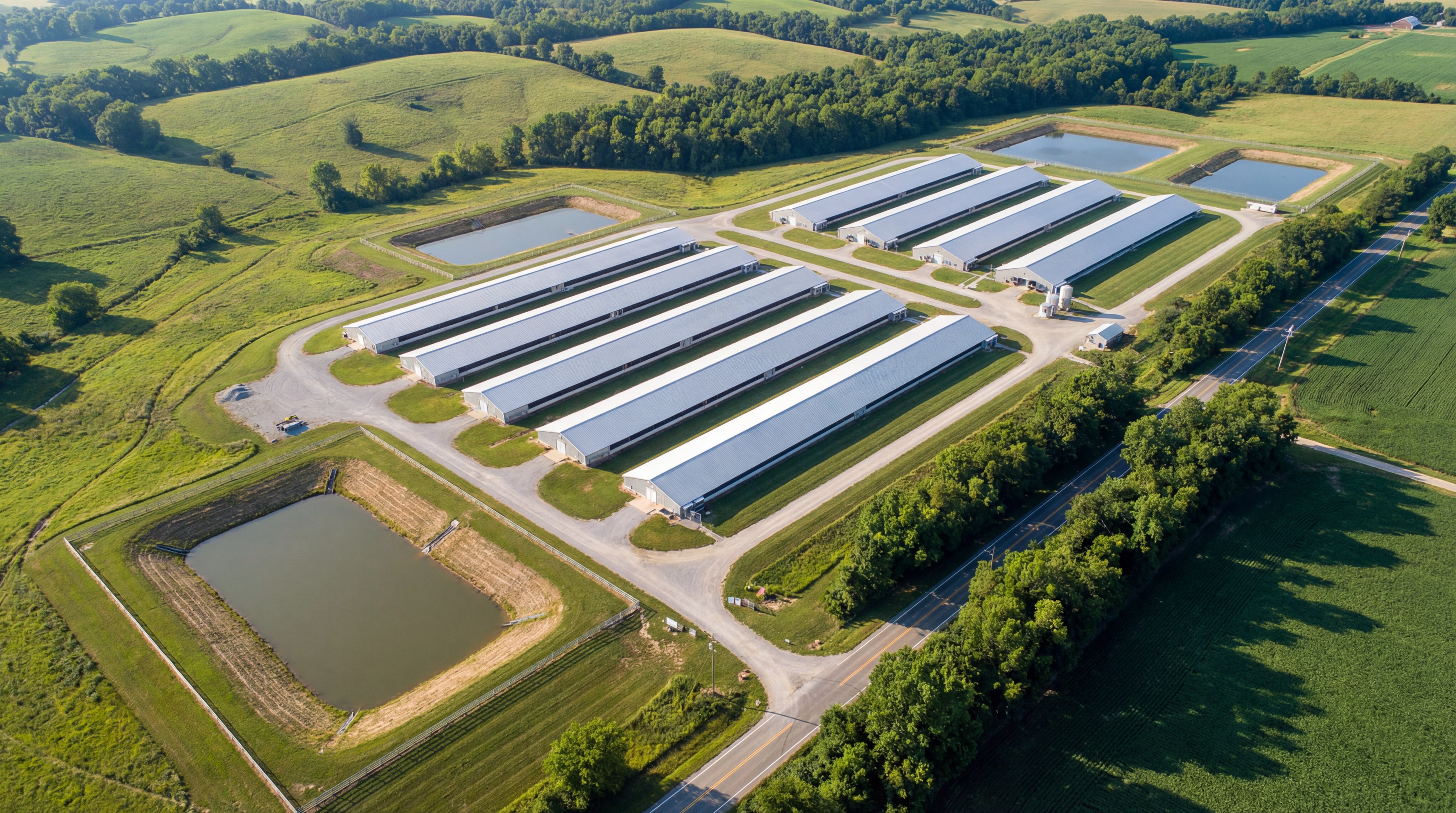
The location of your facility dictates its long-term operational efficiency and biosecurity safety during the entire production lifecycle. A poorly situated commercial chicken house faces constant environmental hazards and logistical delays.
Does topography affect your drainage?
You must evaluate the slope of your land to prevent water from pooling around the foundation. Here is why:
- A 1% to 2% grade ensures water runoff without causing soil erosion.
- Proper drainage prevents moisture from seeping into the litter.
- Dry sites reduce the risk of bacterial growth and pest infestations.
But that’s not all. You should also ensure the building is oriented perpendicular to prevailing winds to maximize natural ventilation potential.
How close are your processing hubs?
You need to minimize the distance between your farm and the feed mills or processing plants. Here is why:
- Shorter transport times reduce stress on the birds during loading.
- Lower fuel costs improve your overall bottom line.
- Reliable road access ensures feed delivery even in harsh weather.
Think about the future of your operation. You want a site that allows for expansion without compromising your biosecurity buffers.
Key Takeaway: Strategic placement reduces environmental stress and lowers transportation costs for feed and birds.
| Factor | Requirement | Impact | |
|---|---|---|---|
| Slope | 1% to 2% grade | Ensures water runoff without erosion | |
| Wind Direction | Perpendicular to length | Maximizes natural ventilation potential | |
| Distance | > 1 mile from other farms | Minimizes disease transmission risks |
This structured approach to site selection forms the foundation of a biosecure and profitable poultry enterprise.
How is a modern commercial chicken house designed?
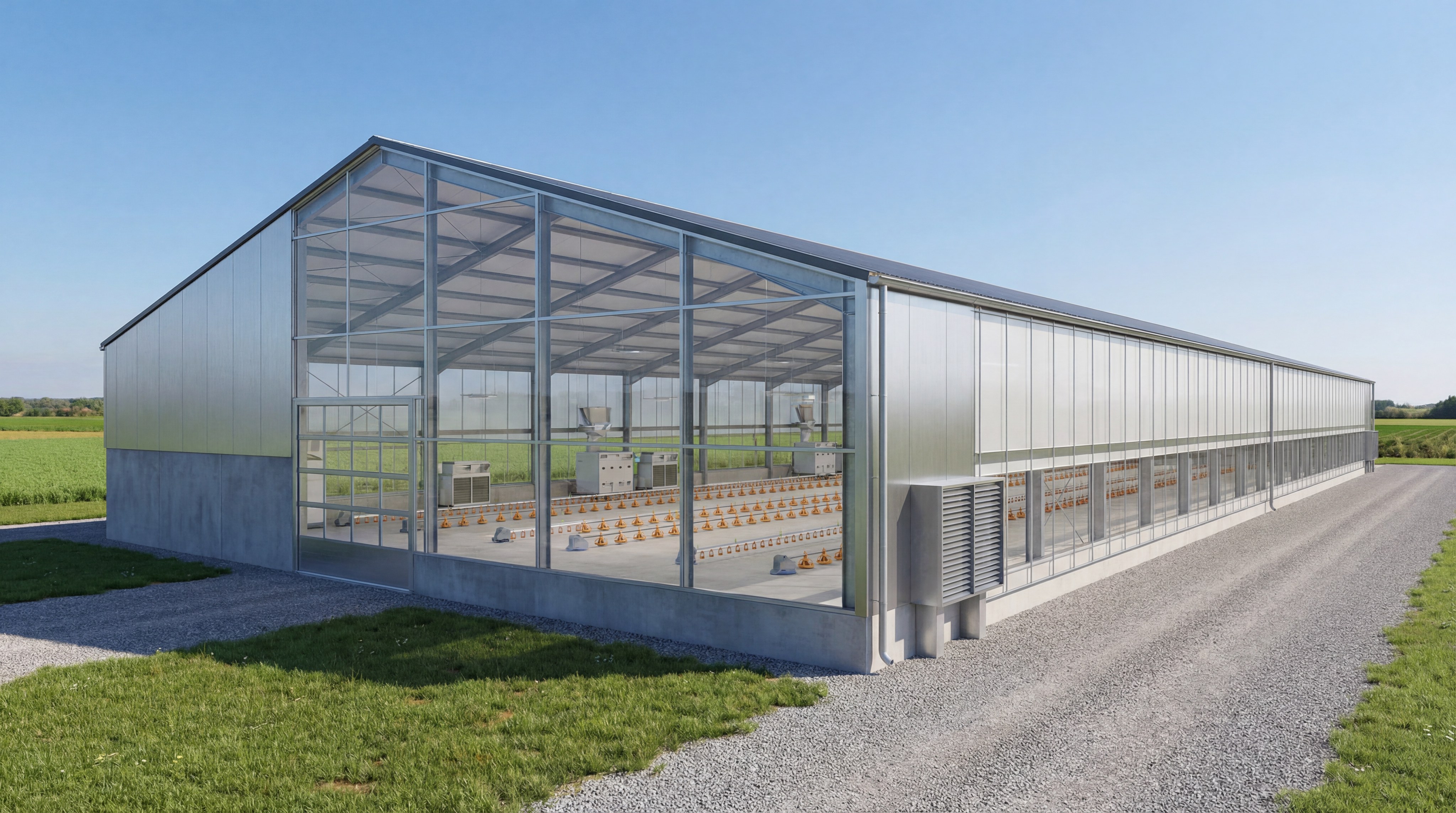
Modern facility design focuses on clear-span steel frames that allow for unobstructed airflow and efficient machinery movement. Utilizing a commercial chicken house framework provides the necessary strength to support heavy internal equipment while maintaining a wide footprint.
Why use clear-span engineering?
You benefit from an interior space free of support columns that would otherwise hinder bird movement and cleaning. Here is why:
- Automated feeding lines can run the full length of the house.
- Clean-out tractors can maneuver without hitting structural posts.
- Airflow remains consistent without physical obstructions.
It gets better. You can customize the width, typically between 40 and 66 feet, to match your specific ventilation and stocking goals.
What is the ideal house orientation?
You must orient the building along an east-west axis to minimize the impact of direct solar radiation. Here is why:
- This placement reduces the heat load on the side walls during summer.
- It helps maintain a more uniform internal temperature for the flock.
- Solar gain is minimized, lowering your cooling energy expenses.
Believe it or not, small design choices lead to big savings. You should work with engineers who understand regional climate patterns.
Key Takeaway: Clear-span steel frames maximize interior space and improve the longevity of the housing unit.
| Design Element | Standard Specification | Purpose | |
|---|---|---|---|
| Width | 40 to 66 feet | Optimizes ventilation and bird density | |
| Length | 400 to 600 feet | Matches automated feeding line capacities | |
| Roof Pitch | 4:12 ratio | Promotes heat rising and air circulation |
Advanced engineering allows you to scale your operations while maintaining strict control over the internal environment.
What materials build a durable commercial chicken house?
Durability in poultry housing depends on materials that can withstand ammonia exposure and high-pressure cleaning cycles. A high-quality commercial chicken house uses corrosion-resistant coatings and high-grade steel to prevent structural degradation.
Why is galvanized steel essential?
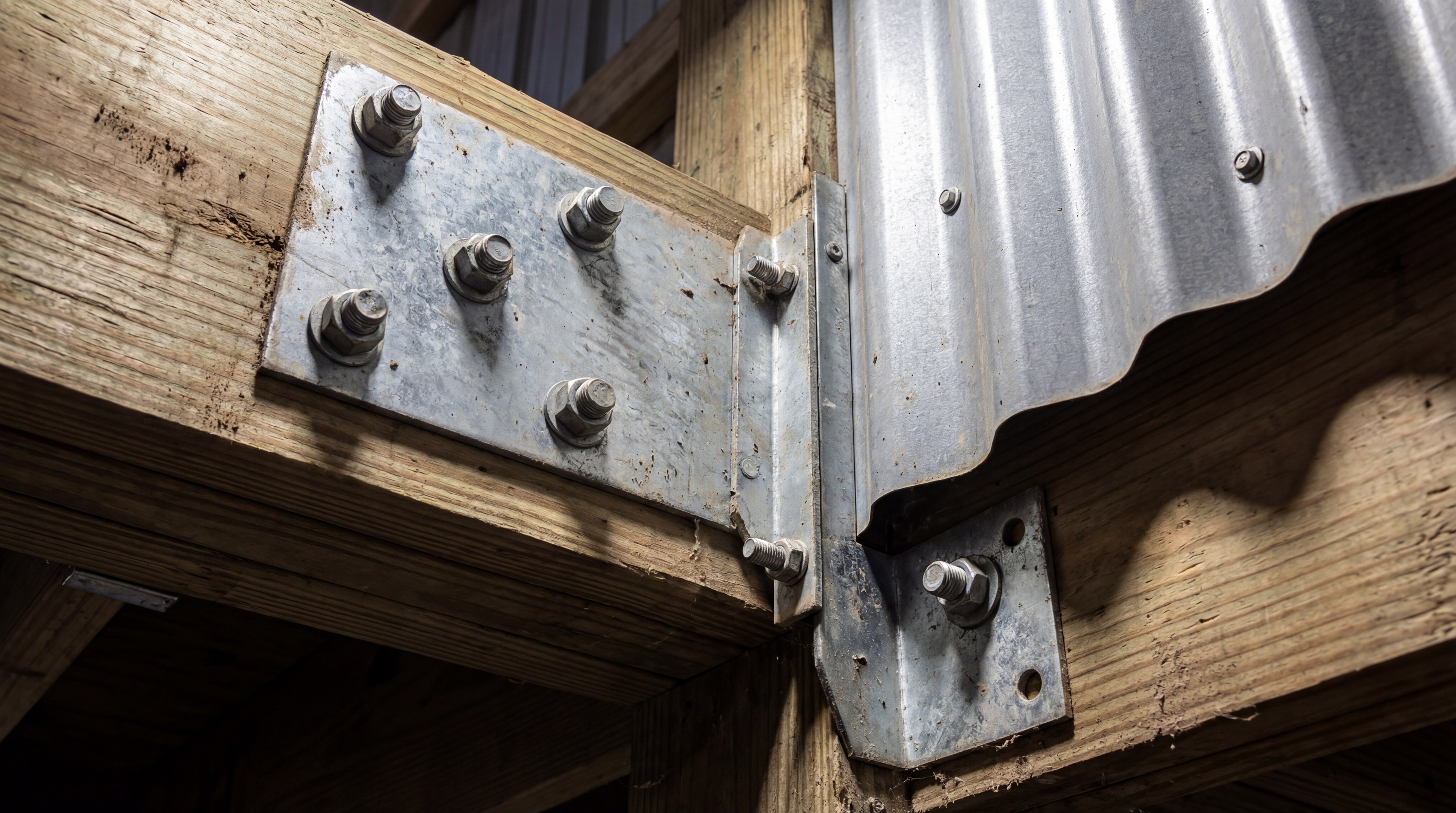
You need framing that resists the corrosive effects of moisture and ammonia gases produced by the birds. Here is why:
- Galvanization provides a protective zinc layer against rust.
- High-tensile steel maintains structural integrity under heavy snow loads.
- Steel is naturally resistant to pests like litter beetles and rodents.
And here’s the kicker. You save on long-term maintenance costs because steel doesn’t warp or rot like traditional wood.
Are sandwich panels the best choice?
You should look for moisture-resistant wall and ceiling liners that provide superior R-value insulation. Here is why:
- Insulated panels keep heat in during winter and out during summer.
- The smooth surfaces are easy to sanitize between flocks.
- Rigid panels prevent wild birds from nesting in the roof space.
It’s a simple fact. Investing in premium materials now prevents catastrophic structural failures later in your career.
Key Takeaway: Using industrial-grade materials prevents structural failure and reduces long-term maintenance overhead.
| Material Component | Benefit | Maintenance Level | |
|---|---|---|---|
| Galvanized Steel | Prevents rust from high humidity | Low | |
| Sandwich Panels | Superior R-value insulation | Medium | |
| Concrete Foundation | Structural stability and pest control | Low |
Selecting the right materials ensures your facility remains productive for decades despite the harsh agricultural environment.
How does a commercial chicken house manage ventilation?
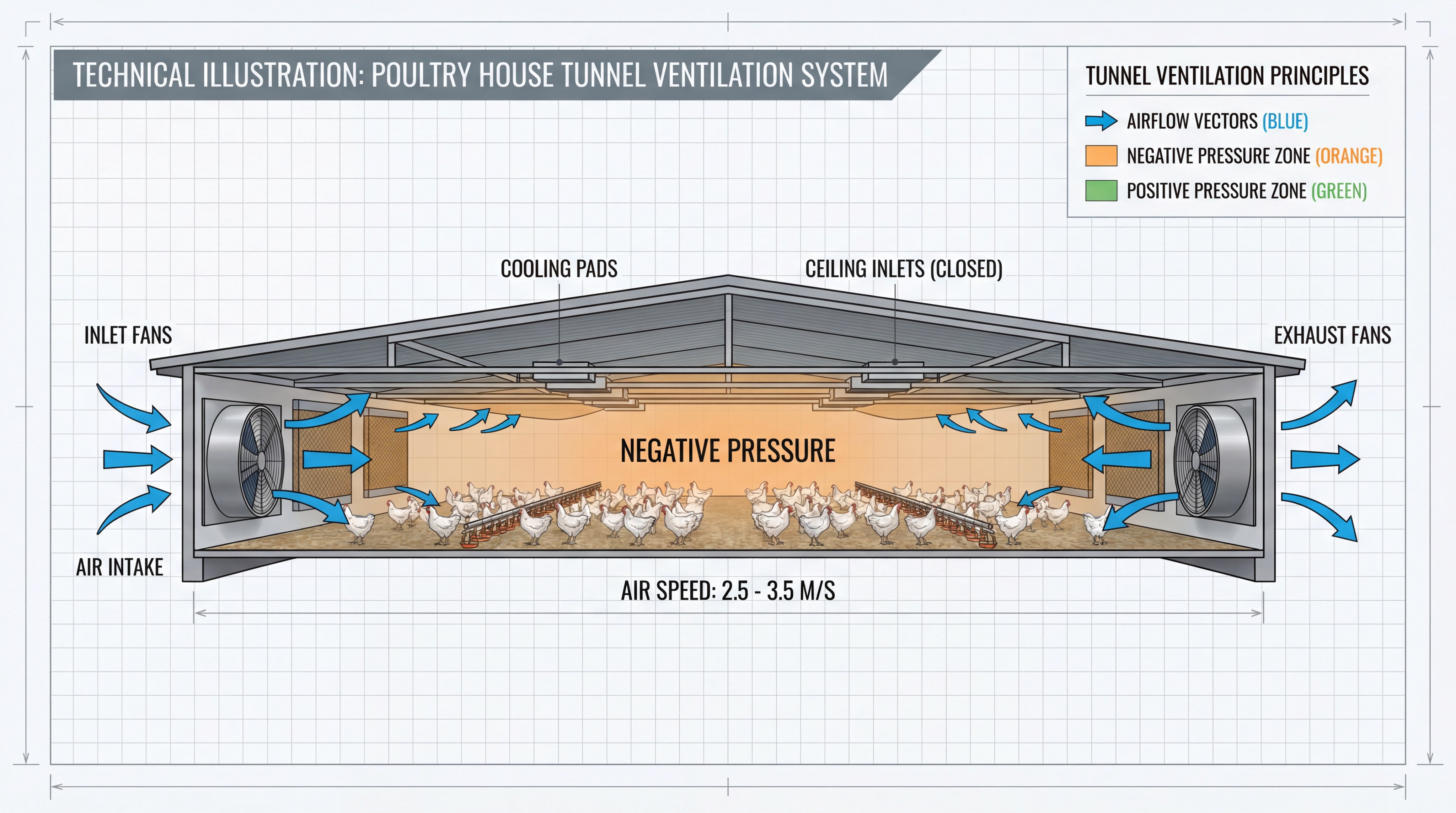
Modern broiler production relies on tunnel ventilation to create a wind-chill effect critical for cooling birds during hot months. Integrating systems within a commercial chicken house ensures that high-volume air movement is consistent throughout the entire structure.
How does tunnel ventilation work?
You use large exhaust fans at one end of the house to pull air through cooling pads at the other. Here is why:
- This creates a high-velocity air stream that removes body heat.
- It maintains oxygen levels while removing harmful CO2 and ammonia.
- Static pressure controls ensure air enters through the correct inlets.
But that’s not all. You can switch to minimum ventilation during winter to conserve heat while still removing moisture.
Why is fan maintenance critical?
You must keep your ventilation fans in peak condition to prevent “hot spots” in the house. Here is why:
- Clean shutters and tight belts ensure maximum air moving capacity.
- Variable speed fans allow for precise temperature adjustments.
- Backup generators are vital to prevent suffocation during power outages.
The truth is, even a ten-minute failure can lead to massive losses. You need a system that alerts you the moment air pressure drops.
Key Takeaway: Precise ventilation control is the most critical factor in maintaining bird health and feed conversion rates.
| Ventilation Mode | Primary Goal | Seasonal Use | |
|---|---|---|---|
| Minimum | Moisture and CO2 removal | Winter/Brooding | |
| Transitional | Temperature regulation | Spring/Autumn | |
| Tunnel | Heat stress prevention | Summer |
Mastering airflow management allows you to maintain optimal growth conditions regardless of the external weather.
Why is lighting critical in a commercial chicken house?
Lighting programs influence the physiological development and behavior of broilers to ensure uniform growth. A modern commercial chicken house uses dimmable LED systems to simulate natural cycles and reduce bird agitation.
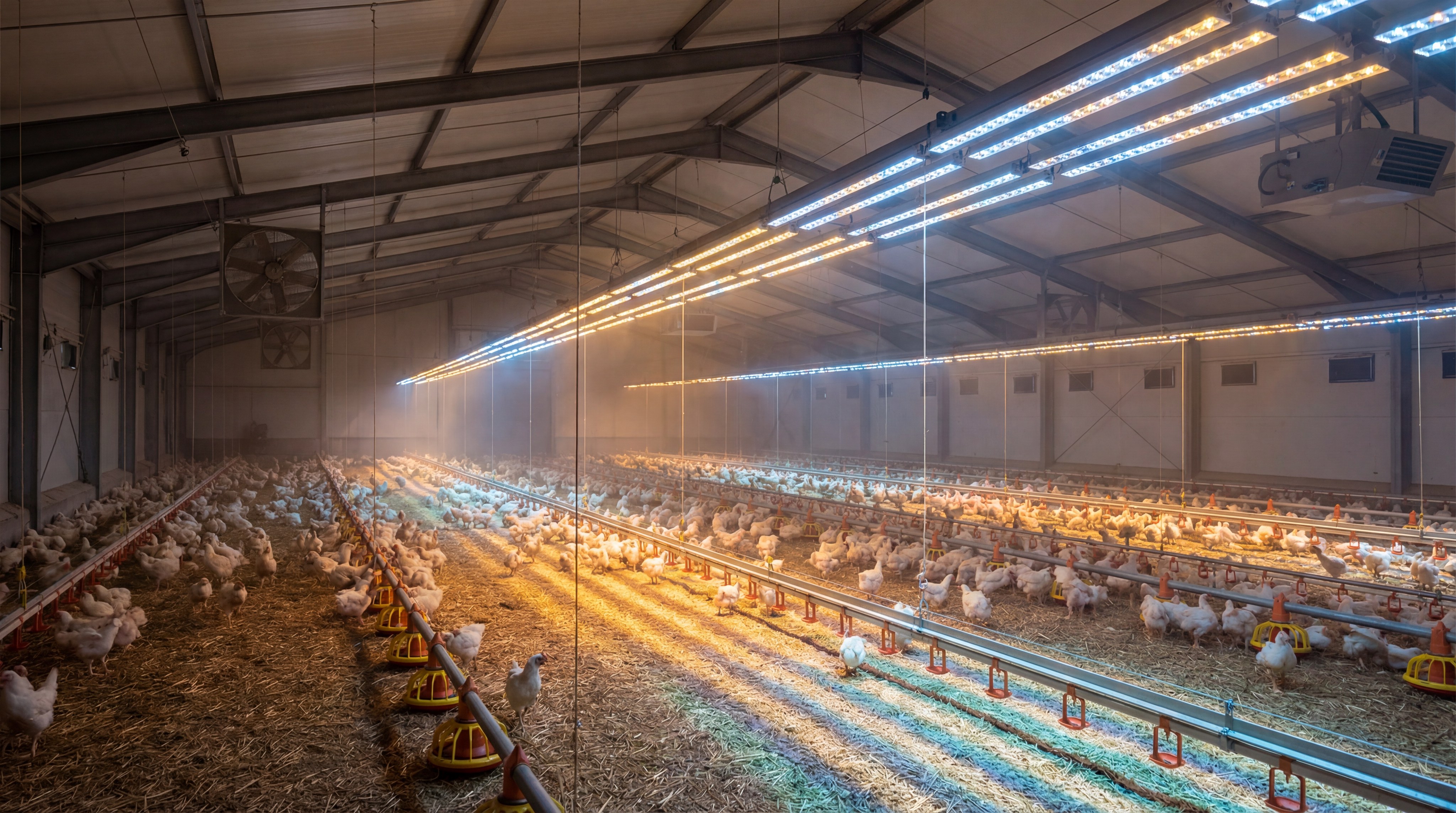
Can LED technology save you money?
You will see a significant reduction in your energy bills by switching from incandescent bulbs to LEDs. Here is why:
- LEDs use up to 80% less electricity for the same light output.
- They have a much longer lifespan in high-humidity environments.
- Dimmable features allow you to control bird activity levels precisely.
Think about it. A calmer flock spends more energy on muscle growth and less on unnecessary movement.
How does light intensity affect growth?
You should adjust light levels based on the age of your birds to encourage healthy development. Here is why:
- Bright light during brooding helps chicks find feed and water.
- Lower intensity during grow-out minimizes stress and aggression.
- A period of darkness improves bone health and metabolic efficiency.
The bottom line is control. You want uniform light distribution to prevent birds from huddling in dark corners.
Key Takeaway: Uniform light distribution prevents huddling and ensures all birds have equal access to resources.
| Light Stage | Intensity (Foot-candles) | Objective | |
|---|---|---|---|
| Brooding | 2.0 – 4.0 | Encourage feed and water find | |
| Grow-out | 0.5 – 1.0 | Minimize activity for muscle growth | |
| Pre-Catch | 0.05 – 0.1 | Calm birds for transport |
Precision lighting is a cost-effective way to improve both bird welfare and your final processing weights.
Why is insulation used in a commercial chicken house?
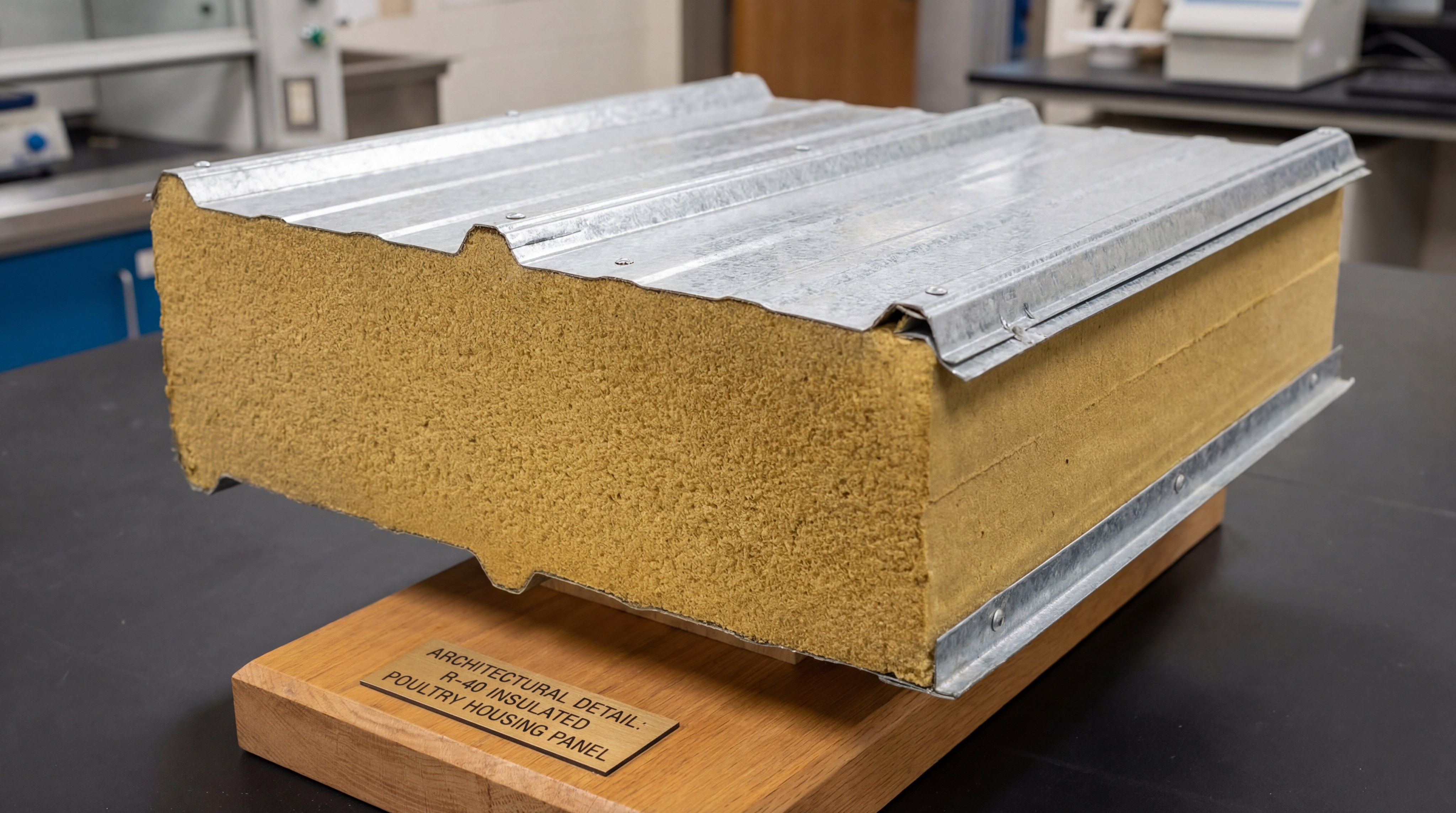
Effective insulation maintains a consistent internal temperature, which is as vital for poultry as it is for a commercial chicken house housing other livestock. Thermal regulation directly impacts the metabolic rate and growth efficiency of your broilers.
Does R-value matter for your farm?
You need to select insulation with a high R-value to prevent thermal transfer through the roof and walls. Here is why:
- High R-values keep the house warmer in winter with less fuel.
- It prevents radiant heat from the sun from overheating the birds.
- Better insulation reduces the workload on your heating and cooling systems.
And it’s not just about temperature. Proper insulation also prevents condensation that can lead to wet litter and respiratory issues.
Which insulation type should you choose?
You can choose between spray foam or rigid sandwich panels depending on your budget and durability needs. Here is why:
- Sandwich panels offer a clean, bird-proof surface that lasts for years.
- Spray foam provides an air-tight seal in older, drafty structures.
- Quality materials prevent rodents from nesting and destroying your insulation.
But wait, there’s more. High-quality insulation pays for itself through significantly reduced energy expenses over just a few flocks.
Key Takeaway: High-quality insulation pays for itself through significantly reduced heating and cooling expenses.
| Region | Recommended R-Value (Wall) | Recommended R-Value (Ceiling) | |
|---|---|---|---|
| Warm Climate | R-7 to R-11 | R-19 | |
| Cold Climate | R-11 to R-19 | R-30 |
Investing in a superior thermal envelope is the most effective way to stabilize your production costs year-round.
What equipment goes inside a commercial chicken house?
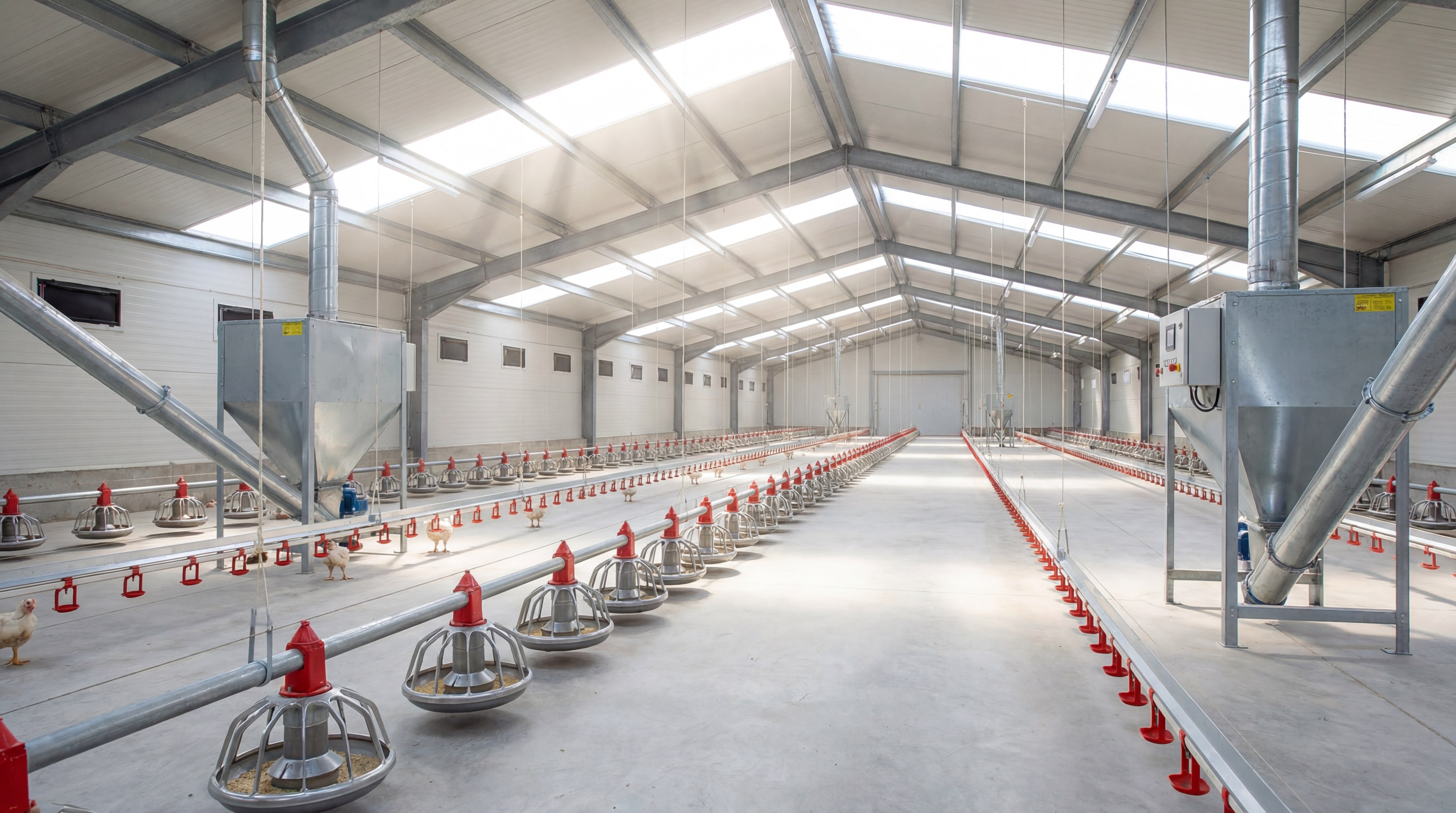
Internal infrastructure must be automated to handle thousands of birds with minimal human intervention. Your commercial chicken house must accommodate expansive automated lines for feeding and watering.
Why use automated feeding lines?
You can ensure that every bird has constant access to fresh feed without the labor of manual filling. Here is why:
- Auger-driven systems distribute feed evenly across the entire house.
- Adjustable pan heights grow with the birds to minimize wastage.
- Sensors in the control pan signal the system to refill automatically.
It gets better. Automation allows you to spend more time observing bird health rather than moving heavy feed bags.
Are nipple drinkers better than bells?
You will find that closed nipple drinking systems are the industry standard for maintaining hygiene. Here is why:
- They provide a clean water source that is protected from dust.
- Litter stays drier because there is no open water to spill.
- Water meters help you track consumption as a health indicator.
The reason is simple. Clean water is the foundation of a healthy immune system for your flock.
Key Takeaway: Automation reduces labor requirements and ensures birds receive consistent nutrition and hydration.
| Equipment Type | Technology | Benefit | |
|---|---|---|---|
| Watering | High-flow nipple drinkers | Reduces litter moisture | |
| Feeding | Automatic pan loaders | Minimizes feed wastage | |
| Sensors | Ultrasonic & Thermistors | Real-time climate adjustments |
Modern equipment allows you to manage larger flocks with higher precision and lower overhead costs.
How is biosecurity kept in a commercial chicken house?
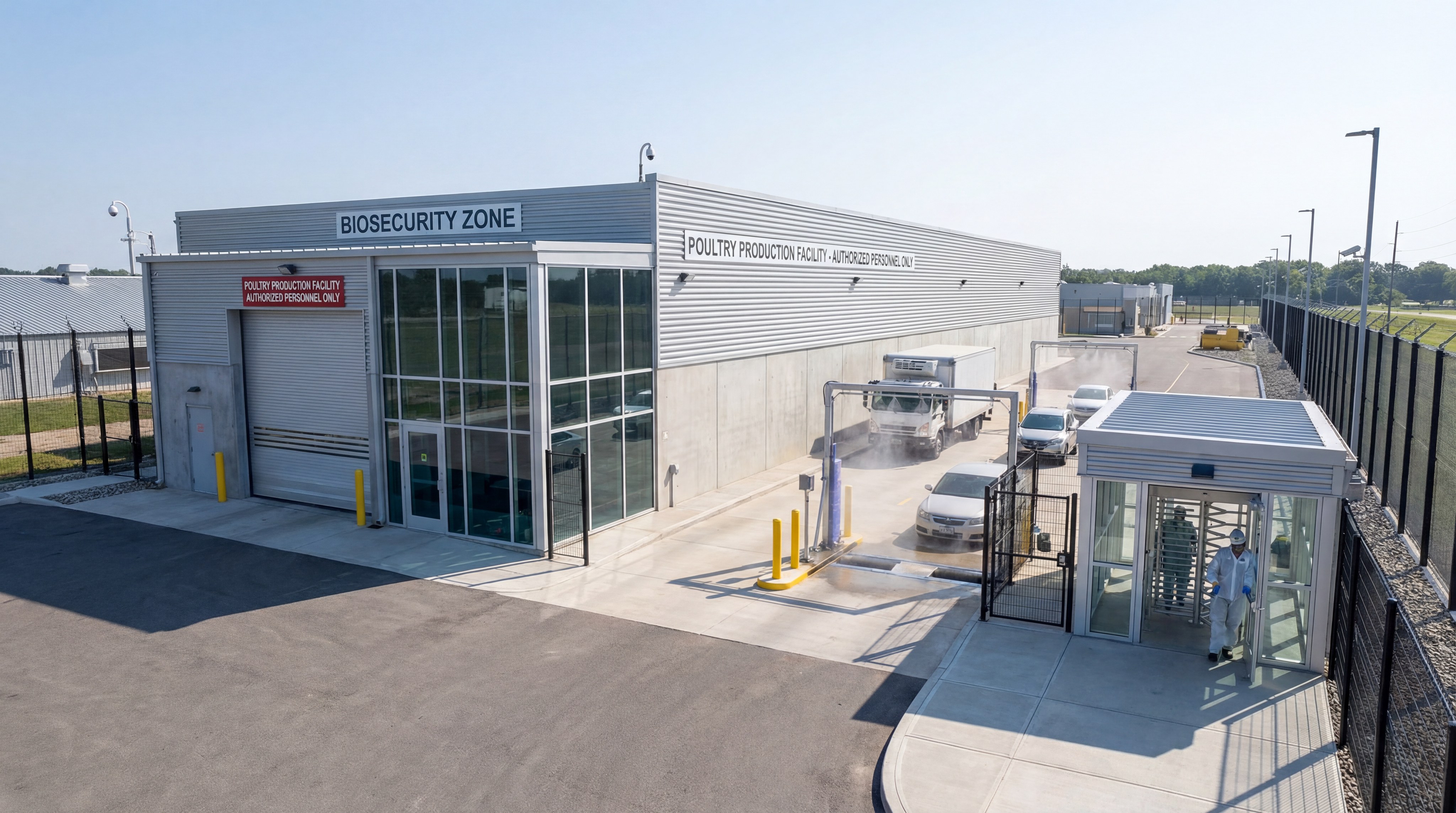
Biosecurity is your primary defense against catastrophic disease outbreaks that can ruin a farm. Facilities like an commercial chicken house must be designed with “clean” and “dirty” zones to prevent pathogen entry.
How do structural barriers help?
You need a well-sealed building envelope to keep out wild birds and rodents. Here is why:
- Screened inlets prevent songbirds from entering the ventilation system.
- Solid concrete footings stop rats from tunneling under the walls.
- Tight-fitting doors ensure that only authorized personnel can enter.
But that’s not all. You should also implement a clear perimeter buffer that is free of vegetation and debris.
Why use a “clean/dirty” zone?
You must establish a strict protocol for anyone entering the production area. Here is why:
- Footbaths and hand-sanitizing stations kill pathogens at the door.
- Dedicated farm clothing prevents cross-contamination between houses.
- Vehicle wash stations remove soil and bacteria from delivery trucks.
Think of it as an insurance policy. A few minutes of sanitation can save your entire flock from a viral outbreak.
Key Takeaway: A well-sealed building envelope is the first line of defense against wild birds and rodent-borne diseases.
| Biosecurity Layer | Measure | Effectiveness | |
|---|---|---|---|
| Physical | Perimeter fencing and screening | High (Pest control) | |
| Chemical | Footbaths and spray stations | Medium (Pathogen control) | |
| Management | All-in/all-out production | High (Cycle sanitation) |
Strict biosecurity protocols are the only way to protect your investment in a high-density production environment.
How is a commercial chicken house floor maintained?
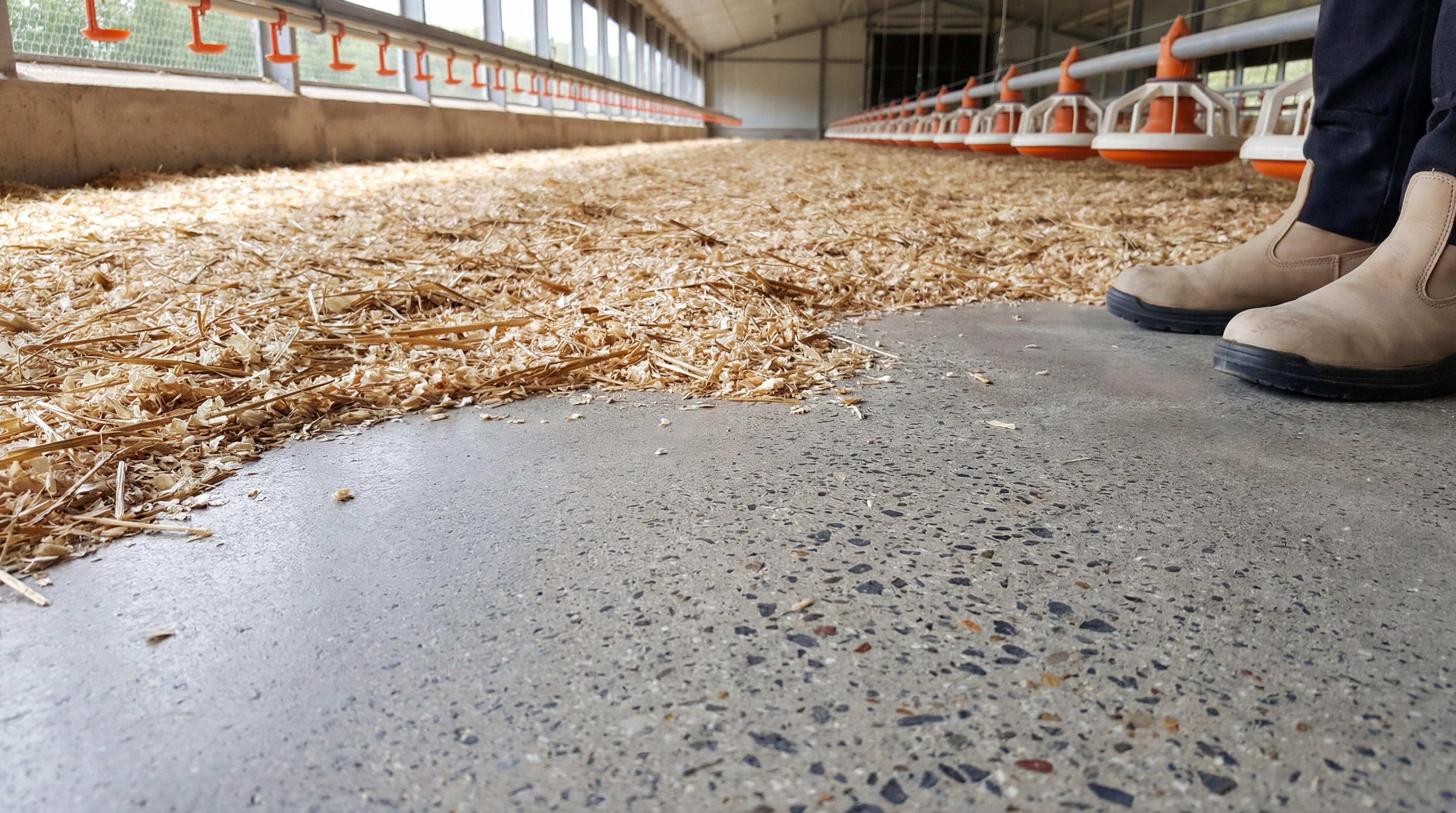
The floor environment is where birds spend their entire life cycle, making moisture control a top priority. A quality commercial chicken house uses engineered flooring to simplify the clean-out process.
Is concrete better than packed earth?
You should consider the long-term biosecurity benefits of a solid concrete floor. Here is why:
- Concrete is easy to wash and disinfect between every flock.
- It prevents groundwater from seeping up and wetting the litter.
- A smooth surface allows for faster and more efficient clean-outs.
And here is the best part. Concrete floors are much more durable when using heavy machinery for litter removal.
How do you manage litter moisture?
You must use high-quality bedding like rice hulls or pine shavings to absorb fecal moisture. Here is why:
- Dry litter prevents paw lesions and breast blisters on the birds.
- It reduces the release of ammonia gas into the air.
- Proper litter depth provides insulation against the cold floor.
The fact is, litter management is a daily task. You need to monitor your ventilation to ensure moisture is constantly being removed.
Key Takeaway: A dry, well-managed floor environment is essential for maintaining footpad health and air quality.
| Floor Type | Cost | Biosecurity Rating | |
|---|---|---|---|
| Concrete | High | Excellent (Sanitizable) | |
| Packed Earth | Low | Poor (Hard to disinfect) | |
| Heated Concrete | Very High | Superior (Bird comfort) |
Maintaining a clean and dry floor is the most effective way to ensure the comfort and health of your broilers.
What is the lifespan of a commercial chicken house?
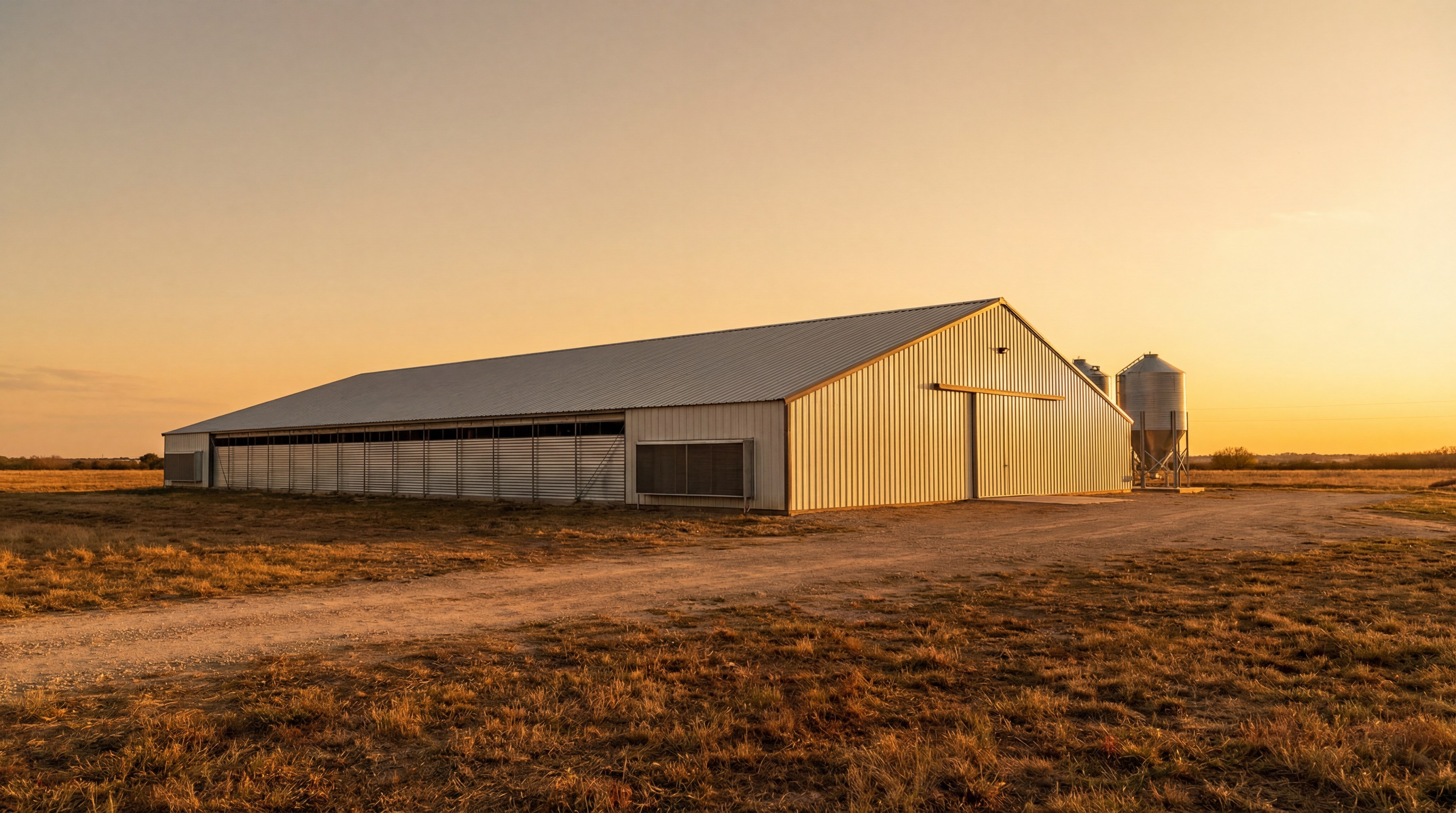
A properly engineered poultry facility should remain productive for over 20 to 30 years with routine care. Investing in a high-quality commercial chicken house allows you to retrofit new technology as the industry evolves.
How do you prevent steel corrosion?
You must perform regular inspections to identify and treat any signs of ammonia-based rust. Here is why:
- Cleaning dust off steel trusses prevents moisture from being trapped.
- Touch-up painting maintains the integrity of the galvanized layer.
- Proper ventilation reduces the concentration of corrosive gases.
Believe it or not, a little maintenance goes a long way. You can double the life of your building with simple annual checks.
Can you retrofit your old house?
You will find that steel-frame buildings are much easier to upgrade with new ventilation or feeding tech. Here is why:
- The clear-span design accommodates almost any equipment layout.
- Steel frames are strong enough to support new, heavier fan systems.
- Modern insulation can be added to the existing structure easily.
Here is why this matters: it allows you to stay competitive without building an entirely new facility every decade.
Key Takeaway: Investing in high-quality structural frames allows the facility to adapt to future technological advancements.
| Component | Expected Life | Key Maintenance | |
|---|---|---|---|
| Steel Frame | 30+ Years | Paint touch-ups | |
| Roofing Panels | 20 Years | Sealant inspection | |
| Ventilation Fans | 7-10 Years | Motor lubrication/Belt changes |
Building for the long term ensures that your farm remains a viable asset for the next generation of producers.
Modern poultry production is a complex balance of structural engineering and biological management. By choosing a high-performance building solution, you provide the environmental precision necessary for bird health and financial success. Our vision is to empower global producers with durable, factory-direct steel structures that redefine agricultural efficiency. To start your journey toward a more profitable and biosecure operation, contact us today .
Frequently Asked Questions
Can I customize the size of my commercial chicken house?Yes, you can specify custom widths and lengths to fit your land and your specific stocking density requirements.
What’s the best material for a poultry house in a humid climate?Galvanized steel is the best choice because it resists rust and corrosion caused by high humidity and ammonia gases.
How often should I clean out the litter?You should perform a full clean-out and disinfection between every flock to maintain strict biosecurity standards.
What is the benefit of a clear-span roof?A clear-span roof eliminates interior support columns, providing an unobstructed space for automated equipment and easier cleaning.
Can I use solar power with these steel structures?Yes, the heavy-duty steel frames are engineered to support the additional weight of solar panel arrays on the roof.